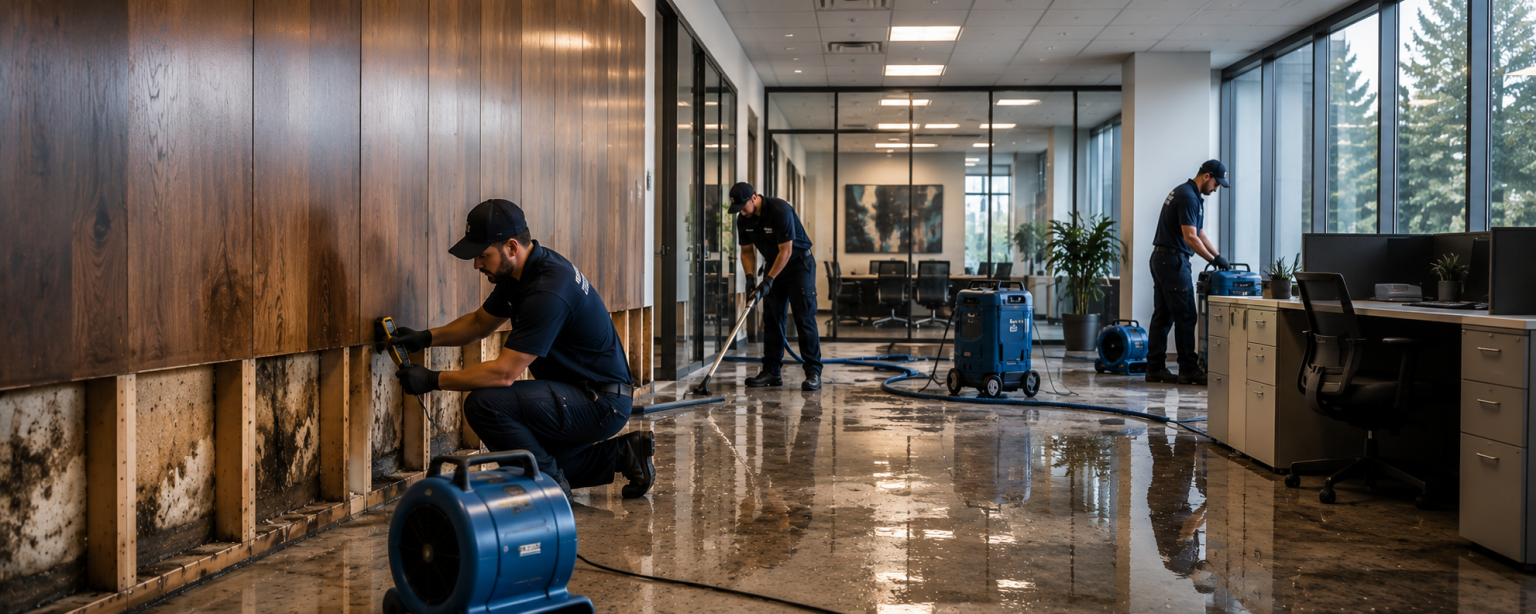
Commercial Water Damage
Missouri — St. Louis
River Flooding, Hard Winters, and a Large Stock of Older Buildings Define St. Louis Water Damage
St. Louis sits at the confluence of the Mississippi and Missouri rivers, which shapes both its commercial geography and its water damage profile. Add a genuine four-season climate, severe spring storms, and a substantial inventory of century-old masonry and brick commercial buildings, and the result is a market with unusually varied loss causes.
Healthcare systems, life science and plant science research, financial services, aerospace and defense manufacturing, breweries, universities, and a dense logistics network all operate here, in a building stock that ranges from new distribution facilities to converted nineteenth-century warehouses.
Commercial Water Damage provides educational resources that help facility managers, property managers, building owners, developers, and commercial contractors better understand commercial water damage throughout the St. Louis metropolitan area.
Older Building Stock Changes the Problem
A large share of St. Louis commercial space predates modern construction assemblies, and that materially affects how water behaves.
Older properties often involve:
- Multi-wythe brick and masonry walls that hold moisture for weeks
- Wood floor systems and heavy timber framing
- Plaster and lath assemblies rather than gypsum board
- Cast iron and galvanized supply and waste piping
- Deep basements and sub-basements below the water table
- Limited or absent vapor barriers
- Asbestos and lead materials requiring abatement protocols
Drying a saturated masonry wall is a different engineering problem than drying modern steel-stud construction, and it usually takes considerably longer.
Four Distinct Seasons, Four Distinct Failure Modes
Commercial water damage commonly results from:
- Spring river flooding and flash flooding
- Severe thunderstorms, hail, and straight-line winds
- Summer humidity driving condensation in cooled buildings
- Ice damming and frozen pipes in winter
- Freeze-thaw damage to masonry and mortar joints
- Combined sewer backups during heavy rainfall
- Aging roof systems and failed flashing
- Fire sprinkler discharges
- HVAC condensate and cooling system failures
Sewer backup deserves particular attention. Category three water carries contamination that changes the scope from drying to remediation, with different safety, disposal, and clearance requirements.
Water Can Travel Well Beyond the Initial Leak
Moisture may migrate through:
- Masonry cavities and mortar joints
- Timber floor systems and subfloors
- Basement and sub-basement levels
- Ceiling plenums and chases
- Mechanical and electrical rooms
- Elevator pits and utility tunnels
- Multi-tenant demising partitions
- Historic finish assemblies
St. Louis Commercial Property Types
Commercial restoration projects throughout the region may involve:
✓ Hospital and healthcare campuses
✓ Life science and plant science research facilities
✓ Aerospace and defense manufacturing
✓ Breweries and food production plants
✓ University and institutional buildings
✓ Converted warehouse and loft office space
✓ Riverfront and downtown historic properties
✓ Distribution centers and cold storage
Research and healthcare facilities add contamination control requirements that heavily constrain how restoration work can be staged.
Business Continuity Is Critical
Recovery planning often includes:
- Phased restoration around occupied areas
- Laboratory and clean space containment
- Research sample and cold chain protection
- Temporary workspace planning
- Overnight and weekend scheduling
- Historic fabric protection during demolition
- Tenant and institutional communication
- Documented business continuity planning
Modern Restoration Protects Valuable Commercial Assets
Commercial restoration frequently includes:
✓ Moisture mapping and thermal imaging
✓ Extended drying protocols for masonry and timber
✓ Industrial desiccant dehumidification
✓ Category three water remediation where required
✓ Historic material preservation
✓ Controlled demolition with abatement coordination
✓ Targeted reconstruction
✓ Post-restoration verification and clearance
Questions St. Louis Property Owners Frequently Ask
- Is this clean water, gray water, or sewer contamination?
- How long will saturated masonry actually take to dry?
- Does the flood zone designation affect insurance coverage?
- Will demolition trigger asbestos or lead abatement?
- Can historic finishes be preserved rather than replaced?
- Are research materials or cold storage contents at risk?
- What basement waterproofing improvements make sense?
- How should storm damage be documented before repairs begin?
Preparing Commercial Buildings for Future Events
Potential improvements include:
✓ Backflow prevention on sewer connections
✓ Sump and ejector pump redundancy with alarms
✓ Basement waterproofing and drainage evaluation
✓ Winter freeze protection and low-temperature alarms
✓ Roof, gutter, and downspout maintenance programs
✓ Masonry repointing and sealant renewal
✓ Leak detection in critical research and IT spaces
✓ Flood response planning for riverfront properties
Why Commercial Water Damage Focuses on St. Louis
St. Louis combines healthcare, research, manufacturing, logistics, and higher education with river geography, a demanding four-season climate, and one of the largest inventories of historic commercial building stock in the Midwest.
Commercial Water Damage provides educational resources that help facility managers, property managers, building owners, developers, and commercial contractors better understand moisture migration, water mitigation, restoration planning, repair strategies, insurance coordination, and long-term building performance.
Whether responding to a sewer backup in a converted downtown warehouse, a frozen pipe at a manufacturing facility, river flooding along the Mississippi, or a roof failure at a healthcare campus, informed planning helps reduce downtime, preserve valuable assets, and support a faster, more efficient commercial recovery.