Commercial Water Damage
California — San Francisco Bay Area
High Property Values, Dense Vertical Buildings, and Atmospheric Rivers Make Bay Area Water Losses Expensive
The San Francisco Bay Area concentrates some of the most valuable commercial real estate in the world into a seismically active region with a compressed, intense wet season. When water damage occurs here, the cost is driven less by the volume of water than by what that water reaches.
The region spans San Francisco high-rises, Peninsula and South Bay technology campuses, East Bay industrial and port facilities, North Bay hospitality and agricultural operations, biotech and life science laboratories, and healthcare systems — each with distinct tolerance for downtime and contamination.
Commercial Water Damage provides educational resources that help facility managers, property managers, building owners, developers, and commercial contractors better understand commercial water damage throughout the San Francisco Bay Area.
Atmospheric Rivers Concentrate a Year of Rain Into Weeks
The Bay Area receives most of its annual rainfall in a handful of intense winter events. Buildings that stay dry for eight months face sustained saturation for days at a time.
Commercial water damage commonly results from:
- Atmospheric river storms and wind-driven rain
- Roof drain and scupper capacity being exceeded
- Curtain wall, glazing, and sealant failures on high-rises
- Below-grade and basement intrusion in downtown cores
- King tides and bay-adjacent flooding
- Storm drain and site drainage backups
- Fire sprinkler discharges
- Domestic supply line failures in older buildings
- Seismic movement stressing pipe joints and connections
Coastal fog and marine layer humidity also reduce natural drying capacity in San Francisco and along the coast, in contrast to the inland East Bay and South Bay.
What the Water Reaches Drives the Cost
Bay Area commercial interiors carry unusually high values per square foot.
Frequently at risk:
✓ Server rooms, network closets, and data infrastructure
✓ Biotech and life science laboratory equipment
✓ Clean rooms and controlled environments
✓ Cold storage of research samples and reagents
✓ Semiconductor and hardware prototyping labs
✓ Premium Class A office fit-outs
✓ Medical imaging and clinical equipment
✓ Building automation and security systems
A laboratory loss can destroy research that has no replacement value at any price, which is why containment and cold chain continuity often outrank building repair in the response priority.
Water Can Travel Well Beyond the Initial Leak
Moisture may migrate through:
- Post-tension slabs and floor penetrations
- Curtain wall cavities and spandrel assemblies
- Elevator shafts, pits, and machine rooms
- Raised access flooring and cable trays
- Ceiling plenums and return air pathways
- Below-grade parking and mechanical levels
- Laboratory service chases and utility corridors
- Multi-tenant demising walls
Bay Area Commercial Property Types
Commercial restoration projects throughout the region may involve:
✓ San Francisco Financial District high-rises
✓ Peninsula and South Bay technology campuses
✓ Biotech and life science facilities
✓ Healthcare campuses and medical office buildings
✓ East Bay industrial, port, and logistics facilities
✓ Data centers and colocation facilities
✓ Hotels, conference, and event venues
✓ Historic and seismically retrofitted buildings
Business Continuity Is Critical
Recovery planning often includes:
- Floor-by-floor phasing in occupied towers
- Laboratory and clean room containment protocols
- Research sample and cold chain protection
- Data center and network continuity planning
- Temporary workspace arrangements
- Overnight and weekend scheduling
- Tenant, investor, and institutional communication
- Documented business continuity planning
Modern Restoration Protects Valuable Commercial Assets
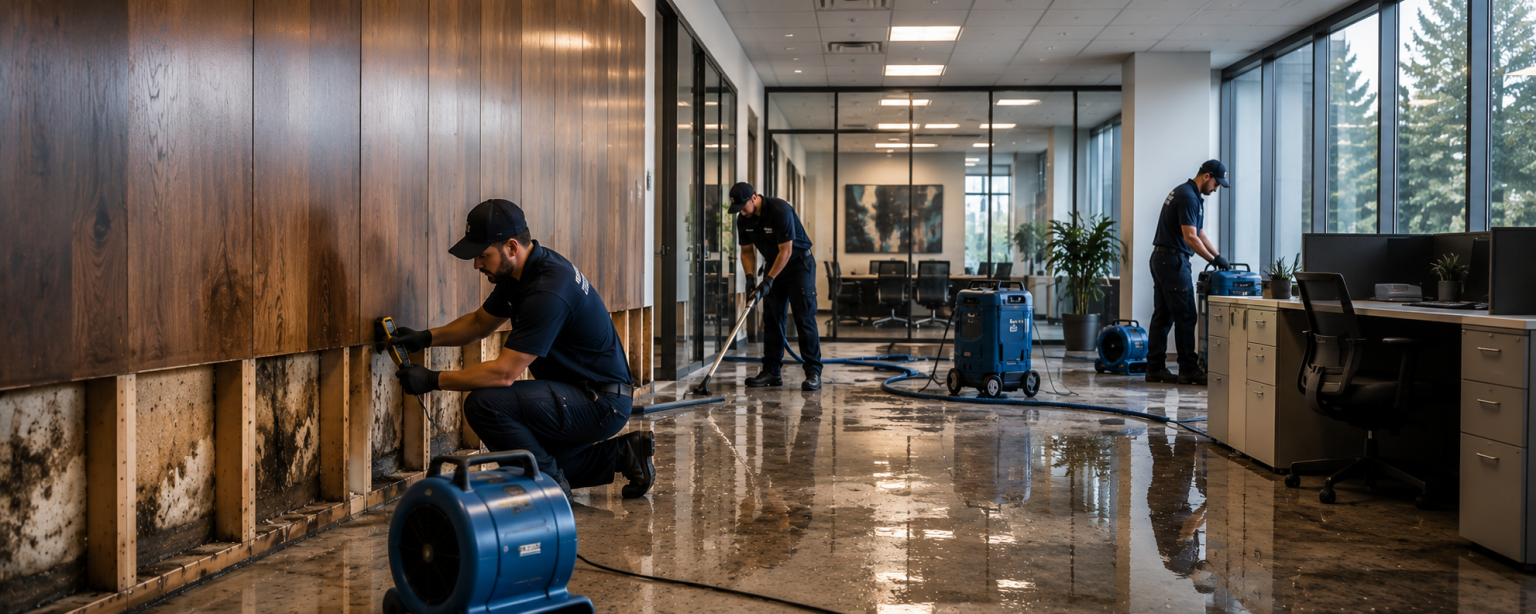
Commercial restoration frequently includes:
✓ Moisture mapping and thermal imaging
✓ Rapid extraction to limit floor-to-floor migration
✓ Structural drying with documented targets
✓ Industrial dehumidification suited to marine humidity
✓ Electronics and laboratory equipment stabilization
✓ Controlled demolition and abatement coordination
✓ Targeted reconstruction and finish matching
✓ Post-restoration verification and clearance
Questions Bay Area Property Owners Frequently Ask
- Did water reach server rooms, labs, or electrical infrastructure?
- Can research samples and cold storage contents be protected?
- How far has moisture migrated through the curtain wall assembly?
- Can tenants remain in occupancy during restoration?
- Will marine humidity extend the drying timeline?
- Will demolition trigger asbestos or lead abatement in an older building?
- How should storm damage be documented separately from deferred maintenance?
- What envelope improvements should precede the next wet season?
Preparing Commercial Buildings for the Next Wet Season
Potential improvements include:
✓ Pre-season roof, drain, and scupper inspections
✓ Curtain wall and sealant condition surveys
✓ Leak detection in server rooms and laboratories
✓ Below-grade waterproofing and sump redundancy
✓ Seismic bracing review for piping and equipment
✓ Fire sprinkler inspection and testing programs
✓ Storm response and escalation procedures
✓ Long-term capital improvement planning
Why Commercial Water Damage Focuses on the Bay Area
The San Francisco Bay Area combines technology, biotech, healthcare, finance, and logistics with dense vertical development, high asset values, seismic considerations, and a rainfall pattern that arrives all at once.
Commercial Water Damage provides educational resources that help facility managers, property managers, building owners, developers, and commercial contractors better understand moisture migration, water mitigation, restoration planning, repair strategies, insurance coordination, and long-term building performance.
Whether responding to curtain wall intrusion during an atmospheric river in the Financial District, a sprinkler discharge above a South Bay data center, a laboratory flood on the Peninsula, or storm drainage backup at an East Bay industrial facility, informed planning helps reduce downtime, preserve valuable assets, and support a faster, more efficient commercial recovery.