Commercial Roofing Water Damage
Nashville, TN
Heavy Rainfall, Severe Storms, and High Humidity Make Roof Leaks a Mold Problem, Not Just a Water Problem
Nashville receives well over four feet of rain in a typical year, distributed across every season rather than concentrated in one. Add severe spring and fall storm systems, occasional tornado activity, hail, ice storms, and sustained summer humidity, and commercial roofs in Middle Tennessee are asked to perform continuously with very little dry recovery time.
The humidity is what distinguishes this market. In a dry climate, a small roof leak may sit in an insulation cavity for months without biological consequence. In Nashville, that same cavity becomes a viable mold environment within days.
Commercial Water Damage provides educational resources that help facility managers, property managers, building owners, developers, and commercial contractors better understand roof-related water damage throughout the Nashville metropolitan area.
Why Commercial Roofs Fail in Middle Tennessee
- Sustained heavy rainfall across all four seasons
- Severe thunderstorms, hail, and straight-line winds
- Tornado and high-wind uplift events
- Winter ice storms and freeze-thaw cycling
- Ponding water on low-slope assemblies
- Organic debris from heavy tree canopy blocking drains
- Algae and biological growth on membrane surfaces
- Rapid commercial construction with compressed schedules
Nashville’s growth is itself a factor. A large volume of commercial roofing has been installed quickly over the past decade, and installation detail quality — particularly at penetrations and terminations — is a recurring source of early-life failures.
Humidity Changes the Response Timeline
Mold requires moisture, an organic food source, and time. Nashville supplies the first generously and shortens the third considerably.
Practical implications:
✓ Response time matters more than in dry climates
✓ Saturated insulation rarely dries in place and usually requires removal
✓ Ceiling tile, gypsum, and paper facings support growth quickly
✓ Dehumidification must overcome high ambient moisture
✓ Concealed cavities need verification, not assumption
✓ Air quality concerns arise in occupied and clinical spaces
✓ Repeated small leaks compound into remediation scope
✓ Clearance verification is often warranted before closing walls
Roof Assemblies Common on Nashville Commercial Buildings
✓ TPO and PVC single-ply membranes
✓ EPDM rubber membranes
✓ Modified bitumen and built-up roofing
✓ Standing seam and structural metal roofing
✓ Spray polyurethane foam with coatings
✓ Insulated metal panel systems
✓ Steep-slope assemblies on historic and institutional buildings
✓ Low-slope roofs with internal drainage
Where Roof Water Actually Goes
- Laterally across the deck to the nearest penetration
- Into roof insulation, where humidity prevents natural drying
- Down structural steel and along beam webs
- Through deck seams, fasteners, and conduit
- Into ceiling plenums and return air pathways
- Down interior wall cavities to lower floors
- Into light fixtures, conduit, and equipment below
- Onto stored inventory and finished goods
Common Roof Failure Points
- Rooftop HVAC curbs and equipment penetrations
- Parapet walls, coping, and counterflashing
- Roof drains, scuppers, and overflow provisions
- Expansion joints and assembly transitions
- Skylights, smoke hatches, and access hatches
- Pipe boots, vents, and conduit penetrations
- Seams, laps, and previously patched areas
- Wind-lifted edge metal and terminations
Emergency Roof Response Versus Permanent Repair
Emergency response typically involves:
✓ Temporary patching, sealing, and tarping
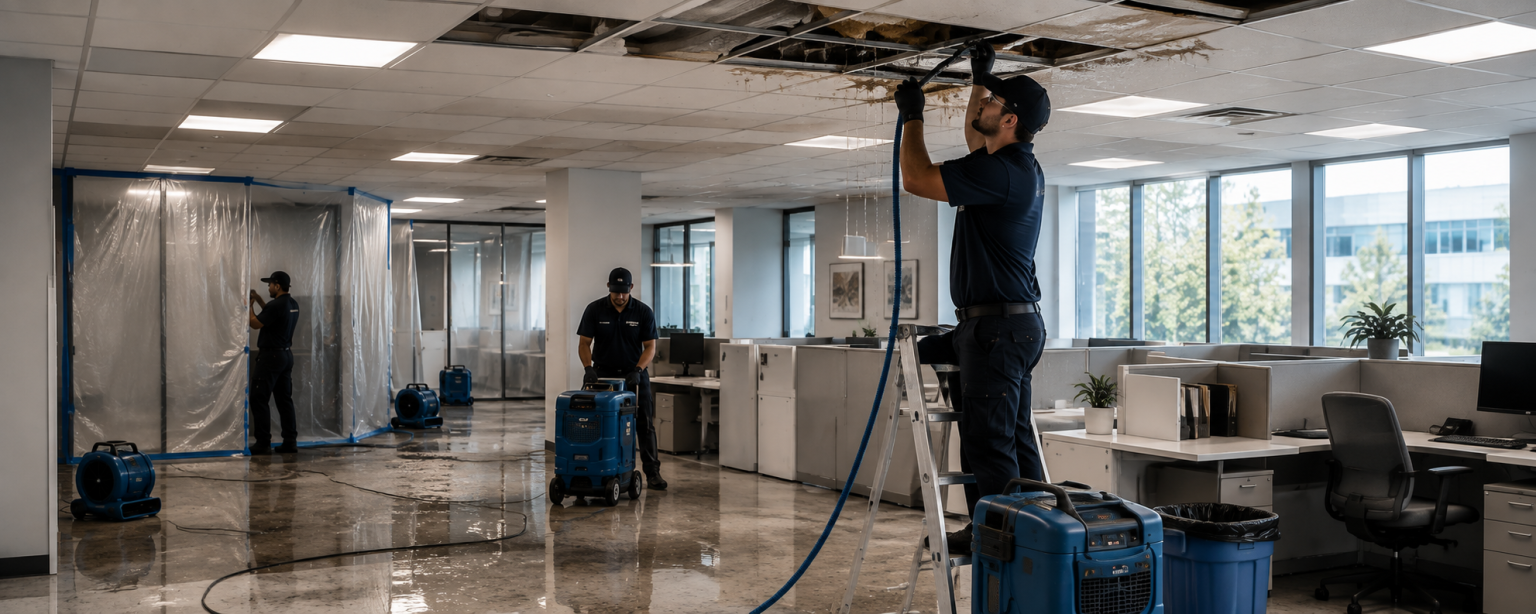
✓ Interior containment and equipment protection
✓ Drain clearing to restore flow
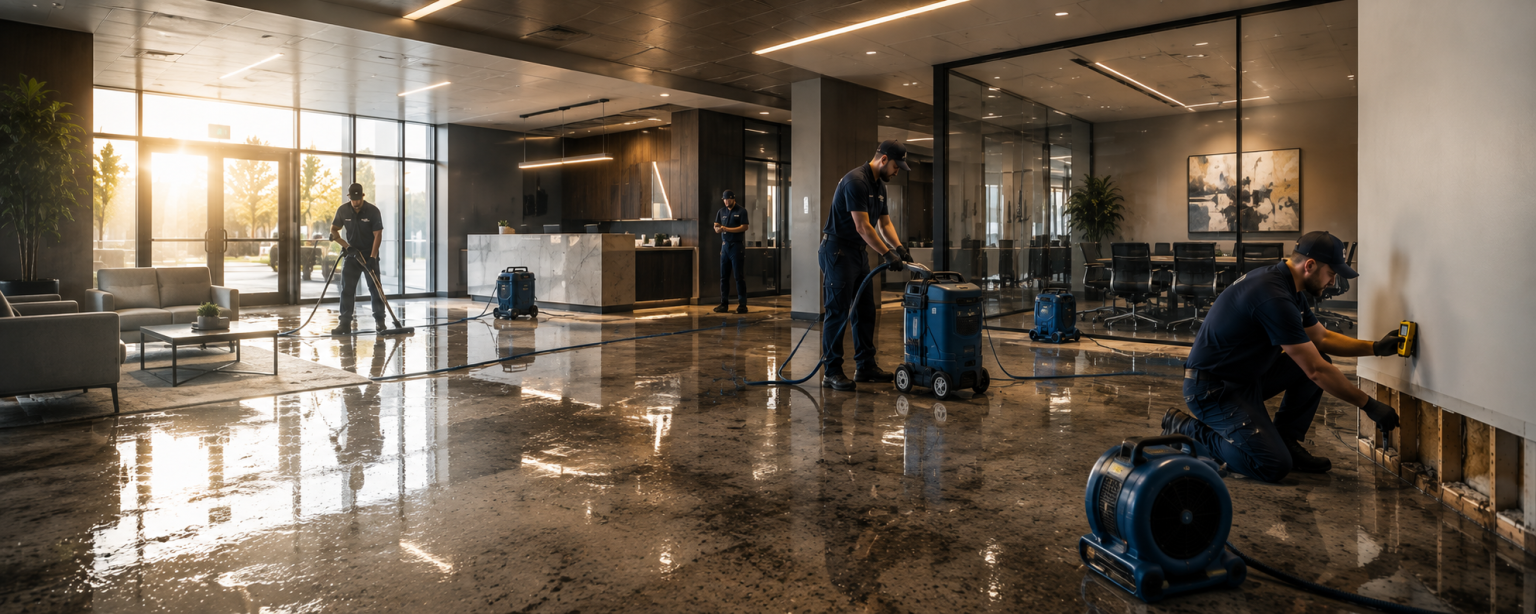
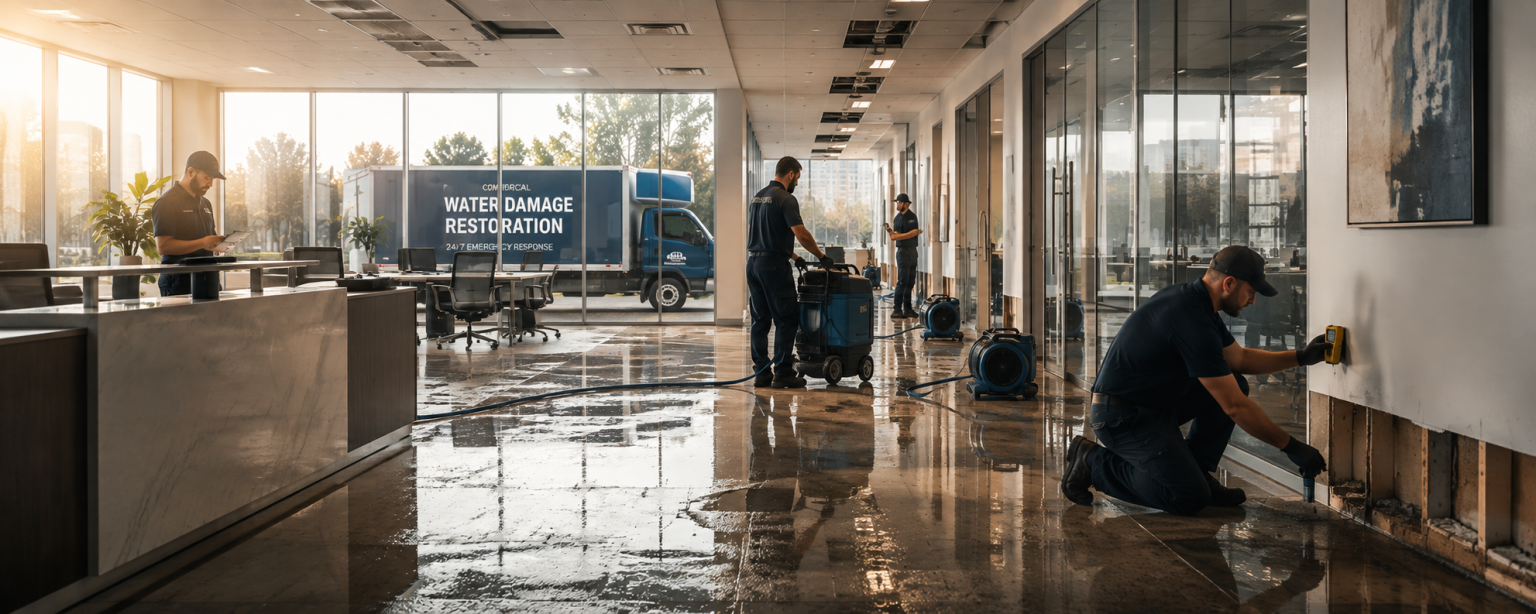
✓ Extraction and immediate dehumidification
✓ Removal of saturated ceiling tile and insulation
Permanent repair requires a moisture survey of the roof assembly, removal of wet insulation, deck evaluation, correction of the failed detail, and interior restoration once the assembly above is verified dry — in this climate, verified rather than assumed.
Nashville Property Types With Significant Roof Exposure
✓ Healthcare systems and medical office buildings
✓ Music, recording, and entertainment venues
✓ Hotels and hospitality properties
✓ Distribution centers and logistics facilities
✓ Automotive and advanced manufacturing plants
✓ Universities and institutional buildings
✓ Downtown office towers and mixed-use developments
✓ Historic and adaptive reuse properties
Recording studios and healthcare spaces are especially sensitive: acoustic assemblies and clinical environments both tolerate moisture poorly and are expensive to reconstruct.
Documenting Roof Water Damage for Insurance
- Correlate damage to dated storm and wind events
- Photograph hail impacts and wind damage before repair
- Use infrared or capacitance surveys to map wet insulation
- Record interior moisture and humidity readings over time
- Document any mold growth and its extent early
- Retain maintenance and prior inspection records
- Separate roof scope from interior and remediation scope
- Track tenant impact and business interruption
Questions Nashville Property Owners Ask About Roof Leaks
- Where did water enter, as opposed to where it appeared?
- How much roof insulation is saturated?
- Has mold growth already begun in concealed cavities?
- Is the metal deck corroded or compromised?
- Was this storm damage or an installation defect?
- Is the roof still under warranty, and does this void it?
- Is drainage adequate for current rainfall intensity?
- Can occupied areas below remain in use during the work?
Preventive Roof Programs That Reduce Water Losses
✓ Quarterly inspections given year-round rainfall
✓ Drain and gutter cleaning tuned to leaf drop
✓ Post-storm inspection protocols
✓ Infrared moisture surveys on aging assemblies
✓ Sealant, flashing, and edge metal renewal cycles
✓ Algae-resistant surfacing and coatings
✓ Interior humidity monitoring in concealed spaces
✓ Warranty tracking and documented maintenance compliance
Why Commercial Water Damage Covers Roofing in Nashville
In Middle Tennessee, a roof leak is rarely just a roof leak. Between the rainfall volume and the humidity, a small unresolved intrusion becomes a remediation project faster here than in most of the country.
Commercial Water Damage provides educational resources that help facility managers, property managers, building owners, developers, and commercial contractors better understand roof assemblies, moisture migration, mold risk, drying strategy, insurance documentation, and long-term building performance.
Whether responding to storm damage at a distribution facility, a curb leak above a healthcare suite, ponding on a downtown low-slope roof, or a recurring drip inside a recording or performance venue, understanding what happens above the ceiling helps reduce downtime, preserve valuable assets, and support a more efficient recovery.