Water emergency? Our commercial crews respond 24/7.
Commercial Water Damage
- 24/7 Response
- Extraction
- Structural Drying
- Restoration
What happens when you call
24/7 dispatch
Call any hour. Crews mobilize for commercial losses, including nights and weekends.
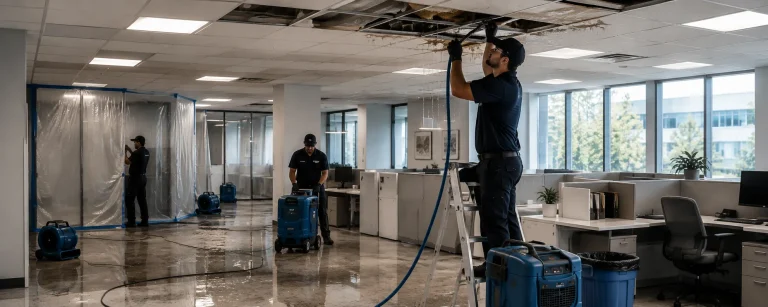
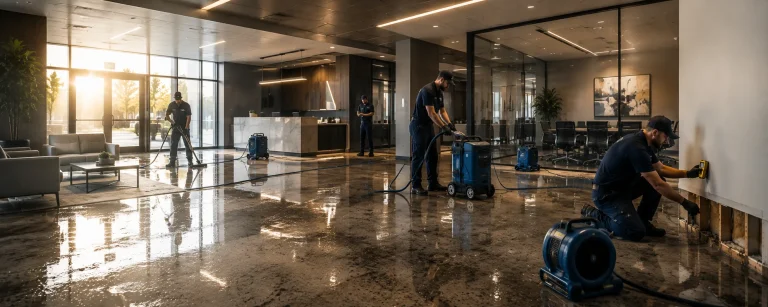
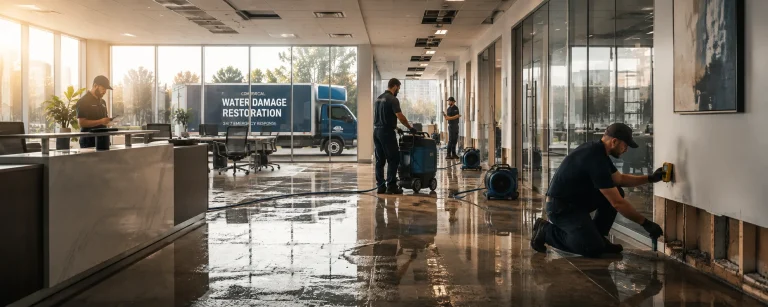
Extraction & drying
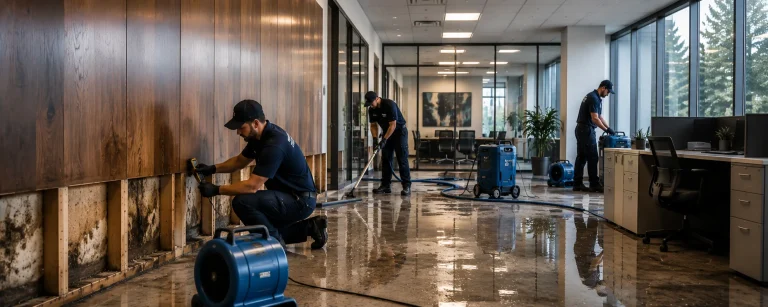
Standing water removed, then structural drying with monitored moisture readings.
Insurance-ready records
Readings, photos and scope notes documented for your carrier from day one.
New York City, NY
Commercial Water Damage in New York City Requires a Different Approach
New York City contains one of the world’s most valuable collections of commercial real estate. From Midtown office towers and Lower Manhattan financial buildings to hotels, hospitals, retail corridors, universities, mixed-use developments, and historic commercial properties, nearly every square foot represents a significant investment.
When water damage occurs, the objective is rarely to replace everything.
Instead, today’s commercial property owners focus on preserving valuable building systems, protecting tenant operations, minimizing downtime, and restoring assets whenever practical.
Commercial Water Damage provides educational resources that help facility managers, property managers, building owners, developers, and commercial contractors better understand commercial water damage throughout New York City.
Repair Has Become More Valuable Than Replacement
Commercial construction has changed dramatically over the past several decades.
Modern buildings often contain:
- Sophisticated mechanical systems
- High-end architectural finishes
- Specialized glass systems
- Custom millwork
- Advanced electrical infrastructure
- Intelligent building controls
- Energy-efficient assemblies
- Premium tenant improvements
Replacing these systems is often significantly more expensive and disruptive than carefully restoring them whenever possible.
As construction costs and property values continue to rise throughout New York City, restoration planning has become an increasingly important part of commercial asset management.
Water Rarely Stays Where It Starts
One of the greatest challenges in New York buildings is understanding how water moves.
Water may travel through:
- Elevator shafts
- Pipe chases
- Concrete floor systems
- Historic masonry walls
- Ceiling plenums
- Mechanical rooms
- Electrical risers
- Multiple tenant floors
- Vertical utility systems
In high-rise buildings, a leak on one floor may affect several floors below before occupants even realize a problem exists.
Understanding moisture migration is often just as important as identifying the original source of the leak.
High-Rise Buildings Create Unique Recovery Challenges
Commercial water damage in New York frequently involves vertical construction rather than horizontal buildings.
Projects often require coordination around:
- Multiple occupied floors
- Elevator access
- Building security
- Limited staging areas
- Loading dock schedules
- Union work environments
- Tenant communication
- After-hours construction
These logistical considerations often influence the recovery strategy as much as the water damage itself.
Occupied Buildings Cannot Simply Shut Down
Many New York office buildings, hotels, healthcare facilities, and retail properties continue operating during restoration and repair activities.
Recovery planning may include:
- Temporary work zones
- Nighttime restoration
- Weekend scheduling
- Occupant safety planning
- Noise management
- Dust containment
- Business continuity planning
- Phased reconstruction
Maintaining daily operations is often one of the highest priorities for commercial property owners.
Restoration Protects Valuable Commercial Assets
Years ago, extensive demolition was often considered the standard response after significant water damage.
Today, restoration technologies and moisture management strategies frequently allow commercial teams to preserve far more of the building than was previously possible.
That shift is especially important in New York City, where replacing specialty finishes, tenant improvements, custom interiors, and building infrastructure can require significant time and investment.
For many commercial properties, restoring existing materials whenever appropriate helps reduce disruption while protecting long-term property value.
Questions New York Property Owners Often Consider
Commercial recovery involves much more than drying wet materials.
Important questions frequently include:
- Can tenant operations continue during repairs?
- Which building systems require immediate attention?
- How far has moisture migrated through the structure?
- Can existing materials be restored rather than replaced?
- What documentation supports insurance coordination?
- How will work be phased throughout the building?
- What long-term maintenance improvements should follow?
- How can future water events be minimized?
- What recovery strategy best protects the property’s long-term value?
These discussions often shape the success of the entire project.
Every New York Property Presents Different Challenges
Commercial water damage affects every property differently.
Recovery strategies may vary between:
- Midtown office towers
- Lower Manhattan financial buildings
- Historic commercial properties
- Retail storefronts
- Hotels
- Healthcare facilities
- Universities
- Industrial and warehouse facilities
- Mixed-use developments
Each building type presents different occupancy requirements, construction methods, infrastructure, and operational priorities.
Looking Beyond Today’s Emergency
Commercial recovery is no longer focused solely on responding to today’s water loss.
Many property owners also evaluate:
- Preventive maintenance
- Roof condition
- Plumbing infrastructure
- Building envelope performance
- Water detection technology
- Emergency response procedures
- Moisture monitoring
- Long-term capital planning
Every water damage event provides an opportunity to strengthen the building against future risks.
Why Commercial Water Damage Focuses on New York City
New York City represents one of the most complex commercial real estate environments in the world.
High-rise construction, dense development, aging infrastructure, valuable tenant improvements, and continuous occupancy require a thoughtful approach to water damage recovery.
Commercial Water Damage provides educational resources that help facility managers, property managers, building owners, developers, and commercial contractors better understand water mitigation, moisture migration, restoration planning, repair strategies, insurance coordination, and long-term asset protection.
Whether managing a localized plumbing failure in Midtown, a roof leak affecting multiple office floors, or a major water event inside a landmark commercial building, informed planning helps reduce downtime, preserve valuable assets, and support a more efficient recovery.
Water Emergency?
Our commercial response team is available 24/7 for water extraction, structural drying and restoration.
Our Services
Talk To A Specialist
Need help with a water loss right now?
Call our commercial team for extraction, drying and restoration planning built around your building and your operations.