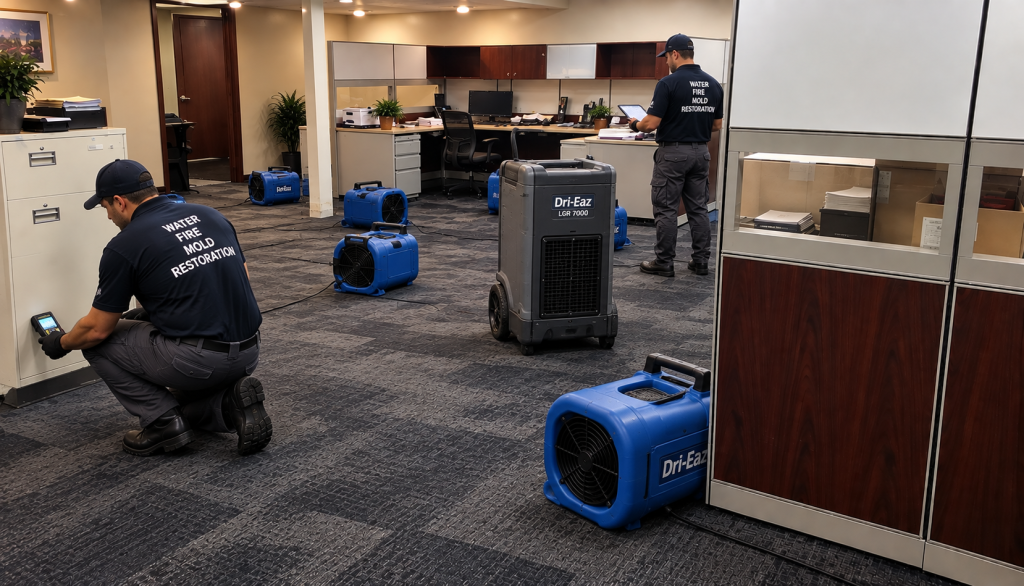
Commercial property restoration is usually described as a construction problem.
A pipe breaks.
Water enters the building.
Crews respond.
Damaged materials are removed.
The building is dried.
Reconstruction occurs.
Eventually, the property reopens.
Every one of those steps matters.
But that sequence leaves out something fundamental.
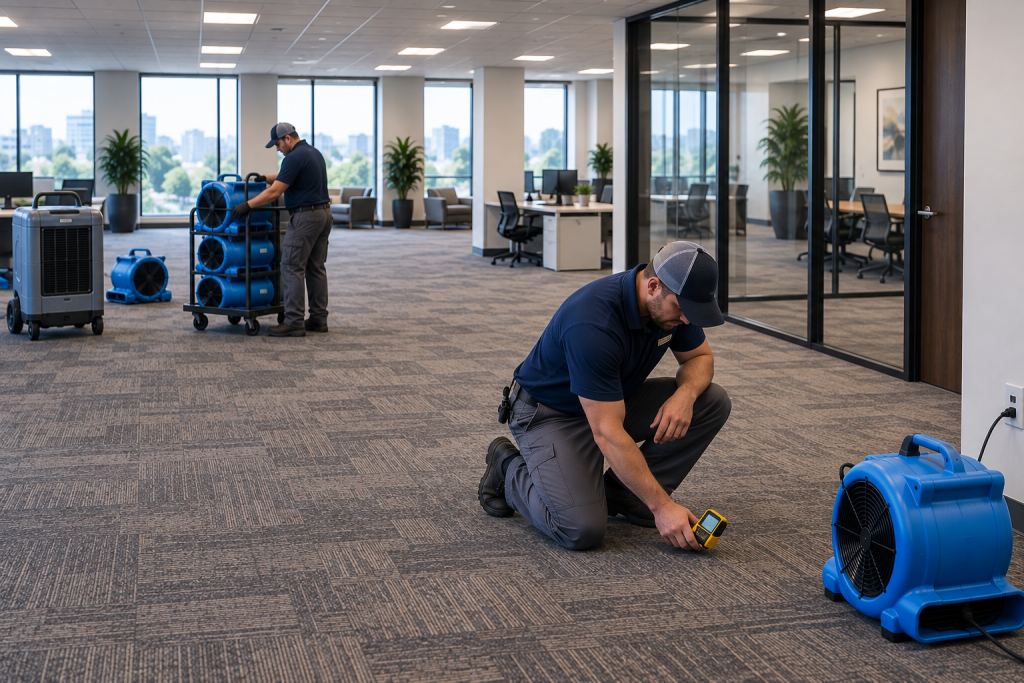
Commercial buildings are not simply collections of construction materials.
They are operating systems.
Electrical infrastructure supports equipment.
Equipment supports production.
Elevators support occupancy.
Loading docks support distribution.
HVAC supports usable environments.
Communications support employees.
Fire/life-safety systems support occupancy.
Tenants depend upon shared building infrastructure.
Customers depend upon access.
Revenue depends upon all of it working together.
Damage one critical part of that system and consequences can spread far beyond the physical damage itself.
A 300-square-foot electrical room can affect a 300,000-square-foot property.
A failed plumbing riser can disrupt multiple floors.
One unavailable loading dock can interfere with an entire distribution operation.
A relatively small elevator-control problem can affect an otherwise undamaged high-rise.
That means commercial restoration needs another layer of thinking.
Not simply:
What was damaged?
But:
What did the damage prevent the property from doing—and what sequence of decisions restores that function fastest?
That is Commercial Recovery Intelligence.
Commercial Water Damage Repair
Find the Leak Before It Spreads
Commercial Water Damage Restoration
Dry the Building, Not Just the Surface
Commercial Flood Damage Recovery
Commercial Water Damage Cleanup
Navigate the Insurance Process
Warehouse Water Damage Recovery
Keep Business Moving During Recovery
Map the Moisture You Cannot See
California Commercial Water Damage
Commercial Restoration Is Not Just the Restoration of Materials
Drywall can be replaced.
Flooring can be installed.
Ceilings can be reconstructed.
Those are physical tasks.
Commercial recovery is broader.
The building must return to useful operation.
That creates two different objectives:
Property Restoration
Restore affected physical conditions.
Operational Recovery
Restore the ability of the property and organization to function.
The two overlap.
They are not identical.
A building can be physically restored while the business remains partially interrupted.
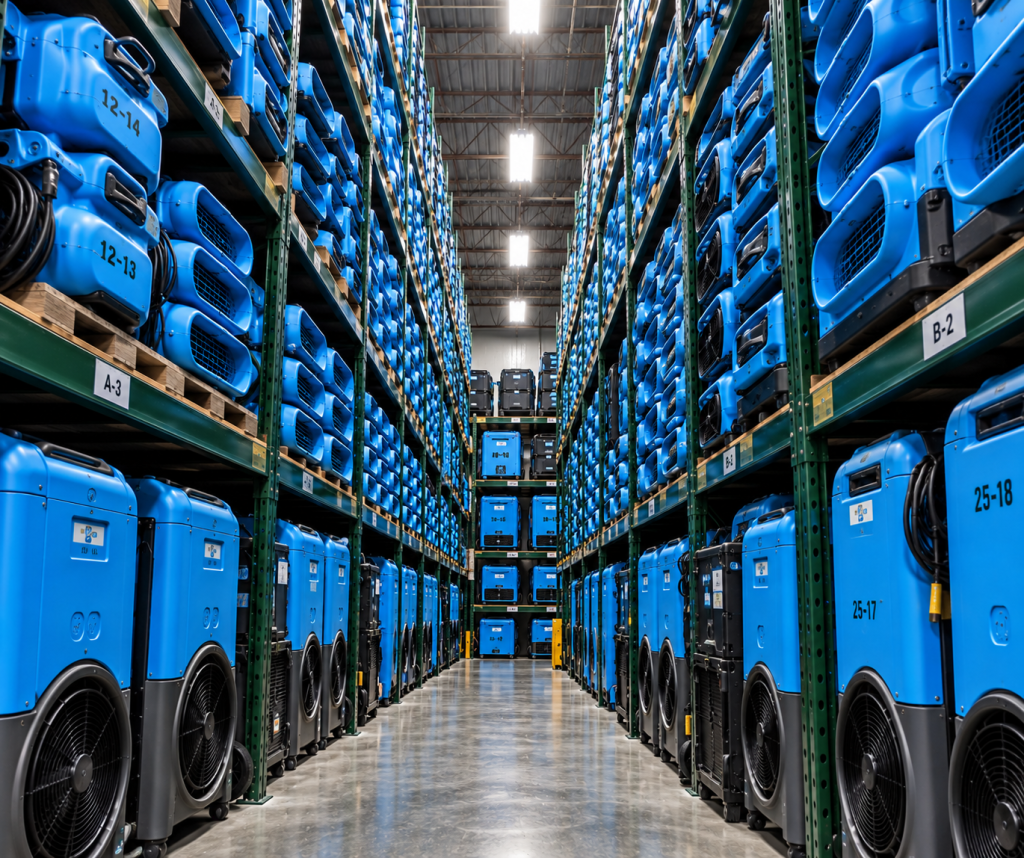
Conversely, substantial portions of a business may return to operation while reconstruction continues elsewhere. For operators of big-box and industrial sites, commercial warehouse restoration shows how recovery intelligence plays out at scale.
Commercial Recovery Intelligence focuses on the relationship between the two.
What Restoration Professionals Watch
Seattle Commercial Water Damage
Bellevue Commercial Water Damage
Arizona Commercial Water Damage
San Diego Commercial Water Damage
Emergency Water Damage Response
How Restoration Accountability Works
Walnut Creek Commercial Water Damage
Carlsbad Commercial Water Damage
The Damage Map Is Only the First Map
Immediately after a commercial property loss, teams naturally create a damage map.
Where did the water go?
Which rooms were affected?
What materials are wet?
Where is demolition required?
That information is essential.
Yet a damage map answers only:
Where is the damage?
It does not answer:
What does the damage mean?
For that, additional maps are needed.
Damage Map
Where did physical damage occur?
Dependency Map
What systems and operations depend upon the affected area?
Choke-Point Map
Which small components can disable large portions of the property?
Occupancy Map
Which areas can operate, partially operate or remain unavailable?
Uncertainty Map
What conditions remain unknown?
Reoccupancy Map
What prevents each area from returning to useful operation?
Together, these maps provide a very different picture of the property.
Find a Commercial Restoration Contractor
The Facility Manager’s Recovery Guide
Commercial Property Water Damage
Industrial Water Damage Recovery
Water Damage Help for Property Managers
When Fire Sprinklers Flood the Building
Why Old Restoration Signals Fail
Washington Commercial Water Damage
Nevada Commercial Water Damage
Remove Moisture Beneath the Surface
Restoration, Repair or Mitigation?
The Five Layers of Commercial Recovery Intelligence
Commercial Recovery Intelligence can be organized into five interconnected layers:
1. Damage Intelligence
What happened, where did it travel and what was actually affected?
2. Building Systems Intelligence
Which infrastructure, systems and operational choke points are involved?
3. Business Continuity Intelligence
What business functions are interrupted, and what can continue?
4. Documentation Intelligence
What evidence supports the findings, decisions, work and recovery milestones?
5. Reoccupancy Intelligence
What conditions must exist for useful operations to return?
These layers move simultaneously.
Together they turn restoration from a sequence of construction activities into a managed recovery system.
Layer 1 — Damage Intelligence: Understand the Real Loss Boundary
Visible damage is rarely the entire story.
Water can migrate:
- Behind walls
- Beneath flooring
- Through ceiling systems
- Along structural components
- Through penetrations
- Between floors
- Through shafts
- Into insulation
- Around storefront and exterior assemblies
- Into mechanical or electrical spaces
The first responsibility of Damage Intelligence is therefore not simply documenting what can be seen.
It is determining the actual damage boundary.
Four Boundaries Can Exist After Commercial Water Damage
A sophisticated investigation distinguishes between several boundaries.
Visible Boundary
Where damage can be directly observed.
Moisture Boundary
Where moisture actually migrated.
Building-System Boundary
Which systems were exposed or affected.
Operational Boundary
How much of the business is affected because of those conditions.
These boundaries may be dramatically different.
Visible boundary ≠ moisture boundary ≠ system boundary ≠ operational boundary.
A small physical loss can therefore produce a large operational event.
Redmond Commercial Water Damage
Pennsylvania Commercial Water Damage
Tacoma Commercial Water Damage
Sugar Land Commercial Water Damage
The Woodlands Commercial Water Damage
Colorado Commercial Water Damage
Fremont Commercial Water Damage
Oakland Commercial Water Damage
San Francisco Commercial Water Damage
San Jose Commercial Water Damage
Philadelphia Commercial Water Damage
Houston Commercial Water Damage
Cambridge Commercial Water Damage
South San Francisco Water Damage
Pasadena Commercial Water Damage
Boston Commercial Water Damage
Commercial Building Water Damage
Hidden Damage Turns Restoration Into Investigation
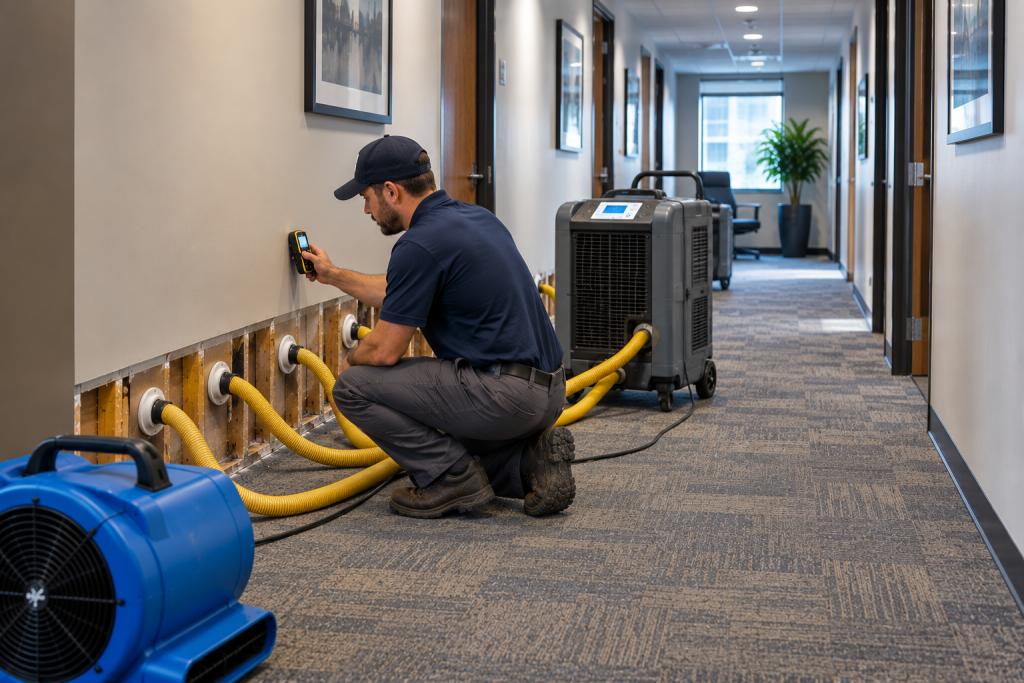
Commercial restoration teams frequently begin work before every condition is known.
That means recovery must convert uncertainty into evidence.
A useful progression is:
OBSERVED
↓
SUSPECTED
↓
TESTED
↓
CONFIRMED
↓
ACTIONED
↓
VERIFIED
The purpose of investigation is not to make the project larger.
It is to make the project more accurate.
Sometimes investigation expands the scope.
Sometimes it clears suspected areas.
Both outcomes reduce uncertainty.
The Information Boundary Moves During Restoration
Imagine only four affected rooms are known on Day 1.
Further investigation confirms three more on Day 2.
Another two are identified on Day 3.
The restoration scope expanded.
The physical damage may not have.
What expanded was the team’s information boundary.
That distinction matters.
Scope expansion and damage expansion are not necessarily the same thing.
Commercial Recovery Intelligence tracks not only what is damaged but also what remains unknown.
Layer 2 — Building Systems Intelligence: Find What Everything Depends Upon
Once the damage is understood, another question becomes more important:
What does the building depend upon?
Commercial properties contain systems whose operational importance is wildly disproportionate to their physical size.
Examples include:
✓ Electrical distribution
✓ Plumbing risers
✓ HVAC controls
✓ Building automation
✓ Elevators
✓ Fire/life-safety infrastructure
✓ Server and communication rooms
✓ Refrigeration
✓ Commercial kitchens
✓ Specialized manufacturing systems
These are operational choke points.
Operational Choke Points Change Restoration Priorities
Imagine two damaged areas.
Area A
20,000 square feet of warehouse flooring.
Area B
250 square feet of electrical infrastructure.
Which is more important?
Square footage says Area A.
Operations may say Area B.
If the electrical infrastructure controls conveyors, loading equipment, lighting and warehouse systems, that 250-square-foot room may determine whether the entire facility operates. Owners dealing with a flooded building can review warehouse flood cleanup and drying for a practical view of recovery intelligence.
Commercial Recovery Intelligence therefore asks:
Which damaged component prevents the greatest amount of useful building function?
That component deserves immediate attention.
Follow Dependencies, Not Just Water
Water follows physical pathways.
Business interruption follows dependency pathways.
Consider:
Water damages electrical equipment
↓
Electrical equipment interrupts refrigeration
↓
Refrigeration failure threatens inventory
↓
Inventory becomes unavailable
↓
Distribution is disrupted
↓
Customers are affected
↓
Revenue is affected.
The water may have traveled twenty feet.
The operational consequence may travel through the entire company.
That leads to one of the central principles of Commercial Recovery Intelligence:
Don’t simply follow the water. Follow what the business depends upon.

Operational Dependency Mapping Shows What Must Be Restored First
A dependency map begins with the desired business function.
Suppose a warehouse must resume shipping.
Shipping requires:
Loading docks
- material handling
- warehouse management systems
- communications
- power
- lighting
- safe access.
Now trace each requirement backward.
Which systems support it?
Which systems are damaged?
Which dependencies are shared?
Which component controls the chain?
That produces a restoration priority based on operational leverage, not merely visible damage.
Find the Choke Point Behind the Choke Point
A damaged HVAC system may appear to be the problem.
But what does the HVAC system depend upon?
Electrical power.
Controls.
Sensors.
Pumps.
Communications.
Water.
One of those systems may actually be the controlling constraint.
Commercial Recovery Intelligence keeps tracing upstream until it finds the dependency that truly controls recovery.
That is the choke point behind the choke point.
Layer 3 — Business Continuity Intelligence: Restore Productive Capacity
Commercial buildings exist to support activity.
Therefore, recovery should measure more than completed construction.
A hotel should track available rooms.
A warehouse should track shipping capacity.
A manufacturer should track production capacity.
An office should track usable workspaces or floors.
A retailer should track customer-accessible operating areas.
This creates a better commercial recovery metric:
How much useful capacity has returned?
Business Recovery Can Move Faster Than Building Recovery
Imagine a warehouse is only 60% through reconstruction.
Yet shipping has returned to 90% of normal capacity.
From a construction perspective:
60% complete.
From a business perspective:
90% recovered.
That is a successful operational outcome.
Now imagine the reverse.
A hotel is 95% physically restored.
One unresolved building system prevents guest occupancy.
Construction:
95%.
Revenue-producing occupancy:
0%.
Commercial Recovery Intelligence recognizes both measurements.
Partial Occupancy Is a Recovery Technology
Commercial restoration does not always need to choose between:
fully open
and
fully closed.
There can be an enormous middle ground.
A damaged property can sometimes be divided into:
Active Restoration Zones
Areas where work continues.
Transition Zones
Controlled interfaces between construction and operations.
Operational Zones
Areas capable of supporting normal or modified business activity.
Support Zones
Temporary areas used to maintain continuity.
This turns partial occupancy into an intentional strategy.
Protect Unaffected Space as Aggressively as Damaged Space
Restoration naturally focuses on damaged areas.
Yet unaffected areas can be economically more valuable.
If 25% of a building is damaged, protecting the operational capability of the remaining 75% may be one of the most important actions taken during the entire project.
Protect:
— Access
— Utilities
— Airflow
— Elevators
— Communications
— Customer pathways
— Tenant entrances
— Loading routes
— Employee areas
— Operational equipment.
Saving operational space can be as valuable as restoring damaged space.
The Minimum Viable Building
A useful Commercial Recovery Intelligence concept is the Minimum Viable Building.
What is the smallest appropriate configuration of the property capable of supporting a meaningful business function?
For a warehouse:
Power + lighting + WMS + loading + material handling + safe access + required building systems. Distribution operations feel recovery intelligence sharply, which is why water damage repair for distribution centers deserves early attention.
Administrative reconstruction may continue.
For a hotel:
Guest access + available rooms + utilities + elevators + necessary building systems + essential support operations.
Some secondary areas may remain under restoration.
The Minimum Viable Building is not about lowering standards.
It is about separating:
Required for useful operation
from
Required for complete restoration.
Layer 4 — Documentation Intelligence: Build the Recovery Record
Restoration changes the evidence.
Water disappears.
Materials are removed.
Walls are opened.
Equipment moves.
Repairs cover previously visible conditions.
Eventually, the property can no longer independently show what happened.
Documentation preserves that history.
That creates two restoration products:
Product 1
The restored property.
Product 2
The reliable record of the recovery.
The building is the first product. The record is the second.
The Commercial Restoration Evidence Chain
Good documentation connects information rather than simply accumulating files.
A useful structure is:
CONDITION
What existed?
↓
EVIDENCE
How do we know?
↓
INTERPRETATION
What does the evidence indicate?
↓
DECISION
What action was selected?
↓
WORK
What was performed?
↓
VERIFICATION
What supports the next milestone?
↓
RESULT
What condition exists afterward?
This is the Commercial Restoration Evidence Chain.
It allows someone who never entered the property to understand why the project evolved the way it did.
Documentation Is Project Memory
Commercial restoration teams change.
Contractors rotate.
Property personnel change.
Months pass.
Human memory becomes unreliable.
The record remains.
Useful documentation can include:
- Initial photographs
- Building-condition information
- Moisture maps
- Investigation records
- Daily logs
- Equipment records
- Scope changes
- Building-system evaluations
- Reconstruction photographs
- Decision records
- Reoccupancy milestones
Documentation should allow the project to answer:
What happened?
What did we know?
What changed?
Why did we make that decision?
What happened next?
Documentation Can Increase Recovery Velocity
Poor information creates questions.
Questions create meetings.
Meetings create inspections.
Inspections create waiting.
Waiting creates dead time.
Organized documentation can help shorten that chain.
This makes documentation an active recovery tool.
Not bureaucracy.
The purpose of documentation is not to create more paperwork. It is to prevent the project from having to rediscover its own history.
Layer 5 — Reoccupancy Intelligence: Design Recovery Backward
Most restoration planning works forward.
Damage
→ mitigation
→ drying
→ reconstruction
→ reoccupancy.
Reoccupancy Intelligence adds the opposite direction.
Start with:
What must the property be capable of doing?
Then work backward.
REOCCUPANCY
↓
OPERATIONAL FUNCTION
↓
DEPENDENCIES
↓
BUILDING SYSTEMS
↓
CONSTRUCTION REQUIREMENTS
↓
RESTORATION REQUIREMENTS
↓
TODAY’S ACTION.
This is backward-designed recovery.
Define the Finish Line Before Racing Toward It
“Reopen the building” is too vague.
A better objective might be:
Restore warehouse outbound shipping to 70% capacity.
Or:
Return Floors 6–10 to normal office occupancy.
Or:
Return 200 hotel rooms to available inventory.
Now the team can identify exactly what that milestone requires.
The finish line becomes measurable.
Reoccupancy Gates Define Readiness
Each operating area can have conditions that must be satisfied before useful operation returns.
These are Reoccupancy Gates.
Depending upon the property, they might involve:
✓ Physical restoration
✓ Electrical systems
✓ HVAC
✓ Access
✓ Elevators
✓ Plumbing
✓ Fire/life-safety systems
✓ Communications
✓ Required testing
✓ Applicable inspections
✓ Appropriate separation from active construction
When one critical gate remains unresolved, it may control the entire milestone.
The Last 5% Can Control the Other 95%
A building can appear almost completely restored.
Then one unresolved dependency prevents reopening.
This is common enough to deserve explicit planning.
The final issue might involve:
a component
an inspection
a specialized evaluation
an elevator
electrical equipment
a building-control system
a long-lead material.
Physically small.
Operationally enormous.
Commercial Recovery Intelligence tries to identify that final 5% during the first 5% of the project. If your facility stores inventory, restoring a warehouse after water loss explains how recovery intelligence affects shipping schedules.
Commercial Restoration Sequencing Determines Recovery Velocity
Working quickly is useful.
Working in the correct order is more useful.
Twenty people performing tasks rapidly can still produce a slow recovery if:
- Critical decisions are waiting
- Long-lead materials haven’t been ordered
- Specialty evaluations occur too late
- Completed work must be reopened
- Trades wait on one another
- Inspections are discovered late
- Low-priority areas finish while operational choke points remain unresolved
Commercial Recovery Intelligence therefore focuses on recovery velocity.
Recovery Velocity Measures Permanent Forward Progress
Traditional construction productivity asks:
How much work did we complete today?
Recovery Velocity asks:
How much closer did today’s work move the property toward useful operation?
Those are not always the same thing.
Painting ten secondary rooms creates visible progress.
Resolving one electrical dependency may return an entire floor to operation.
The second task can have far greater recovery value.
Eliminate Dead Time
Commercial restoration schedules often contain hidden periods where nothing important advances.
Waiting for:
— Access
— Decisions
— Engineering
— Materials
— Inspections
— Specialty contractors
— Documentation
— Equipment
— Authorization
— Building information.
This is dead time.
Some waiting is unavoidable.
Much of it can be anticipated.
Commercial Recovery Intelligence continuously asks:
What are we waiting for now—and what will we be waiting for three days from now if nobody acts today?
That question increases recovery velocity.
Use Multiple Recovery Lanes
Large commercial restoration projects should not operate as one sequential line.
Run parallel lanes.
Lane 1 — Physical Restoration
Stabilization, mitigation, drying and reconstruction.
Lane 2 — Building Systems
Electrical, mechanical, elevators, controls and specialized systems.
Lane 3 — Documentation
Evidence, findings, scope changes and project records.
Lane 4 — Procurement
Materials, equipment and long-lead components.
Lane 5 — Business Continuity
Temporary operations and partial occupancy.
Lane 6 — Reoccupancy
Verification, release zones and operational return.
One lane can advance while another encounters a temporary constraint.
That prevents one unanswered question from unnecessarily freezing the entire project.
Commercial Recovery Intelligence Manages Uncertainty Explicitly
Commercial buildings contain unknowns.
Pretending otherwise does not make them disappear.
Instead, create an Uncertainty Register.
For each important unknown:
What is the question?
What could it affect?
Who owns it?
How will it be investigated?
When must the answer be known?
What cannot proceed without it?
Now uncertainty becomes part of project management.
Burn Down Uncertainty Before It Becomes Expensive
Unknown conditions become more expensive as reconstruction progresses.
Early:
Easy to investigate.
Later:
Assemblies are closing.
Later still:
New finishes may need to be disturbed.
Therefore, track Uncertainty Burn-Down.
18 major unknowns
↓
13
↓
9
↓
5
↓
2
↓
0 critical unknowns before permanent closure.
This is another form of project progress.
Every important question answered reduces future risk.
Pre-Loss Intelligence Changes Post-Loss Recovery
Commercial Recovery Intelligence should begin before the loss whenever possible.
A property can establish a Pre-Loss Restoration Readiness Assessment.
Document:
✓ Critical building systems
✓ Operational choke points
✓ Utility shutoffs
✓ Single points of failure
✓ Building plans
✓ Major equipment
✓ Known existing conditions
✓ Emergency contacts
✓ Specialty vendors
✓ Long-lead components
✓ Alternative operating areas
✓ Current building photographs
✓ Recent tenant improvements
✓ Operational dependencies
Now the restoration team does not begin with a blank page.
The Restoration Baseline Matters
A commercial building does not become new because it experiences property damage.
It already has history.
Previous leaks.
Repairs.
Aging materials.
Tenant improvements.
Maintenance conditions.
Equipment approaching replacement.
Therefore, restoration must distinguish where possible between:
NEW
Conditions associated with the current event.
EXISTING
Conditions supported as pre-existing.
AGGRAVATED
Existing conditions affected by the current event.
UNDETERMINED
Conditions for which available evidence does not yet establish the relationship.
This creates a more accurate restoration baseline.
One Loss Creates Six Recoveries
Commercial property damage doesn’t create only a building recovery.
It can create six simultaneous recoveries.
1. Building Recovery
Restore the physical property.
2. Business Recovery
Restore productive capacity.
3. Insurance Recovery
Develop and communicate the information required through the claim process.
4. Tenant Recovery
Return affected occupants to useful space.
5. Regulatory Recovery
Address applicable inspections, requirements and specialized processes.
6. Financial Recovery
Recover from the economic consequences of disruption.
These six recoveries rarely finish simultaneously.
The Six-Recovery Dashboard
A project can therefore track:
BUILDING — GREEN / YELLOW / RED
BUSINESS — GREEN / YELLOW / RED
INSURANCE — GREEN / YELLOW / RED
TENANT — GREEN / YELLOW / RED
REGULATORY — GREEN / YELLOW / RED
FINANCIAL — GREEN / YELLOW / RED
Then ask:
Which recovery currently controls the next major milestone?
That turns executive restoration reporting into decision intelligence.
Commercial Recovery Intelligence Is Really Constraint Management
When the framework is reduced to its core, commercial recovery repeatedly asks the same question:
What is preventing the next important thing from happening?
Today it may be water.
Tomorrow it may be electrical evaluation.
Next week it may be a replacement component.
Later it could be an inspection.
Then tenant access.
Then a financial or administrative issue.
The constraint moves.
The management process follows it.
Find constraint
↓
understand dependency
↓
assign responsibility
↓
remove constraint
↓
verify result
↓
identify next constraint.
This is the operating rhythm of intelligent commercial recovery.
A Commercial Recovery Intelligence Dashboard
A major commercial loss could be managed through one executive dashboard.
DAMAGE INTELLIGENCE
Known damage boundary
Areas under investigation
Critical hidden conditions
SYSTEMS INTELLIGENCE
Operational choke points
Critical building systems
Single points of failure
BUSINESS CONTINUITY
Current operating capacity
Closed areas
Partial occupancy
Temporary operations
UNCERTAINTY
Critical unknowns
Decision deadlines
Uncertainty burn-down
DOCUMENTATION
Evidence status
Major findings
Scope changes
Outstanding records
RECOVERY VELOCITY
Current critical path
Dead-time risks
Long-lead dependencies
REOCCUPANCY
Next release zone
Remaining gates
Reoccupancy choke point
SIX RECOVERIES
Building
Business
Insurance
Tenant
Regulatory
Financial
Now executives don’t need 500 photographs and a construction schedule to understand the project.
They need to know:
Where are we?
What is stopping us?
What happens next?
The Daily Commercial Recovery Intelligence Meeting
A sophisticated daily recovery meeting can be surprisingly short if it asks the right questions. Teams in Las Vegas and the Bay Area can find warehouse water damage restoration services that accounts for recovery intelligence from day one.
1. What changed since yesterday?
New damage findings?
New system information?
New operational conditions?
2. What is still unknown?
Which uncertainty matters most?
3. What is today’s primary recovery constraint?
What currently controls the next milestone?
4. What can operate?
Can additional areas return to useful service?
5. What is waiting?
Materials?
Decision?
Specialist?
Inspection?
Documentation?
6. What will become tomorrow’s bottleneck?
Can we solve it today?
7. What is the next reoccupancy milestone?
What gates remain?
That’s a very different meeting from:
“How much drywall did we remove yesterday?”
Measure Recovery Differently
Commercial restoration traditionally measures activity.
Square feet removed.
Equipment deployed.
Rooms dried.
Materials installed.
Commercial Recovery Intelligence adds outcome measurements.
Damage Intelligence
How much uncertainty remains about the loss boundary?
Operational Recovery
How much useful capacity has returned?
Recovery Velocity
How quickly are critical dependencies being eliminated?
Partial Occupancy
How much unaffected or restored property remains productive?
Reoccupancy
How many critical gates remain?
Documentation
Can major decisions be reconstructed from evidence?
Business Continuity
How much interruption has been avoided?
These measurements describe recovery, not merely construction.
The Commercial Recovery Intelligence Cycle
The entire framework can be reduced to a repeating cycle.
OBSERVE
What happened?
↓
INVESTIGATE
What is actually affected?
↓
MAP
What systems and operations depend upon it?
↓
PRIORITIZE
Which condition creates the greatest recovery constraint?
↓
ACT
Perform the work that removes that constraint.
↓
DOCUMENT
Preserve the evidence, reasoning and result.
↓
VERIFY
Did the action achieve the intended condition?
↓
REOCCUPY
Can useful operations return?
↓
REASSESS
What is the next constraint?
Then repeat.
This is the Commercial Recovery Intelligence Cycle.
From Damage Response to Recovery Intelligence
Traditional restoration begins with damage.
Commercial Recovery Intelligence begins there too.
It simply refuses to stop there.
The damage must be understood.
The building systems must be understood.
Operational dependencies must be mapped.
Choke points must be identified.
Unknowns must be systematically reduced.
Evidence must be preserved.
Work must be intelligently sequenced.
Unaffected operations should be protected.
Partial occupancy should be considered.
Reoccupancy should be designed backward.
Financial consequences should influence urgency.
And every major action should answer one question:
How does this move the property closer to useful operation?
That question creates a bridge between restoration contractors and the people actually responsible for the commercial property.
Owners.
Operations leaders.
General contractors.
Risk professionals.
Tenants.
Executives.
They may see the loss differently.
Commercial Recovery Intelligence gives them a common recovery model.
The Goal Is Not Faster Construction. It Is Faster Recovery.
Speed matters.
But speed without sequence creates rework.
Speed without investigation creates missed conditions.
Speed without documentation creates questions.
Speed without dependency mapping restores low-priority areas while critical systems remain unavailable.
Speed without business continuity unnecessarily expands downtime.
Speed without reoccupancy planning can produce a nearly finished building that still cannot operate.
The better objective is Recovery Velocity.
Permanent forward progress toward useful operation.
That requires more than labor.
It requires intelligence.
Commercial Restoration Should Restore the System, Not Just the Damage
A commercial property is an interconnected system.
The physical building supports utilities.
Utilities support equipment.
Equipment supports operations.
Operations support customers and tenants.
Those activities produce revenue.
Revenue supports the organization.
Damage can interrupt that chain anywhere.
Commercial restoration therefore should not be viewed solely as repairing the point where physical damage occurred.
It should identify where the entire operating system was interrupted and systematically restore the dependencies that make the property useful. Industrial properties add their own wrinkles to recovery intelligence; see industrial warehouse water damage for more detail.
That means asking:
What happened?
What remains unknown?
What was already there?
What is physically affected?
What systems depend upon it?
Where are the choke points?
What business function is being interrupted?
What evidence supports our decisions?
What can continue operating?
What is creating dead time?
What must happen before reoccupancy?
Which recovery currently controls the next milestone?
Then one final question:
What is the most important thing we can do today to move the property toward useful operation tomorrow?
That is Commercial Recovery Intelligence.
Not simply repairing walls.
Not simply drying materials.
Not simply completing construction.
It is the systematic restoration of a commercial property’s ability to function.
Understand the damage.
Map the dependencies.
Find the constraint.
Protect the operation.
Preserve the evidence.
Reduce the uncertainty.
Sequence the recovery.
Design reoccupancy backward.
Restore useful function.
That is the difference between commercial property restoration and commercial recovery intelligence.
See systems-based recovery applied to your property
From dependency mapping to reoccupancy, we plan every project this way — including full-scale warehouse water damage repair where shipping downtime is the real cost.
Related Reading
- Commercial Restoration Downtime — why business interruption can cost more than the property damage.
- Operational Dependency Mapping — what must be restored first.
- Operational Choke Points — small damage that can shut down an entire property.
- Hidden Commercial Water Damage — why visible damage is rarely the full damage.
- Dry Does Not Mean Ready — when a building is actually safe to reoccupy.
- Partial Occupancy During Restoration — keeping the business operating during repairs.
- Commercial Restoration Sequencing — why the order of recovery can matter more than speed.
- Commercial Restoration Documentation — why the evidence of the work matters as much as the work.
- Pre-Loss Building Conditions — establishing what existed before the damage.
- The Six Recoveries After a Commercial Property Loss — building, business, insurance, tenant, regulatory, and financial.
- Commercial Restoration Under Uncertainty — how scope changes as hidden damage is discovered.
- Reoccupancy Planning — why recovery should be designed backward.
- IICRC S500 Standard for Professional Water Damage Restoration — the industry reference for restoration practice.