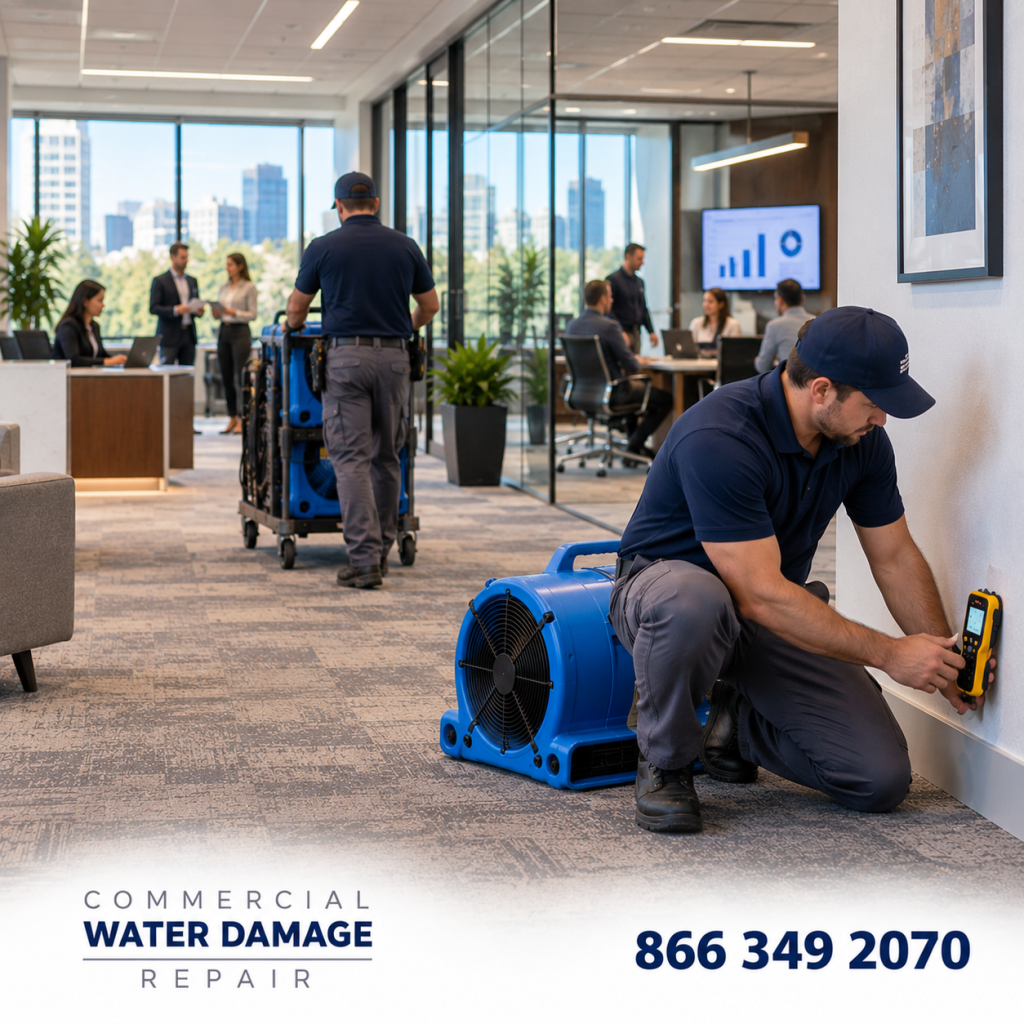
A commercial building can suffer $100,000 in physical damage and experience a business loss several times larger.
That distinction is one of the most important—and frequently overlooked—principles in commercial restoration.
Water can be extracted. Damaged drywall can be removed. Flooring can be replaced. Mechanical systems can be repaired. Yet every hour a hotel cannot sell rooms, a warehouse cannot ship products, an office cannot accommodate employees or a manufacturing facility cannot operate represents another form of damage.
The building loss eventually stops. Business interruption can continue accumulating.
For that reason, effective commercial property restoration should not focus exclusively on repairing what was damaged. Recovery planning should also determine which building functions must be restored first, which operations can continue during construction and where restoration decisions can reduce downtime. For operators of big-box and industrial sites, commercial warehouse restoration shows how downtime and business interruption plays out at scale.
The Second Loss: What Happens After the Property Damage Occurs
Physical damage is usually obvious.
A pipe fails. Water moves through several floors. Ceiling materials become saturated. Electrical systems are exposed. Flooring is damaged. Operations are interrupted.
Those conditions create the first loss.
The second loss begins when the building can no longer perform the function for which it exists.
A commercial property may simultaneously experience:
- Lost revenue
- Interrupted production
- Reduced occupancy
- Cancelled reservations
- Delayed shipments
- Tenant disruption
- Employee relocation
- Customer displacement
- Contractual penalties
- Temporary facility expenses
- Supply-chain interruptions
- Additional labor and logistics costs
Some expenses disappear when repairs are completed.
Others create consequences lasting weeks or months beyond physical restoration.
Property damage describes what happened to the building. Business interruption describes what happened to the organization because of it.
Understanding both is fundamental to commercial disaster restoration planning.
When Commercial Water Damage Becomes an Operational Emergency
Not every square foot of damage carries equal economic importance.
Consider a 300,000-square-foot distribution facility.
Water damage affecting several thousand square feet of unused storage space may create a substantial restoration project without stopping the operation.
Now imagine considerably less water reaches the facility’s electrical distribution equipment, server infrastructure or loading-dock controls.
The damaged footprint could be smaller.
The operational consequence could be dramatically larger.
✓ Damage size does not automatically determine loss severity.
✓ The location and function of the affected systems matter.
✓ Critical building dependencies can transform a relatively contained event into a major business interruption.
This is why square footage alone provides an incomplete picture of a commercial property loss.
Commercial Building Choke Points Can Determine the Entire Recovery
Certain areas of a building function as operational choke points.
Failure in one of these locations can affect areas far beyond the physical damage.
Examples can include:
- Main electrical rooms
- Switchgear and electrical distribution
- Fire alarm systems
- Elevators and elevator controls
- Domestic water systems
- Plumbing risers
- Boilers and chillers
- HVAC controls
- Building automation systems
- Data and telecommunications rooms
- Commercial kitchens
- Refrigeration equipment
- Loading docks
- Manufacturing equipment
- Medical systems
- Security and access-control systems
A restoration team therefore needs to understand more than where the water went.
They need to understand what the water affected and what depends upon it.
That changes restoration priorities considerably.
The $50,000 Repair That Can Create a $500,000 Problem
Imagine a commercial property suffers a plumbing failure.
The direct restoration and reconstruction cost ultimately reaches $50,000.
At first glance, that number appears to represent the financial severity of the event.
It doesn’t necessarily.
Suppose the affected area prevents the business from operating normally for ten days. Revenue falls. Employees remain on payroll. Temporary facilities are required. Orders are delayed. Customers move elsewhere.
Suddenly the economics look very different.
Direct property damage → $50,000
Operational interruption → potentially much greater
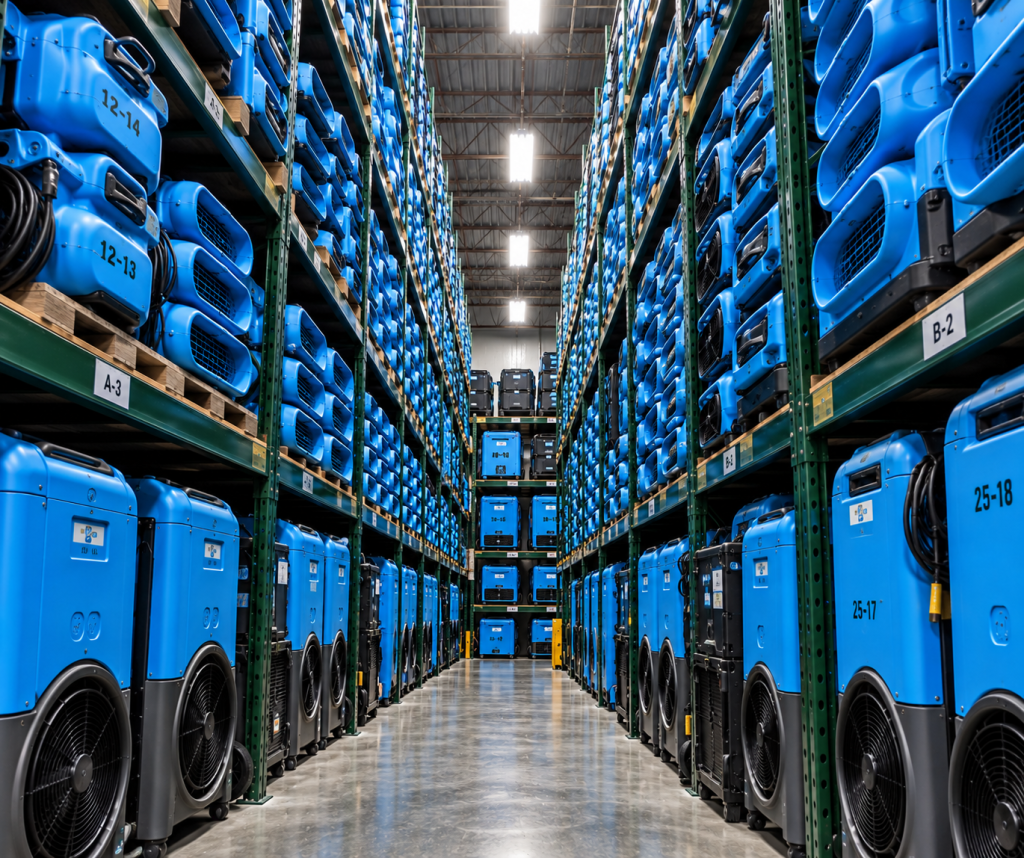
The numbers will differ dramatically by property, industry and event, but the principle remains: Owners dealing with a flooded building can review warehouse flood cleanup and drying for a practical view of downtime and business interruption.
The most expensive component of a commercial property loss may be time.
Consequently, restoration decisions should sometimes be evaluated by how much operational downtime they eliminate, rather than simply how much the individual repair costs.
Every Commercial Building Has a Different Downtime Clock
A day means something different to every commercial property.
Hotel Water Damage
A hotel earns revenue through usable rooms, meeting facilities, food service and other operating areas.
One damaged room creates one type of problem.
Loss of domestic water, elevators, fire protection or electrical infrastructure can create something entirely different.
— Can unaffected rooms remain occupied?
— Can one wing operate independently?
— Are common areas accessible?
— Can guests safely move through the property?
— Which building system controls the reopening decision?
Warehouse Water Damage
Warehouses depend heavily upon movement.
A relatively small event affecting loading operations, inventory systems, electrical distribution or material-handling equipment can interfere with a much larger operation.
✓ Protect inventory
✓ Maintain shipping capability
✓ Preserve loading access
✓ Separate restoration activities from active operations
Manufacturing Facility Restoration
Production environments introduce another level of dependency.
Water may affect:
- Production lines
- Controls
- Electrical systems
- Specialized machinery
- Raw materials
- Finished products
- Clean environments
- Quality-control processes
Here, restoring a particular machine or utility connection could potentially be more economically important than completing thousands of square feet of cosmetic reconstruction.
Office Building Water Damage
Office properties introduce tenant considerations.
One affected floor may be isolated while others continue functioning.
Damage involving elevators, restrooms, electrical distribution, HVAC or life-safety systems, however, can create building-wide complications.
Different building type. Different dependencies. Different restoration priorities.
Stop Asking Only: “How Fast Can We Finish?”
Speed matters enormously during commercial water damage restoration.
However, there’s a better question:
How quickly can we restore useful building function?
Those objectives aren’t always identical.
Complete reconstruction might require six weeks.
Partial business operations might be achievable in four days.
If so, the restoration strategy should recognize that distinction immediately.
Rather than treating reopening as one giant finish line, commercial recovery can sometimes be divided into operational milestones. Distribution operations feel downtime and business interruption sharply, which is why water damage repair for distribution centers deserves early attention.
Emergency stabilization → Stop additional damage.
Critical systems recovery → Restore infrastructure necessary for operations.
Partial reoccupancy → Return usable areas to service.
Phased reconstruction → Continue repairs around operating portions of the property.
Full restoration → Complete remaining reconstruction and return the property to normal conditions.
That is fundamentally different from simply drying the building and then beginning repairs.
Partial Occupancy Can Change the Economics of Commercial Restoration
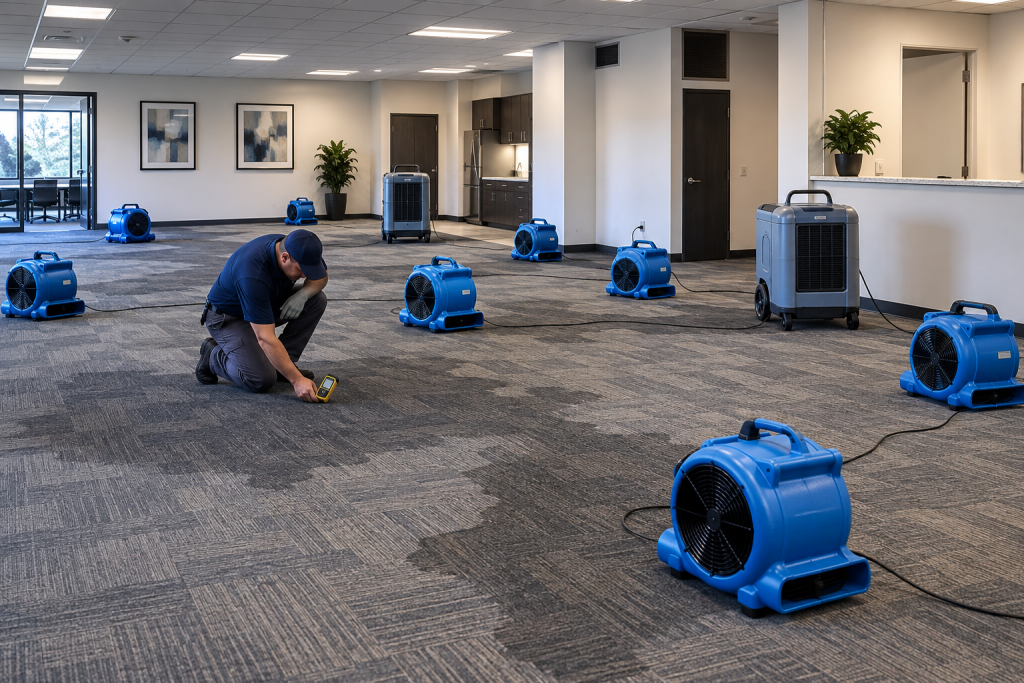
Commercial restoration does not always require an all-or-nothing choice between closed and completely restored.
Depending upon the damage, building configuration, applicable requirements and professional determinations, portions of a property may sometimes operate while restoration continues elsewhere.
This can require carefully planned:
- Containment
- Temporary access routes
- Dust and debris control
- Airflow management
- Noise scheduling
- Temporary utilities
- Work-zone separation
- After-hours construction
- Phased inspections
- Material staging
- Employee or tenant relocation
The objective becomes restoration around the business instead of removal of the business from the restoration.
For certain commercial properties, that distinction can substantially reduce interruption.
The Critical Path Matters More Than Having 100 People Running Around
Large crews look impressive.
They don’t automatically produce faster commercial recovery.
Imagine reconstruction crews are ready, but electrical equipment has not been evaluated.
Nothing moves.
Perhaps materials arrive, but an engineering determination remains outstanding.
Another delay.
Drying finishes, yet an inspection cannot occur for three days.
More lost time.
The real problem is often not labor capacity.
It is dependency management.
A sophisticated commercial restoration schedule identifies the critical path:
Assessment
→ Stabilization
→ Investigation
→ Mitigation
→ Verification
→ Repair
→ Systems testing
→ Reoccupancy
Throwing additional labor at a blocked dependency doesn’t necessarily shorten that sequence.
Removing the blockage does.
Dead Time: The Commercial Restoration Cost Nobody Puts on the Wall
There is working time.
Then there is dead time.
Dead time occurs when restoration progress stops because something else hasn’t happened.
Examples include:
— Waiting for access
— Waiting for authorization
— Waiting for specialized inspections
— Waiting for engineering
— Waiting for materials
— Waiting for electrical evaluation
— Waiting for documentation
— Waiting for decisions
— Waiting for another contractor
— Waiting for building management
Each delay can extend business interruption without producing any additional restoration value. If your facility stores inventory, restoring a warehouse after water loss explains how downtime and business interruption affects shipping schedules.
For a large commercial operation, eliminating two days of dead time can potentially be more valuable than shaving several percentage points from a construction estimate.
That makes coordination itself a loss-mitigation activity.
Commercial Restoration Should Follow Business Priorities
Traditional construction naturally focuses on completing the project.
Commercial disaster recovery has another priority:
Restore the highest-value functions as early as reasonably possible.
One useful approach is to divide affected operations into tiers.
Priority 1 — Operations Required to Open
These are true operational dependencies.
- Life-safety systems
- Critical utilities
- Required access
- Essential electrical infrastructure
- Required plumbing
- Critical HVAC
- Necessary communications
Priority 2 — Operations Required to Function Efficiently
The business may technically operate without them, but capacity or productivity is reduced.
Priority 3 — Areas That Can Remain Under Restoration
These portions may be important without preventing substantial business operations.
That prioritization creates a very different recovery schedule.
Instead of restoring the property according to geography alone—
Floor 1 → Floor 2 → Floor 3
—the team can restore according to operational importance—
Critical system → revenue area → supporting operation → secondary area → cosmetic completion.
Business Continuity Belongs Inside the Restoration Conversation
Business continuity is sometimes treated as something management handles while contractors handle the building.
In reality, the two are interconnected.
Restoration decisions influence operational decisions.
Operational priorities should influence restoration decisions.
Facility managers, property managers, ownership, contractors and other relevant professionals therefore benefit from establishing early:
✓ What absolutely must remain operational?
✓ What can temporarily relocate?
✓ Which areas can be isolated?
✓ What building systems serve multiple areas?
✓ Which repair creates the largest operational benefit?
✓ What is preventing partial reopening?
✓ Which decision currently controls the critical path?
Those questions transform restoration from reactive construction into commercial recovery planning.
Measuring Commercial Restoration Success Differently
There is a simple way to rethink the entire process.
Don’t measure only:
How many square feet were dried?
Measure:
How much usable building function was restored?
Don’t measure only:
When was reconstruction completed?
Consider:
When did revenue-producing operations resume?
Don’t measure only:
How much did restoration cost?
Also evaluate:
How much additional business interruption did the restoration strategy prevent?
That doesn’t diminish workmanship, safety, documentation or proper restoration practices.
It places them inside the larger reason commercial properties are restored in the first place.
The Real Product of Commercial Restoration Is Recovery
Walls matter.
Floors matter.
Mechanical systems matter.
Glass, ceilings, electrical equipment and finishes matter.
Ultimately, however, a commercial building exists to perform a function.
A hotel accommodates guests.
A warehouse moves goods.
A hospital treats patients.
A manufacturing facility produces products.
An office supports organizations and employees.
A retail property serves customers.
Effective commercial restoration reconnects the damaged building to that function as quickly and responsibly as circumstances allow. Teams in Las Vegas and the Bay Area can find warehouse water damage restoration services that accounts for downtime and business interruption from day one.
That is why business interruption deserves to be considered from the beginning of a commercial property loss—not after the physical restoration scope has already been established.
The fundamental question isn’t simply:
“How quickly can we repair this building?”
A more powerful commercial recovery question is:
“What is preventing this business from operating, and what must happen next to remove that obstacle?”
Once restoration is viewed through that lens, downtime stops being an unfortunate side effect of property damage.
Downtime becomes something the recovery strategy is specifically designed to reduce.
Facing business interruption from a commercial water loss right now?
Our commercial team plans restoration around your operations to limit business interruption, not just your square footage — including warehouse water damage repair built to protect shipping and inventory.
Related Reading
- Business Continuity — keeping operations running during a commercial restoration project.
- Warehouse Water Damage Repair — protecting shipping, inventory, and facility performance.
- Facility Manager Guide — what facility teams need to know before and during a loss.
- Insurance Process — documentation and claims support for commercial losses.
- Restoration vs Repair vs Mitigation — understanding the terminology of commercial recovery.
- IICRC S500 Standard for Professional Water Damage Restoration — the industry reference for restoration practice.