Water emergency? Our commercial crews respond 24/7.
Home / Water Sources / Commercial Roof Leaks
Commercial Roof Leaks
- 24/7 Response
- Extraction
- Structural Drying
- Restoration
What happens when you call
24/7 dispatch
Call any hour. Crews mobilize for commercial losses, including nights and weekends.
Extraction & drying
Standing water removed, then structural drying with monitored moisture readings.
Insurance-ready records
Readings, photos and scope notes documented for your carrier from day one.
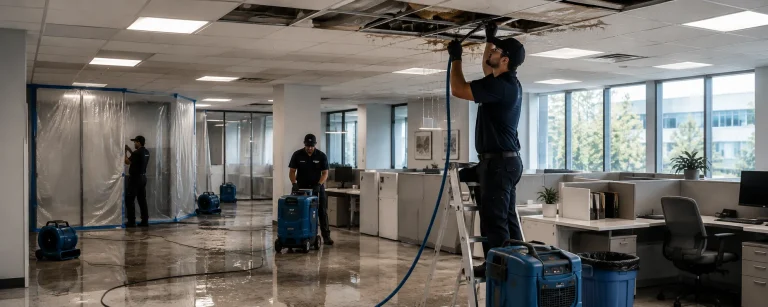
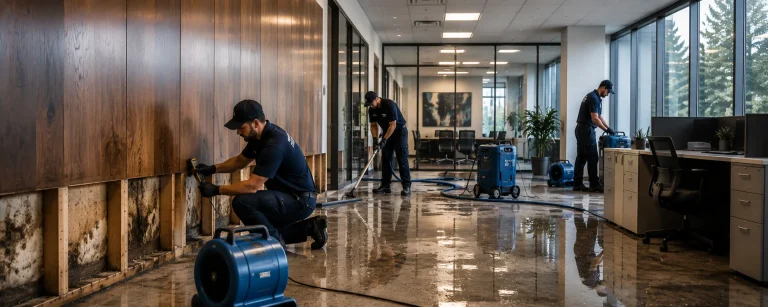
A commercial roof leak rarely announces itself at the point of failure. Water enters through a seam, a flashing detail, a drain, or a penetration on the roof surface, then travels along the deck until it finds an opening. By the time a stain appears on a ceiling tile two floors down, the water has usually been moving through the building for some time.
That gap between entry and discovery is what makes roof leaks expensive in commercial buildings. The visible damage is a symptom. The actual affected area often includes insulation, deck assemblies, wall cavities, electrical components and anything stored or installed beneath the pathway.
Where Commercial Roofs Usually Fail
Low-slope commercial roofs fail at details far more often than they fail in the field of the membrane. The places worth checking first are the ones where the roof system is interrupted:
- Flashing at parapets, curbs and walls
- Roof drains, scuppers and overflow drains
- Penetrations for HVAC units, vents, conduit and piping
- Seams and laps in single-ply membranes
- Expansion joints and transitions between roof sections
- Equipment curbs that have shifted or settled
- Skylights and hatches
Ponding water accelerates all of it. Standing water adds weight, finds pinholes, and works at seams every time the roof heats and cools. A roof that drains properly can tolerate a small defect for a long time. A roof that ponds cannot.
How Water Travels Once It Is Inside
Water entering a commercial roof assembly does not fall straight down. It follows the deck, the slope of the structure, conduit runs, and the path of least resistance until something stops it or something lets it through.
On a metal deck it can run along the flutes for a considerable distance. Above a suspended ceiling it can spread across insulation before saturating a single tile. In a multi-story building it can enter a wall cavity and appear on a lower floor entirely away from the roof defect.
This is why the first question after a roof leak is not only where the water appeared, but where it could have gone. Tracing the pathway matters more than measuring the stain.
What Gets Damaged First
Roof leaks tend to damage building systems before they damage finishes, and building systems are what keep a commercial property operating.
- Insulation loses performance once it is wet and often has to be removed
- Ceiling grid and tile stain, sag and fail
- Light fixtures and electrical components above the ceiling are exposed
- Data and communication cabling runs through the same ceiling space
- Drywall partitions wick moisture upward from the top plate down
- Flooring beneath the pathway absorbs whatever arrives
- Tenant inventory, equipment and stock sit directly in the path
Early Warning Signs Worth Acting On
Most roof leaks give warning before they become an emergency. The signs are easy to dismiss because they look minor:
- A ceiling tile that stains, dries, and stains again after each rain
- Rust at the deck, grid or fastener heads
- Bubbling paint or a soft spot at the top of a wall
- A musty smell in one area that does not clear
- Efflorescence or mineral streaking on interior masonry
- Repeated tenant complaints from the same corner of the building
A recurring stain in the same place is not a cosmetic problem. It is evidence of an unresolved pathway, and each cycle adds to the damage inside the assembly.
The Commercial Response Sequence
Responding to a roof leak in an occupied commercial building follows an order. Skipping steps usually means doing the work twice.
Stop the intrusion. Temporary protection on the roof keeps the next rain from resetting the project. That may mean patching a seam, clearing a drain, or covering a section until permanent repairs can be scheduled.
Establish the affected area. Investigation follows the pathway rather than the stain, using moisture readings and targeted access where the evidence points.
Protect what is still working. Contents, equipment and occupied areas beneath the pathway get covered or relocated before demolition starts.
Remove what cannot be dried. Saturated insulation and compromised ceiling materials generally come out. Structure, deck and many finishes can often be dried in place.
Dry the assembly. Wall cavities, deck assemblies and concrete hold moisture long after surfaces feel dry, and they are monitored until they reach the target condition.
Coordinate the roof repair. Interior reconstruction that happens before the roof is permanently repaired is at risk from the next storm.
What Property and Facility Managers Deal With
A roof leak creates a building problem and a tenant problem at the same time. Tenants want to know when their space is usable. Ownership wants to know whether this is a repair or the start of a roof replacement. Both questions depend on information that only becomes available after investigation.
It helps to separate the two tracks early. The restoration work addresses what the water damaged. The roofing decision addresses why it happened and whether the assembly has reached the end of its service life. Treating them as one project tends to delay both.
Documentation That Matters Later
Roof leaks are frequently disputed, because the cause can be a sudden event, long-term wear, or a maintenance issue, and the interior damage looks similar in each case. A clear record made while the evidence still exists protects everyone involved.
- Photographs of the roof condition at the suspected entry point
- Photographs of the interior before any demolition
- Moisture readings by location, with dates
- Weather at the time of the event
- Prior leak complaints and repair history for the same area
- What was removed, and why
Reducing the Odds of the Next One
Roof leaks are among the more preventable sources of commercial water damage, because the failure points are known and reachable.
- Inspect the roof twice a year and after major storms
- Keep drains, scuppers and gutters clear, especially in fall
- Recheck details after any rooftop equipment work
- Track repairs by location so repeat problems become visible
- Address ponding rather than patching around it
- Know the age and remaining service life of the assembly
When a Roof Leak Becomes a Water Damage Project
The point at which a roof leak stops being a maintenance item and becomes a restoration project is usually the point at which water reaches something that cannot simply dry out on its own: insulation, wall cavities, electrical equipment, flooring assemblies or tenant property.
At that stage the work is no longer about the roof. It is about establishing how far the water traveled, drying the building back to a safe condition, and returning the affected space to use with a record of what was found and what was done.
Water Emergency?
Our commercial response team is available 24/7 for water extraction, structural drying and restoration.
Our Services
Talk To A Specialist
Need help with a water loss right now?
Call our commercial team for extraction, drying and restoration planning built around your building and your operations.