Water emergency? Our commercial crews respond 24/7.
Home / Water Sources / Foundation Water Intrusion
Foundation Water Intrusion
- 24/7 Response
- Extraction
- Structural Drying
- Restoration
What happens when you call
24/7 dispatch
Call any hour. Crews mobilize for commercial losses, including nights and weekends.
Extraction & drying
Standing water removed, then structural drying with monitored moisture readings.
Insurance-ready records
Readings, photos and scope notes documented for your carrier from day one.
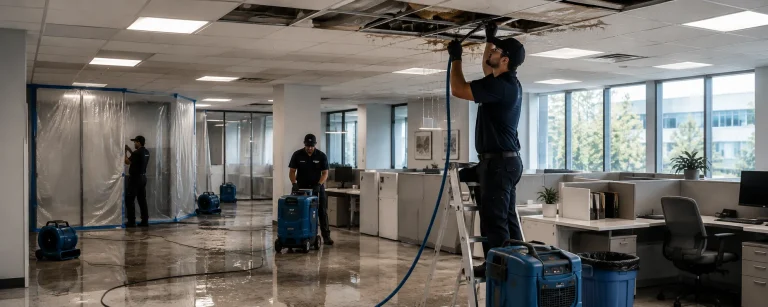
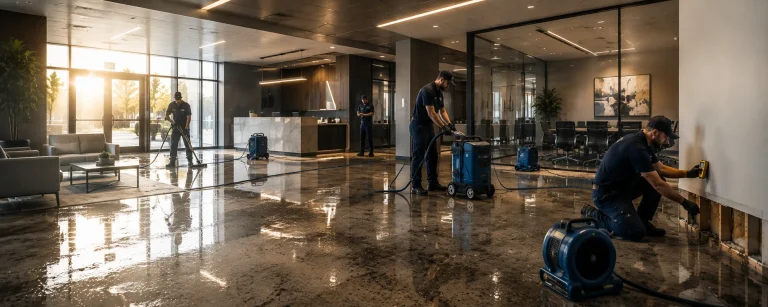
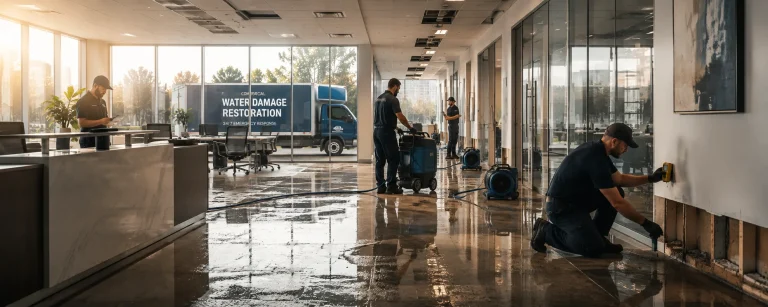
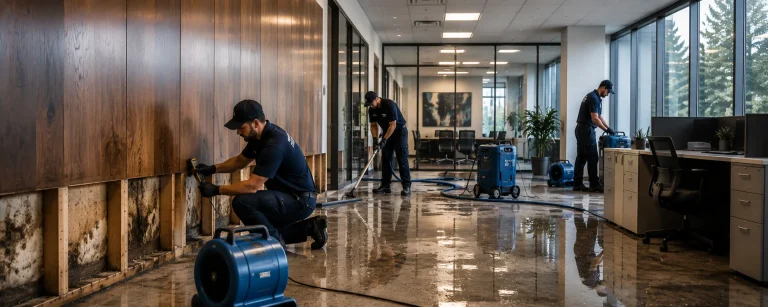
Foundation intrusion is water that enters a commercial building from below grade. It moves through basement walls, slabs, joints and penetrations, driven by groundwater and hydrostatic pressure rather than by a failed component inside the building.
These losses behave differently from every other water source on this site. There is no valve to close and no equipment to repair. The water arrives when conditions outside the building make it arrive, and it returns under the same conditions until the cause is addressed.
How Water Gets Through a Foundation
- Cracks in foundation walls, from settlement, shrinkage or movement
- The cold joint where the wall meets the slab
- Slab cracks and control joints
- Penetrations for utilities, conduit and piping
- Failed or aged waterproofing and damp-proofing on the exterior
- Window wells, stairwells and area drains that fill faster than they drain
- Failed or undersized sump pumps, or pumps without backup power
- Blocked perimeter drainage
- Grading and site drainage that direct water toward the building
Hydrostatic pressure is the mechanism behind most of it. When saturated soil surrounds a below-grade wall, the water has weight and pressure behind it, and it will use any available path. Concrete that is perfectly sound for structural purposes is not necessarily watertight under that pressure.
Why These Losses Repeat
A pipe break happens once. Foundation intrusion happens every time the conditions repeat, which usually means every significant rainfall, every spring thaw, or every seasonal rise in the water table.
That is why interior repairs alone rarely resolve the problem. Replacing drywall and flooring after each event addresses the damage but not the cause, and the next storm produces the same result. Buildings that break the cycle do it by correcting drainage, waterproofing or pumping capacity, and only then rebuilding the interior.
What Gets Damaged
- Below-grade flooring and anything porous in contact with the slab
- The lower portion of wall assemblies, including insulation and framing
- Storage, records and inventory kept in basements
- Mechanical and electrical equipment installed at low level
- Elevator pits and their equipment
- Below-grade parking structures and their finishes
- Tenant spaces on lower levels
Basements collect what the rest of the building does not want: file storage, spare equipment, mechanical plant and archived records. That makes the contents exposure unusually high relative to the floor area affected.
The Response Sequence
Establish whether water is still entering. Unlike other sources, the flow may continue as long as conditions outside persist, which affects when drying can realistically begin.
Restore or supplement pumping. Sump systems that failed or were overwhelmed are repaired or supported with temporary pumping capacity.
Extract and remove contents. Standing water is removed and stored items are evaluated, which in below-grade spaces is often the largest part of the loss.
Establish how far it traveled. Wall assemblies and flooring wick water upward from the slab, so the affected boundary is usually higher than the visible water line.
Dry, with realistic expectations. Concrete and masonry hold moisture and release it slowly, so below-grade drying takes longer than equivalent work above grade.
Address the cause before rebuilding. Drainage, waterproofing and pumping capacity are resolved before finishes are replaced, or the cycle repeats.
Water Quality Below Grade
Groundwater is not clean supply water. It has passed through soil, and in many events it arrives alongside storm water that has run across pavement and site surfaces. Where site drainage and sanitary systems interact, the water quality question becomes more significant still.
The practical effect is that porous materials in contact with the water are more likely to be removed than dried, and the affected area is evaluated with the water source in mind rather than treated as a clean water loss.
Early Warning Signs
- Efflorescence, the white mineral residue on below-grade walls
- Damp patches that appear after rain and fade between storms
- Staining at the base of walls or along the wall and slab joint
- Musty odor in basement areas that does not clear
- Rust at the base of metal framing, racking or equipment
- A sump pump that runs more often, or longer, than it used to
- Cracks that widen or begin to show mineral deposits
Prevention and Risk Reduction
- Keep site grading sloped away from the building
- Maintain gutters, downspouts and site drainage so discharge is directed away
- Service sump pumps, test float switches and add alarms
- Provide backup power for pumps, since intrusion and power loss often coincide
- Keep perimeter drainage clear where it exists
- Seal utility penetrations through below-grade walls
- Store contents off the floor on racking or pallets
- Track events by location and rainfall to identify patterns
Backup power for pumping deserves emphasis. The storms that raise the water table are the same storms that knock out power, and a sump system without a backup is unavailable at exactly the moment it is needed.
Documentation
- Date and rainfall conditions for each event
- Photographs of entry points and affected areas
- Moisture readings, including wall assemblies above the visible line
- Contents affected, which is often the largest element below grade
- Pump performance and any failures
- Prior events at the same location
The history matters more here than with any other source. A single event is an incident; a pattern across several storms is evidence of a building condition, and it is what justifies investment in correcting the cause.
Fix the Cause, Then the Finishes
Foundation intrusion is the water source most likely to be treated as a recurring nuisance rather than a building problem. Each event is cleaned up, the space is put back, and the next storm starts it again.
Breaking that pattern means treating the drainage and waterproofing work as the real project and the interior restoration as the part that follows it. Rebuilt finishes above an unresolved cause have a predictable service life, and it is measured in storms.
Water Emergency?
Our commercial response team is available 24/7 for water extraction, structural drying and restoration.
Our Services
Talk To A Specialist
Need help with a water loss right now?
Call our commercial team for extraction, drying and restoration planning built around your building and your operations.