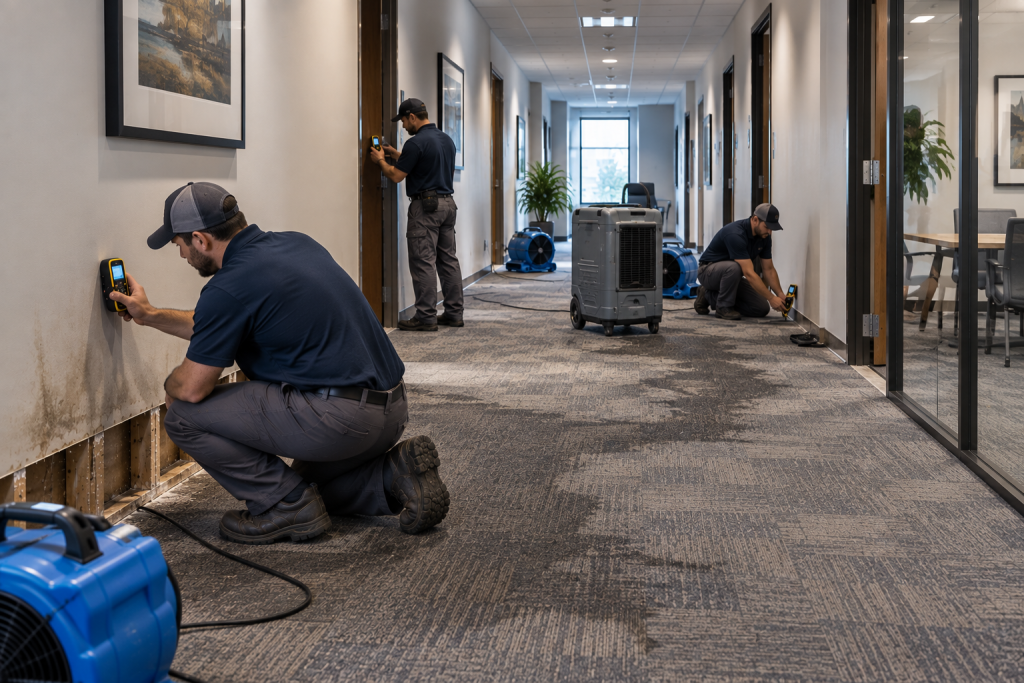
The ceiling stain is not the water damage.
It is evidence of water damage.
A puddle on the floor tells you where some of the water ended up. Swollen baseboards reveal that certain materials absorbed moisture. Discolored ceiling tiles show where water became visible.
None of those observations necessarily identify the full extent of a commercial water damage event.
Water can travel behind walls, beneath flooring, above ceilings, through insulation, along structural components and into mechanical or electrical spaces before anyone realizes a problem exists.
Commercial buildings make this particularly important because they contain interconnected assemblies and systems extending far beyond the room where damage first appears.
Visible damage tells you where to begin looking. It does not necessarily tell you where to stop. Read more about how warehouse restoration works if hidden moisture is a concern for your property.
Effective commercial water damage restoration therefore requires investigation—not simply observation.
What Is Hidden Commercial Water Damage?
Hidden commercial water damage is moisture intrusion or resulting deterioration that is not readily apparent from normal visual inspection.
Sometimes the source itself is concealed.
Elsewhere, the source is obvious but the migration path isn’t.
A burst pipe above a ceiling may release water that becomes visible in one office while simultaneously traveling through wall cavities, insulation and adjoining assemblies.
Common concealed locations can include:
- Behind drywall
- Inside wall cavities
- Above suspended ceilings
- Beneath flooring
- Under cabinets and millwork
- Inside insulation
- Around structural components
- Beneath roofing assemblies
- Around window and storefront systems
- Inside mechanical spaces
- Around plumbing penetrations
- Within shafts and chases
Finding these areas can be especially important in large commercial properties where complicated construction assemblies allow water to move in directions that are not immediately obvious.
Water Doesn’t Respect Room Boundaries
Building plans divide commercial properties into rooms, suites and floors.
Water doesn’t care.
Once released, moisture follows gravity, material characteristics, openings, penetrations and available pathways.
A plumbing failure inside one tenant space can potentially migrate:
Across the floor
→ into adjacent materials
Downward
→ through penetrations and assemblies
Horizontally
→ through wall systems or beneath flooring
Into cavities
→ where visual inspection becomes difficult
Toward building systems
→ potentially affecting electrical, mechanical or communications infrastructure.
Consequently, labeling an event “water damage in Suite 210” may describe where the problem was discovered rather than the actual boundary of the loss.
The Four Boundaries of Commercial Water Damage
A useful way to understand a complicated commercial water loss is to stop thinking about one damage boundary.
There may actually be several.
1. The Visible Boundary
This is what people immediately see.
Wet flooring.
Ceiling stains.
Damaged drywall.
Standing water.
Discoloration.
The visible boundary is important—but usually represents only the starting point of the investigation.
2. The Moisture Boundary
This identifies materials and assemblies actually affected by moisture.
It can extend beyond visible evidence.
3. The Building-System Boundary
Water may interact with electrical, HVAC, plumbing, elevator, fire-protection, communications or building-control systems.
Those systems can extend far beyond the physically wet area.
4. The Operational Boundary
This is the portion of the property or business whose function is affected.
A small wet electrical room could create an operational boundary encompassing an entire building. Property owners comparing options can look at warehouse drying and dehumidification to see where hidden moisture fits.
Visible boundary ≠ moisture boundary ≠ system boundary ≠ operational boundary.
Understanding those differences is fundamental to sophisticated commercial water damage assessment and restoration.
The Ceiling Stain Is a Clue, Not a Diagnosis
Consider a brown stain appearing on a commercial ceiling.
Someone looks above the tile and discovers a leaking pipe.
Problem solved?
Not necessarily.
Important questions remain:
— How long was the leak active?
— Where did the water travel before becoming visible?
— Which materials were contacted?
— Did water enter insulation?
— Are adjacent wall cavities affected?
— Did moisture migrate to another floor?
— Are electrical or mechanical components nearby?
— Has the source been completely identified and controlled?
The stain provides a location.
Investigation determines the extent.
That difference separates finding evidence of commercial water damage from understanding the commercial water loss.
Water Can Travel Sideways Before It Travels Down
People naturally expect water to fall vertically.
Commercial construction can make migration considerably more complicated.
Water may encounter:
- Structural decking
- Concrete slabs
- Floor coverings
- Framing
- Insulation
- Vapor-control materials
- Ceiling systems
- Mechanical penetrations
- Conduits
- Pipes
- Expansion joints
- Wall assemblies
Those components can redirect movement.
A leak originating above one room can potentially become visible somewhere else.
Likewise, the area directly beneath the source may not show the first obvious signs.
Source location and visible damage location are not always the same.
That becomes particularly important when investigating recurring leaks.
Multi-Story Buildings Create Vertical Water Pathways
Commercial high-rises, hotels, hospitals and multifloor office properties create another challenge.
Water can migrate vertically through:
✓ Plumbing penetrations
✓ Mechanical shafts
✓ Electrical penetrations
✓ Elevator-related spaces
✓ Wall cavities
✓ Stair and utility areas
✓ Floor openings
✓ Building chases
One floor may therefore show obvious damage while another contains concealed moisture.
In a significant event, restoration professionals need to understand the vertical pathway of the loss, not simply inspect the floor where someone first reported water.
Wall Cavities Can Hide an Entire Second Damage Zone
Finished commercial walls conceal numerous components.
Framing.
Insulation.
Electrical wiring.
Plumbing.
Backing.
Fire-rated assemblies.
Other building systems.
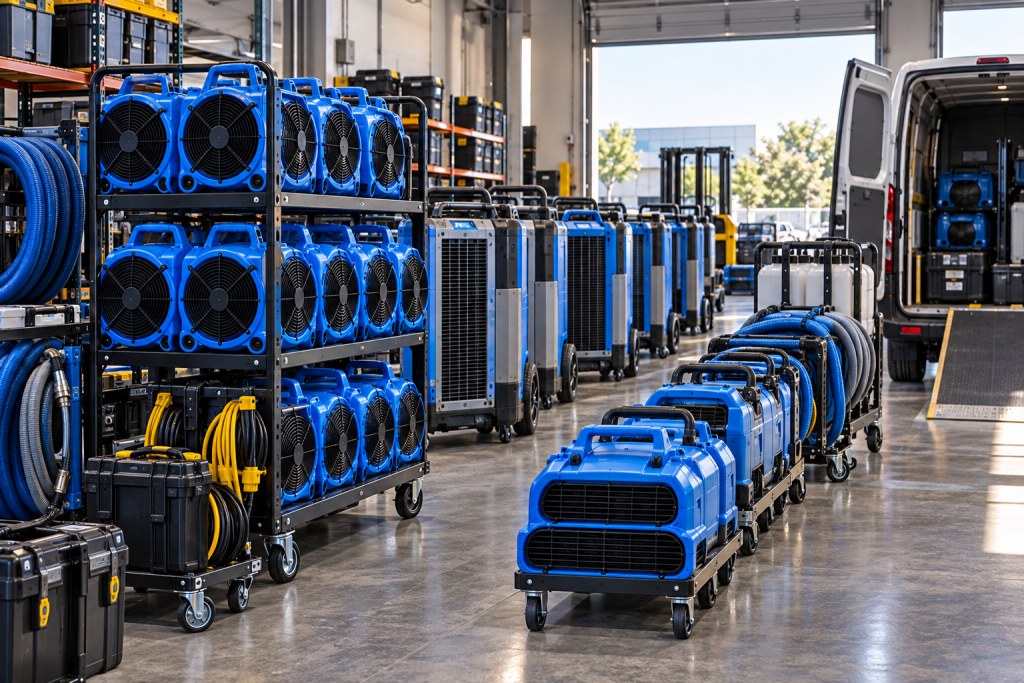
Water entering a wall cavity may leave surprisingly little immediate evidence on the finished surface.
A wall can therefore look relatively normal while materials behind it remain affected.
That creates an important restoration principle:
The appearance of the finish does not necessarily describe the condition of the assembly.
Commercial water damage investigation should distinguish between what can be observed on the surface and what evidence indicates may be occurring inside the construction.
Flooring Can Conceal Water Over a Much Larger Area
Floors are another common source of uncertainty.
Water appearing on top of a floor is easy to see.
Moisture beneath a floor system is different.
Depending upon the construction, water can potentially migrate beneath:
- Carpet systems
- Resilient flooring
- Wood products
- Raised floors
- Tile assemblies
- Underlayments
- Equipment bases
- Built-in furnishings
The visible wet area may therefore be smaller than the affected area beneath the finished surface.
This matters because simply drying what is visible does not necessarily address what has migrated into concealed layers.
Insulation Can Complicate Commercial Drying
Insulation presents its own challenge because it often exists specifically where visual access is limited. Large warehouse water damage adds another layer to hidden moisture that is easy to underestimate.
Wall systems.
Roof assemblies.
Mechanical areas.
Exterior assemblies.
Ceiling spaces.
Depending upon the material and conditions, determining whether insulation has been affected can require more than looking at adjacent finishes.
The same principle applies:
Visible dryness on the outside does not automatically establish conditions inside the assembly.
Commercial restoration decisions should be based on appropriate investigation of the materials and construction involved.
Hidden Water Damage Around Storefronts and Exterior Glazing
Commercial water intrusion doesn’t always begin with a plumbing failure.
Exterior building-envelope problems can allow water into concealed assemblies around:
- Storefront windows
- Curtain walls
- Commercial doors
- Window perimeters
- Flashings
- Sealant joints
- Roof-to-wall transitions
- Parapets
- Penetrations
The interior symptom might be a small stain near a window.
Yet the actual pathway could begin several feet away.
That makes recurring commercial leaks especially difficult.
Repairing the interior stain without identifying the exterior pathway can produce an endless cycle:
Water appears
→ interior gets repaired
→ rain returns
→ water reappears
→ interior gets repaired again.
The restoration problem cannot be permanently resolved until the water-entry mechanism is understood.
HVAC Systems Can Expand the Investigation Beyond the Wet Area
Mechanical systems deserve particular attention after certain commercial water events.
HVAC infrastructure can extend throughout large portions of a property.
Depending upon what occurred, where it occurred and the systems involved, investigation may need to consider whether affected areas interact with:
- Air handlers
- Ductwork
- Mechanical rooms
- Filters
- Insulation
- Controls
- Return-air pathways
- Supply systems
This doesn’t mean every water loss contaminates an entire HVAC system.
It means the mechanical system should not be ignored simply because most of it lies outside the visibly damaged room.
Commercial buildings are connected. Restoration investigations should recognize those connections.
Electrical Damage Can Be Hidden Even When the Water Is Gone
Water on the floor eventually disappears.
That doesn’t automatically resolve questions involving electrical components that were exposed during the event.
Electrical equipment may be located:
— Inside walls
— Above ceilings
— In floor systems
— Within dedicated equipment rooms
— Inside control cabinets
— Along concealed pathways
This creates another important distinction.
Drying the surrounding construction does not itself determine the condition of every building system exposed to the loss. For operators of big-box and industrial sites, commercial warehouse restoration shows how hidden moisture plays out at scale.
Where appropriate, qualified professionals may need to evaluate specialized systems separately.
Commercial restoration is therefore often multidisciplinary.
The Hidden Damage May Not Be Moisture at All
One of the most overlooked ideas in commercial water restoration is that the hidden problem can be a consequence rather than hidden water itself.
A water event can potentially lead to:
- Corrosion
- Material deterioration
- Adhesive failure
- Finish damage
- Insulation problems
- Equipment concerns
- Indoor environmental issues
- Loss of system reliability
- Secondary microbial growth under appropriate conditions
By the time these consequences become visible, the original water may no longer be present.
That is why the question isn’t simply:
“Is it wet now?”
Another question matters:
“What happened to this material or system while it was wet?”
Time Changes the Hidden-Damage Equation
A recently discovered supply-line failure and a slow leak that existed unnoticed for weeks are very different investigation problems.
Duration matters.
A short-duration event may have a relatively understandable migration pattern.
A long-term leak can allow moisture to interact with materials repeatedly or continuously.
Therefore, determining the probable timeline can be extremely valuable.
Useful clues may include:
✓ Occupant reports
✓ Maintenance records
✓ Previous leak complaints
✓ Building-management-system information
✓ Photographs
✓ Material conditions
✓ Weather history for exterior intrusion
✓ Prior repairs
The question “When did someone notice it?” is not necessarily the same as “When did it begin?”
Commercial Water Damage Investigation Is a Process of Reducing Uncertainty
At the beginning of a large loss, nobody knows everything.
That’s normal.
The purpose of investigation is to progressively replace uncertainty with evidence.
A useful progression looks like this:
Observed
→ What can we directly see?
Suspected
→ Where could water reasonably have migrated?
Investigated
→ What additional areas have been evaluated?
Confirmed
→ What materials or systems are actually affected?
Documented
→ What evidence supports the determination?
Addressed
→ What action is appropriate based upon those findings?
This approach is considerably more reliable than assuming the first visible boundary represents the final restoration scope.
Moisture Mapping Helps Turn Clues Into a Damage Picture
Commercial properties can be too large and complicated to manage from memory.
Mapping creates structure.
A commercial moisture investigation may document information such as:
- Source location
- Visible damage
- Affected rooms
- Material types
- Moisture observations
- Vertical migration
- Suspected concealed areas
- Building-system exposures
- Previously investigated areas
- Areas requiring additional evaluation
As information develops, the map changes.
That’s important.
A commercial water damage map should represent what the evidence currently shows— not what someone assumed during the first hour.
Thermal Imaging Is Useful—But It Isn’t X-Ray Vision
Technology can improve commercial water damage investigations.
It can also create false confidence when misunderstood.
Thermal imaging may help identify temperature patterns that warrant further investigation.
Those patterns do not automatically prove:
“There is water inside this wall.”
Temperature differences can have multiple causes.
The same caution applies to other instruments.
Equipment provides information.
Interpretation turns information into a restoration decision.
That means sophisticated commercial moisture investigation generally relies upon multiple observations rather than one dramatic-looking image from one instrument.
Don’t Demolish Everything Just to Find Out
There is an opposite mistake.
Concern about hidden damage does not justify unnecessary destructive investigation everywhere. Owners dealing with a flooded building can review warehouse flood cleanup and drying for a practical view of hidden moisture.
Effective commercial restoration should balance:
investigate enough to understand the loss
against
avoid unnecessary disruption to unaffected construction.
That may involve progressively escalating the investigation.
Start with building information and non-destructive observations.
Follow the evidence.
Use targeted access when appropriate.
Document findings.
Expand only where conditions justify expansion.
This approach is especially important in occupied commercial buildings where unnecessary demolition can create additional downtime, dust, noise, access problems and reconstruction costs.
Hidden Damage and Business Interruption Are Closely Connected
Hidden water damage creates another economic problem:
uncertainty delays decisions.
Suppose management wants to reopen a commercial area.
Visible surfaces appear dry.
However, nobody has established whether adjacent assemblies or critical systems were affected.
Now the business faces uncertainty.
Can employees return?
Can reconstruction begin?
Can equipment be installed?
Does another area require investigation?
Every unanswered question can potentially delay the critical path.
Finding hidden damage early isn’t only about protecting construction materials.
It can accelerate commercial decision-making.
The Costliest Hidden Damage May Be the Damage Found Too Late
Imagine a concealed affected area is discovered during initial investigation.
The restoration plan changes.
That’s inconvenient.
Now imagine the same condition is discovered after:
- New flooring has been installed
- Walls have been closed
- Tenants have returned
- Equipment has been replaced
- Furniture has been moved back
- Final finishes are complete
The physical condition may be identical.
The consequences are not.
Now completed work may need to be disturbed.
Occupants may be displaced again.
Schedules change.
Documentation becomes more complicated.
Downtime can return.
Early discovery is often dramatically less disruptive than late discovery.
Look Beyond the Room: Follow the Water Pathway
A useful commercial investigation question is:
“If water entered here, where could it reasonably go next?”
Then follow the building.
Look downward.
Look laterally.
Consider penetrations.
Understand cavities.
Review adjacent rooms.
Identify systems passing through the area.
Check what exists on the floor below.
Determine whether exterior assemblies could be involved.
This turns restoration from a room-by-room inspection into water-pathway analysis.
Follow the Water—Then Follow the Systems
Water migration tells only half the story.
Once the physical pathway is understood, ask what infrastructure intersected that pathway.
For example:
Pipe failure above ceiling
↓
Water travels through ceiling cavity.
↓
Electrical components are present.
↓
Water enters wall assembly.
↓
Wall continues into adjoining tenant space.
↓
Floor penetration provides downward pathway.
↓
Lower-floor ceiling becomes affected.
Now the investigation isn’t merely:
“How far did the water travel?”
It becomes:
“What did the water encounter along the way?”
That is a much more useful commercial restoration question.
Different Buildings Hide Water Differently
Commercial construction varies enormously.
Office Buildings
Suspended ceilings, wall cavities, raised floors and shared building systems can complicate investigation.
Hotels
Repeated room layouts, vertical plumbing stacks and multiple floors create opportunities for water to migrate beyond the original room.
Hospitals and Healthcare Facilities
Complex building systems and specialized spaces can increase the importance of carefully defining affected areas.
Warehouses
Large open areas may appear simple, while offices, electrical rooms, insulation and specialized storage environments introduce hidden concerns.
Manufacturing Facilities
Equipment bases, process systems, pits, electrical infrastructure and specialized assemblies can make the physical loss only one portion of the investigation.
Retail and Mixed-Use Properties
Multiple tenants, storefront assemblies, shared utilities and different construction types can create complicated migration pathways.
The building itself determines how the water behaves.
Hidden Water Damage Documentation Protects the Recovery Process
Documentation becomes particularly important when the extent of damage isn’t immediately obvious.
A strong record can establish:
✓ What was initially observed
✓ What areas were investigated
✓ Why additional investigation occurred
✓ What evidence was discovered
✓ How the affected boundary changed
✓ Which systems required specialized evaluation
✓ What restoration actions followed
That creates a traceable story.
Instead of:
“We opened another wall because we thought it might be wet.”
the project record can show:
Observation → evidence → investigation → finding → decision.
That is a far stronger commercial restoration process.
When Should Hidden Commercial Water Damage Be Suspected?
No single indicator proves concealed damage.
However, further investigation may be warranted when circumstances suggest the visible condition doesn’t explain the event.
Possible warning signs include:
- Recurring staining
- Unexplained odors
- Material deterioration
- Swelling or deformation
- Repeated exterior leaks
- Moisture appearing far from the apparent source
- Damage on multiple floors
- Water near penetrations or shafts
- Wet materials adjacent to apparently dry assemblies
- Unexplained finish failure
- A leak known to have existed for an uncertain period
Most importantly:
If the visible damage doesn’t make sense given the amount, source, duration or pathway of the water, keep investigating.
The Commercial Water Damage Question That Changes Everything
Most people entering a damaged building instinctively ask:
“Where is the water?”
That’s a reasonable beginning.
Commercial restoration requires going further.
Ask:
Where did it originate?
Where could it travel?
What materials did it encounter?
Which building systems crossed its path?
How long could those conditions have existed?
What evidence establishes the actual boundary?
What remains uncertain?
Those questions reveal the difference between cleaning up what is visible and understanding what actually happened. Distribution operations feel hidden moisture sharply, which is why water damage repair for distribution centers deserves early attention.
Visible Damage Is the Beginning of the Investigation
Commercial water damage can be deceptive because buildings conceal enormous amounts of infrastructure behind finished surfaces.
Walls hide utilities.
Ceilings hide mechanical systems.
Floors conceal layers.
Shafts connect stories.
Exterior assemblies contain multiple drainage and weather-control components.
One visible symptom may therefore represent only a small portion of a much larger pathway.
The goal should not be to assume that every concealed area is damaged.
Nor should the goal be to assume that everything outside the visible stain is fine.
The objective is to follow evidence until the true extent of the loss is reasonably understood.
Start with what can be seen.
Trace where the water could have traveled.
Determine what it encountered.
Investigate where evidence leads.
Document what is discovered.
Then build the restoration strategy around the actual damage boundary rather than the apparent damage boundary.
Because in commercial water damage restoration:
What you can see tells you where the problem appeared. What you investigate tells you how far the problem actually went.
Not sure how far a water loss actually traveled?
We investigate before we scope the repair, including on large-footprint properties covered by our warehouse water damage repair team.
Related Reading
- Operational Choke Points in Commercial Buildings — when small damage controls a whole property.
- Operational Dependency Mapping — deciding what gets restored first.
- Moisture Mapping Services — turning scattered readings into a damage picture.
- Commercial Leak Detection — finding recurring sources before they spread.
- Structural Drying — addressing what investigation confirms, not just what’s visible.
- IICRC S500 Standard for Professional Water Damage Restoration — the industry reference for restoration practice.