The first commercial restoration scope is often created when the project team knows the least about the building.
Think about that.
A major water loss occurs at 2:00 a.m.
Crews arrive.
Several rooms contain standing water.
Ceiling materials are saturated.
Water appears to have migrated into adjoining spaces.
Building management wants to know the extent of damage.
Ownership wants a cost.
Operations wants a reopening date.
Tenants want to know whether they can return.
Everyone wants certainty.
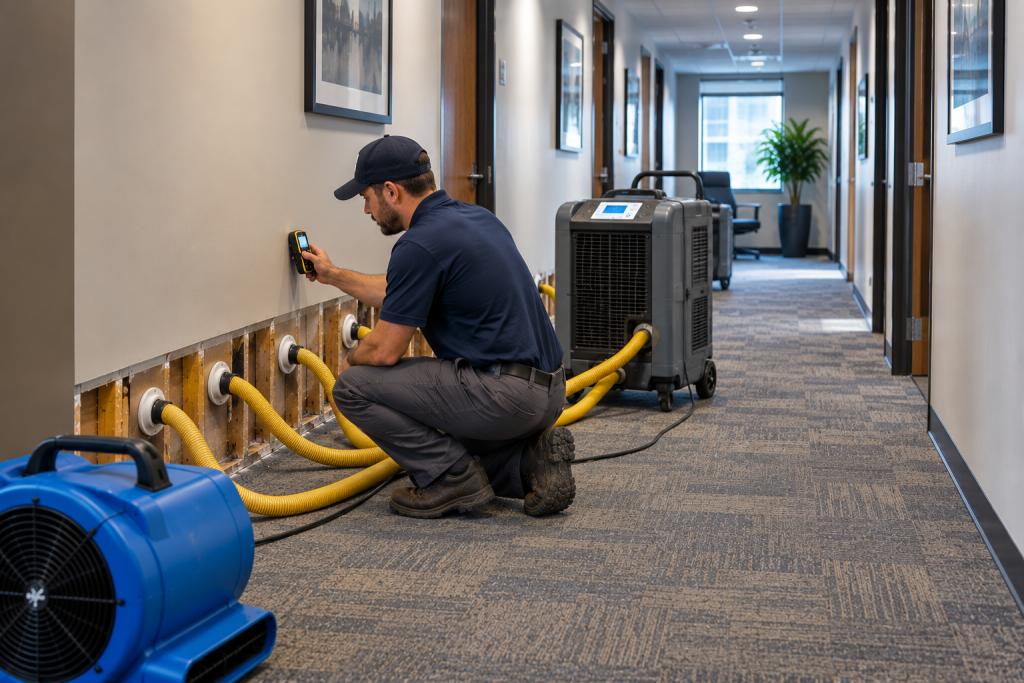
Yet walls are still closed.
Flooring remains in place.
Mechanical systems haven’t been fully evaluated.
The floor below may not have been inspected.
Building plans could be outdated.
Nobody yet knows exactly what happened inside concealed assemblies.
The restoration team therefore faces an unavoidable reality:
The moment when everyone wants the most certainty is often the moment when the least information is available.
Commercial restoration is not simply construction after damage.
It is decision-making under uncertainty.
The scope should become more precise as evidence develops.
Why the First Commercial Restoration Scope Is Rarely the Final Scope
Initial scopes serve an important purpose.
They establish what is known at that moment.
However, commercial buildings hide enormous amounts of information behind finished construction. Industrial properties add their own wrinkles to scope changes; see industrial warehouse water damage for more detail.
Walls conceal utilities.
Ceilings hide mechanical infrastructure.
Flooring covers multiple layers.
Shafts connect floors.
Equipment hides penetrations.
Exterior assemblies contain drainage paths and concealed interfaces.
Until investigation progresses, portions of the loss remain unknown.
That means an early scope may contain:
Confirmed work
- probable work
- possible work
- unknown conditions.
Treating all four categories as equally certain creates problems.
A Changing Scope Does Not Automatically Mean Someone Made a Mistake
Suppose the first inspection identifies water damage in three rooms.
Later investigation confirms moisture inside a shared wall.
The wall is opened.
Additional migration is discovered in an adjoining space.
The restoration boundary expands.
Was the first assessment wrong?
Not necessarily.
The first assessment may have accurately described what could reasonably be established with the information available at that time.
New evidence changed the understanding.
That’s fundamentally different from an error.
Commercial restoration scope should follow evidence. If the evidence changes, the scope may need to change with it.
The real question isn’t:
“Why did the scope change?”
It is:
“What new information justified the change?”
The Commercial Restoration Certainty Ladder
A useful way to manage complicated commercial losses is to classify information according to certainty.
OBSERVED
Something can be directly seen, measured or otherwise documented.
SUSPECTED
Building configuration, migration patterns or other evidence suggests an additional condition may exist.
TESTED
The suspected condition has been investigated.
CONFIRMED
Investigation establishes that the condition exists.
ACTIONED
The confirmed condition results in an appropriate restoration response.
VERIFIED
The resulting work or condition reaches the relevant project milestone.
This creates a disciplined progression:
Observed
→ Suspected
→ Tested
→ Confirmed
→ Actioned
→ Verified
Not every suspicion becomes confirmed damage.
That’s important.
Investigation should reduce uncertainty in both directions.
It can expand the scope.
It can also establish that suspected areas do not require inclusion.
Unknown Does Not Mean Damaged
Commercial restoration teams should avoid two opposite mistakes.
Mistake 1 — Assume Everything Is Fine Until Damage Is Visible
This can underestimate concealed migration.
Mistake 2 — Assume Every Concealed Area Is Damaged Because It Might Be
This can create unnecessary investigation, disruption and demolition.
A better category is:
Unknown.
Unknown means exactly that.
Evidence is not yet sufficient to establish the condition.
The appropriate next step may be investigation.
Uncertainty should trigger a question—not automatically a conclusion.
That principle protects the project from both under-scoping and over-scoping.
Commercial Buildings Are Full of Hidden Variables
Residential construction can contain concealed conditions.
Commercial properties multiply them.
A large office, hotel, hospital, warehouse or manufacturing facility may contain:
- Multiple wall assemblies
- Different generations of construction
- Tenant improvements
- Shared mechanical systems
- Electrical distribution
- Plumbing risers
- Fire-rated assemblies
- Elevator systems
- Building automation
- Exterior glazing
- Roofing interfaces
- Specialized equipment
- Raised flooring
- Ceiling plenums
- Shafts and chases
Now add decades of repairs and modifications.
The restoration team may be investigating a building whose actual configuration differs substantially from the drawings.
Uncertainty is not an exception in commercial restoration. It is part of the environment.
Hidden Commercial Water Damage Creates Expanding Boundaries
Visible water provides an initial clue.
It does not necessarily define the final damage boundary.
Imagine water appears inside an office.
Initial inspection confirms:
Room A — affected.
Evidence suggests possible migration through a shared wall.
Investigation confirms:
Room B — affected.
Water then appears to have followed a floor penetration.
Inspection below confirms:
Room C — affected.
Now the scope has expanded from one room to three.
The physical damage did not necessarily expand during the investigation.
Knowledge of the damage expanded.
That distinction is critical.
Scope Expansion and Damage Expansion Are Not the Same Thing
This is one of the most useful concepts in a complex commercial loss.
Suppose water affected ten rooms before the restoration team arrived.
Only four are initially identifiable.
Day 1 scope:
4 confirmed rooms.
Day 2 investigation:
3 additional rooms confirmed.
Day 3:
3 more confirmed.
The documented scope grew:
4 → 7 → 10.
But the damage may have remained exactly the same throughout those three days.
What changed?
The information boundary.
Therefore:
A growing restoration scope does not always mean the loss is still physically spreading. Sometimes the investigation is catching up with damage that already occurred. Warehouse restoration is one place where scope changes is tested hardest, so it helps to plan ahead.
This distinction can make project communication much clearer.
Every Commercial Loss Has an Information Boundary
We usually talk about the water boundary.
There is another boundary:
the information boundary.
Inside that boundary are conditions the team reasonably understands.
Outside it are areas where important questions remain.
As investigation progresses:
Information boundary expands
↓
Unknown areas decrease
↓
Confirmed conditions increase
↓
Scope becomes more precise.
The objective is not simply expanding the scope.
It is shrinking uncertainty.
That is the real purpose of commercial restoration investigation.
The Scope Has Three Layers
Instead of pretending the project has one perfectly known scope, consider three layers.
Layer 1 — Confirmed Scope
Work supported by current evidence.
Layer 2 — Investigative Scope
Areas or systems requiring additional evaluation.
Layer 3 — Contingent Scope
Work that may become necessary depending upon what investigation reveals.
This structure makes the project easier to explain.
For example:
Confirmed: Remove affected ceiling materials in Rooms 201–204.
Investigative: Evaluate shared wall cavity adjacent to Room 204.
Contingent: Expand removal and drying if concealed moisture is confirmed.
Now uncertainty is visible rather than hidden inside an estimate.
Scope Contingencies Are Not the Same as Scope Padding
A contingency identifies a plausible future requirement dependent upon unresolved information.
Padding simply adds unnecessary work or cost without evidence.
Those are not the same thing.
A legitimate contingent condition might be:
Additional restoration may be required if investigation confirms moisture migration beneath the flooring beyond the currently established boundary.
That statement acknowledges uncertainty.
It does not claim the additional area is damaged.
Commercial restoration planning becomes stronger when teams can say:
“We don’t know yet, and here is how we intend to find out.”
Investigation Zones Can Control Uncertainty
Instead of opening everything, divide uncertain areas into investigation zones.
Zone A — Confirmed Affected
Restoration action proceeds.
Zone B — High Suspicion
Evidence strongly supports targeted investigation.
Zone C — Adjacent / Monitoring
No confirmed damage, but conditions warrant observation or measurement.
Zone D — Cleared
Investigation does not currently support inclusion in the affected scope.
This creates a controlled investigation strategy.
The goal is to prevent two extremes:
demolish too little
and
demolish too much.
Evidence determines movement between zones.
Open the Smallest Area That Answers the Biggest Question
Destructive investigation can provide valuable information.
It also creates additional construction.
That suggests another useful principle:
Use the least disruptive investigation capable of answering the important question.
Suppose the question is whether moisture migrated into a wall cavity.
Opening an entire 40-foot wall simply to answer that question may be unnecessary.
A targeted investigation may establish whether broader access is justified.
If evidence confirms wider damage, expand appropriately.
If not, unnecessary demolition may be avoided.
This is progressive investigation.
Commercial Restoration Is a Series of Evidence Gates
Large losses can be managed through decision points.
Before advancing to the next phase, ask whether sufficient information exists.
Gate 1 — Source
Do we understand and control the active source?
Gate 2 — Boundary
Do we reasonably understand where the loss migrated?
Gate 3 — Systems
Which building systems intersected the affected area?
Gate 4 — Mitigation
What affected materials or conditions require action?
Gate 5 — Verification
Have appropriate restoration objectives been reached?
Gate 6 — Reconstruction
Is enough uncertainty resolved to permanently close assemblies?
Gate 7 — Reoccupancy
Are the necessary conditions for intended use appropriately established?
Each gate prevents one type of uncertainty from being carried unnecessarily into the next phase.
Don’t Build Over an Unanswered Question
Commercial reconstruction creates pressure.
Ownership wants visible progress.
Tenants want walls closed.
Contractors want to keep moving.
However, permanent construction can make unresolved questions dramatically more expensive.
Imagine uncertainty remains about moisture inside an assembly.
The wall is closed anyway.
Two weeks later, additional investigation becomes necessary.
Now:
New drywall
→ removed.
New paint
→ lost.
New insulation
→ disturbed.
Schedule
→ extended.
Occupants
→ disrupted again.
The unanswered question did not disappear.
It became more expensive.
Unresolved uncertainty should be addressed before reconstruction makes the answer harder to obtain.
Hidden Damage Can Change More Than Quantity
Scope changes are often imagined as:
more drywall
more flooring
more rooms.
Hidden discoveries can also change the type of project.
For example:
A simple ceiling leak may reveal involvement with electrical equipment.
Now an electrical professional may be needed.
Water near an exterior wall may reveal a building-envelope issue.
Now the source investigation changes.
Moisture in a mechanical area may create HVAC questions.
A damaged rated assembly may introduce specialized reconstruction considerations.
The scope hasn’t merely become larger.
It has become more complex.
The Scope Can Expand Upstream
Most people expect restoration scopes to expand outward from visible damage.
Sometimes they expand backward toward the source.
Imagine interior water damage appears beneath a commercial window.
Initial scope:
Repair interior finishes.
Investigation finds recurring moisture.
Further evaluation identifies a problem within the exterior assembly.
Now the project may involve:
interior restoration
- building-envelope investigation
- source correction
- exterior repair.
The restoration scope moved upstream.
This matters because repairing consequences without resolving the source can create repeated damage. A related question is how scope changes changes during emergency warehouse water extraction.
The Scope Can Expand Downstream Too
A commercial loss can create consequences beyond the originally wet materials.
Water affects electrical infrastructure.
Electrical interruption shuts down refrigeration.
Refrigeration failure affects inventory.
Now one physical event has produced several downstream scopes.
Similarly:
Water event
→ elevator interruption
→ upper-floor access problem
→ tenant disruption.
Or:
Water event
→ production equipment outage
→ manufacturing interruption
→ shipping delays.
The commercial scope therefore includes more than square footage.
It can contain operational consequences.
The Restoration Scope and the Recovery Scope Are Different
This distinction deserves its own language.
Restoration Scope
What physical work is required to address the property damage?
Recovery Scope
What must happen for the business and property to return to useful operation?
The restoration scope may include:
Drywall, flooring, drying, electrical work and reconstruction.
The recovery scope may additionally involve:
Temporary operations, alternate access, tenant relocation, equipment replacement, inspections, system testing and phased reoccupancy.
The restoration scope fixes the damage. The recovery scope restores the function.
Commercial projects benefit from understanding both.
Scope Changes Should Have an Evidence Trail
Every meaningful scope expansion should answer:
What was originally known?
What new information appeared?
What investigation followed?
What was confirmed?
How did the finding change the work?
That produces a simple chain:
Initial scope
↓
new evidence
↓
investigation
↓
confirmed condition
↓
scope revision.
This connects directly to the Commercial Restoration Evidence Chain.
A scope change without an explanation creates questions.
A scope change supported by documented evidence creates a story.
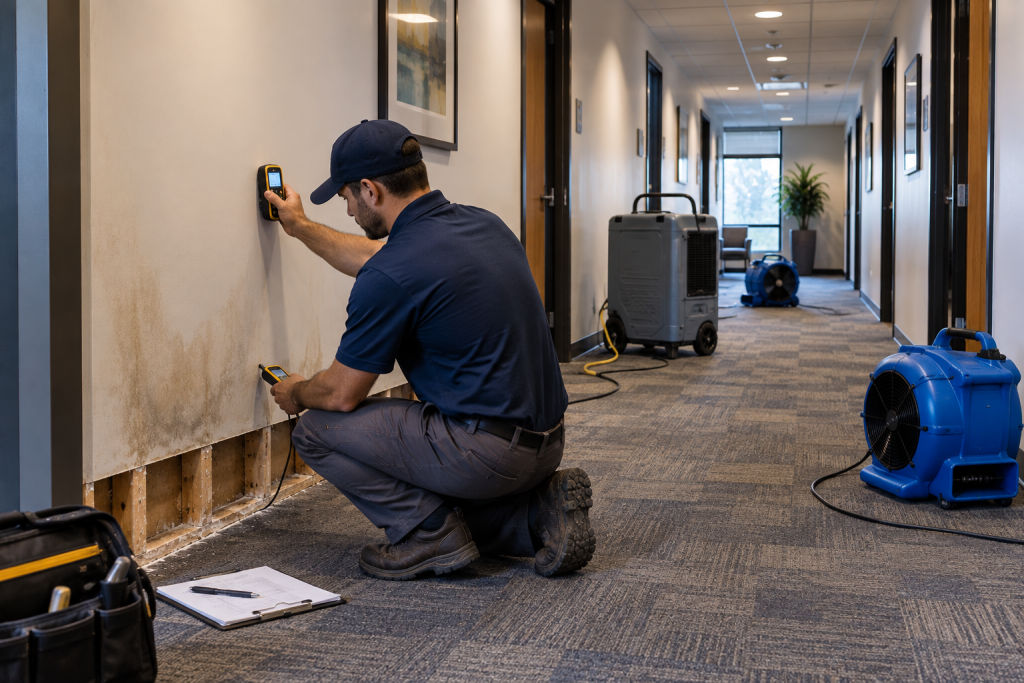
Photograph the Moment the Project Changes
Certain moments deserve especially strong documentation.
The first opening in a wall.
Discovery of concealed moisture.
Previously hidden deterioration.
Water migration beneath flooring.
Unexpected system exposure.
A previously unknown building assembly.
These discoveries may exist only briefly before restoration changes them.
Capture:
Wide context
→ where is the condition?
Medium context
→ what assembly is involved?
Detail
→ what exactly was discovered?
Then connect those photographs to the resulting decision.
Now the scope change is reconstructable later.
Time Can Reveal Conditions That Were Not Obvious Initially
Some commercial water damage becomes easier to understand as the project progresses.
Materials are exposed.
Moisture patterns become clearer.
Building systems become accessible.
Operational testing reveals failures.
That doesn’t mean every late discovery was unavoidable.
It means commercial restoration should maintain an active investigation mindset until important uncertainties are resolved.
A dangerous assumption is:
“We already scoped the project, so there cannot be anything else.”
A better position is:
“This is our current scope based on the evidence available today.”
That language leaves room for reality.
Slow Leaks Create More Uncertainty Than Obvious Events
A sprinkler discharge at 10:15 a.m. may have a relatively clear start time.
A concealed plumbing leak discovered behind a wall can be different.
When did it begin?
How frequently did it leak?
How far did moisture migrate?
Was previous damage already present?
Did materials experience repeated exposure?
Was the condition related to earlier maintenance issues?
Now the project must investigate both:
Where did the water go?
and
When did the condition develop?
The timeline itself becomes uncertain.
Pre-Loss Conditions Can Complicate Scope Decisions
Hidden investigation may reveal conditions that existed before the current loss.
Old staining.
Previous repairs.
Corrosion.
Deterioration.
Construction defects.
That creates another classification problem.
Is the condition:
NEW?
EXISTING?
AGGRAVATED?
UNDETERMINED?
Discovery does not establish causation.
Finding something during the current restoration does not automatically mean the current event created it.
This is why pre-loss building-condition documentation and restoration-under-uncertainty belong together.
Different Experts Reduce Different Types of Uncertainty
A restoration contractor cannot answer every question inside a complex commercial building.
Different uncertainties may require different expertise.
Depending upon the project:
- Electricians evaluate electrical questions.
- Mechanical professionals address HVAC issues.
- Engineers address structural or specialized technical conditions.
- Building-envelope specialists investigate certain intrusion pathways.
- Elevator professionals evaluate elevator systems.
- Environmental professionals address relevant environmental questions.
- Fire/life-safety specialists evaluate their systems.
- Other specialists may be appropriate for specialized commercial equipment.
Commercial recovery becomes stronger when uncertainty is routed to the person qualified to reduce it. Read more about how warehouse restoration works if scope changes is a concern for your property.
Uncertainty Should Have an Owner
One of the easiest ways for an unresolved question to become a delay is for nobody to own it.
For every significant unknown, identify:
Question
What don’t we know?
Impact
What could this uncertainty affect?
Owner
Who is responsible for resolving it?
Method
How will it be investigated?
Deadline
When does the answer become necessary?
Dependency
What work cannot proceed until it is resolved?
Now uncertainty becomes manageable.
Without this structure, unknowns linger until they become emergencies.
Create an Uncertainty Register
Large commercial losses can benefit from an Uncertainty Register.
For example:
U-01 — Possible Moisture Beneath Flooring
Status: Suspected
Impact: Could expand flooring restoration scope.
Next action: Targeted investigation.
Owner: Restoration team.
Decision needed before: Flooring replacement begins.
U-02 — Electrical Equipment Exposure
Status: Confirmed exposure; condition unresolved.
Impact: Could affect floor reoccupancy.
Next action: Qualified electrical evaluation.
Decision needed before: System return to normal service.
U-03 — Exterior Leak Source
Status: Undetermined.
Impact: Interior reconstruction could be vulnerable to recurring intrusion.
Next action: Building-envelope investigation.
Decision needed before: Permanent interior closure.
Now the project isn’t merely tracking work.
It is tracking what it still needs to learn.
Rank Unknowns by Consequence
Not every unanswered question deserves equal urgency.
A small uncertainty involving cosmetic trim is different from uncertainty involving critical electrical infrastructure.
A useful classification is:
Level 1 — Recovery-Critical Unknown
Could affect safety, major building systems, reoccupancy or significant business operations.
Level 2 — Scope-Critical Unknown
Could materially change restoration or reconstruction work.
Level 3 — Schedule-Critical Unknown
Could create substantial delay if not resolved early.
Level 4 — Noncritical Unknown
Needs resolution but does not currently control major recovery decisions.
This helps teams investigate intelligently rather than simply investigating everything in the order discovered.
The Cost of an Unknown Increases as the Project Advances
An unresolved question on Day 1 may cost little to investigate.
The same question after reconstruction can become expensive.
Consider:
Emergency phase
Easy access.
↓
Drying phase
Moderate access.
↓
Reconstruction phase
Access becoming restricted.
↓
Finished construction
Question now requires disturbing completed work.
This creates an uncertainty cost curve.
The longer a critical unknown survives, the more expensive it can become to answer.
Resolve high-consequence uncertainties early.
Commercial Restoration Should Reduce Uncertainty Every Day
Progress is normally measured by completed work.
Square feet demolished.
Rooms dried.
Walls reconstructed.
Equipment removed.
Another useful measurement is:
How many important unknowns did we eliminate today?
Yesterday:
18 major unknowns.
Today:
12.
Tomorrow:
8.
That is real project progress.
Because each resolved uncertainty makes future decisions easier.
This creates a new restoration metric:
Uncertainty Burn-Down.
The objective is to steadily convert:
Unknown
→ Known
→ Actionable
→ Resolved.
Scope Confidence Should Increase Over Time
Early scope:
Low information / higher uncertainty.
Mid-project scope:
More investigation / greater confidence.
Pre-reconstruction scope:
Major unknowns resolved / high confidence.
Final scope:
Work completed / conditions documented.
This progression is healthy.
A commercial restoration scope should not necessarily be judged by whether it remained unchanged. Property owners comparing options can look at warehouse drying and dehumidification to see where scope changes fits.
It should be judged partly by whether it became more accurate as evidence improved.
Don’t Promise False Precision Too Early
Everyone wants the number.
How much will it cost?
How long will it take?
How many rooms are affected?
When can we reopen?
Those are reasonable questions.
The mistake is answering with artificial certainty before the project supports it.
Instead, separate:
What is known
from
what is estimated
from
what depends upon unresolved conditions.
For example:
Current confirmed damage involves Floors 2 and 3. Additional investigation is underway around the plumbing chase and floor penetrations. The reconstruction schedule will become more precise once those areas are evaluated.
That is more useful than a precise date built upon assumptions nobody has tested.
Ranges Can Be More Intelligent Than False Exactness
Early commercial restoration planning may benefit from ranges.
Known minimum scope
probable scope
potential high-side scope if specific contingencies are confirmed.
The same approach can apply to schedules.
Best-supported current timeline
- identified dependencies
- conditions capable of extending it.
This makes uncertainty visible and manageable.
Precision should increase as information increases.
Communicate What Changed, Not Just the New Number
Suppose the estimate changes from $400,000 to $575,000.
Simply sending the new number creates an obvious question:
Why?
A stronger update explains:
Original assumption
→ affected area ended at Corridor B.
New evidence
→ moisture confirmed beneath adjoining flooring.
Investigation
→ additional rooms evaluated.
Finding
→ four additional areas confirmed affected.
Scope impact
→ flooring, drying and reconstruction quantities increased.
Now the number has context.
The same principle applies to schedule changes.
Schedule Uncertainty Should Be Documented Too
Scope isn’t the only variable.
Commercial recovery schedules change when:
- Hidden damage is discovered
- Specialty evaluations take longer
- Materials become unavailable
- Equipment requires replacement
- Inspections affect timing
- Access becomes restricted
- Tenant requirements change
- Long-lead items emerge
A schedule update should therefore answer:
What changed?
Why did it change?
Which milestone moved?
What can continue in parallel?
Can another recovery path reduce the delay?
That transforms schedule changes from surprises into managed dependencies.
Scenario Planning Makes Uncertainty Useful
Instead of waiting for an unknown to resolve, plan around possible outcomes.
Imagine an electrical component is under evaluation.
Scenario A — No Significant Repair Required
Reoccupancy sequence continues.
Scenario B — Repair Required
Add repair duration and testing.
Scenario C — Replacement Required
Long-lead procurement may control recovery.
Now the project can prepare for all three.
If Scenario C becomes reality, procurement research may already be underway.
Uncertainty doesn’t always require waiting. Sometimes it requires planning multiple paths forward.
Ask What Can Continue While We Don’t Know
An unresolved question should not freeze the entire project unless it truly controls everything.
Suppose one wall requires additional investigation.
Can drying continue elsewhere?
Can unaffected areas begin reconstruction?
Can materials be ordered?
Can temporary operations be established?
Can tenant communication advance?
Can other floors be prepared for reoccupancy?
This connects uncertainty management directly to commercial restoration sequencing.
One lane may stop.
The entire recovery does not necessarily have to stop with it.
Commercial Restoration Under Uncertainty Needs Decision Deadlines
Some questions can remain open temporarily.
Eventually, every critical uncertainty reaches a point where an answer is necessary.
Call this the decision deadline.
For example:
Replacement flooring doesn’t need to be selected during emergency extraction.
But the decision must occur before procurement would delay reconstruction.
An elevator component doesn’t need a final determination during the first hour.
Yet evaluation must happen before elevator availability becomes the reoccupancy bottleneck.
Good recovery management asks:
“When is the latest responsible moment this question can remain unanswered?”
Then work backward.
The Commercial Restoration Uncertainty Loop
Complex losses often repeat the same cycle:
OBSERVE
Something unusual appears.
↓
QUESTION
What might explain it?
↓
INVESTIGATE
Gather additional evidence.
↓
CLASSIFY
Confirmed, cleared or still uncertain?
↓
DECIDE
What action follows?
↓
DOCUMENT
Record the reasoning and result.
↓
UPDATE
Revise scope, schedule or priorities if necessary.
Then repeat.
This is the Commercial Restoration Uncertainty Loop.
A major project may move through this loop hundreds of times.
Uncertainty Is Not Failure—Unmanaged Uncertainty Is
Nobody can know everything about a concealed commercial building during the first inspection.
Pretending otherwise creates false confidence.
The goal of professional commercial restoration isn’t perfect foresight.
It is disciplined discovery.
Identify what is known.
Separate assumptions from evidence.
Record important unknowns.
Investigate according to consequence.
Assign responsibility.
Resolve critical questions before they become expensive.
Update the scope when evidence justifies it.
Document why the project changed.
Then keep moving.
The measure of a strong restoration process is not whether uncertainty existed. It is whether uncertainty was systematically converted into reliable decisions. Large warehouse water damage adds another layer to scope changes that is easy to underestimate.
The Best Final Scope May Look Very Different From the First
Imagine a major commercial water loss.
Hour 2
Three rooms visibly affected.
Day 1
Moisture mapping identifies possible migration into adjoining assemblies.
Day 2
Targeted investigation confirms two additional rooms.
Day 3
Electrical exposure requires specialty evaluation.
Day 5
Flooring investigation identifies additional migration.
Day 7
The damage boundary stabilizes.
Day 10
Major system questions are resolved.
Day 14
Reconstruction scope becomes highly defined.
The final scope is much larger and more detailed than the first.
That does not necessarily mean the project spiraled out of control.
It may mean the project moved from:
low information
to
high information.
That is exactly what investigation is supposed to accomplish.
Commercial Restoration Is the Progressive Elimination of Unknowns
At the beginning of a major property loss, uncertainty is everywhere.
Where did the water travel?
What is behind this wall?
Was the floor below affected?
Did the electrical system experience exposure?
Is the roof leak new?
Was this stain already present?
Can this equipment be repaired?
Can this tenant return?
How long will replacement materials take?
Nobody should invent answers simply because the questions are uncomfortable.
Instead:
Observe.
Map.
Investigate.
Test.
Confirm.
Document.
Decide.
Update.
Every cycle reduces uncertainty.
Eventually, the restoration team reaches a point where the building, scope, dependencies and recovery requirements are sufficiently understood to move confidently toward reconstruction and reoccupancy.
That is the real progression:
UNKNOWN
↓
SUSPECTED
↓
INVESTIGATED
↓
CONFIRMED
↓
ACTIONABLE
↓
RESOLVED
Commercial restoration under uncertainty is therefore not about eliminating every unknown on Day 1.
It is about making sure today’s unknown does not become tomorrow’s surprise.
Because the first scope describes what the team knows at the beginning.
The final scope should describe what the evidence ultimately proved.
Want a scope that's built on evidence, not guesswork?
We investigate before we finalize a number, including on warehouse water damage repair projects where the real damage boundary isn’t obvious on day one.
Related Reading
- Hidden Commercial Water Damage — why the visible damage is rarely the full damage.
- Pre-Loss Building Conditions — separating existing conditions from new findings.
- Commercial Restoration Documentation — recording each scope change as it happens.
- Commercial Restoration Sequencing — keeping a moving scope on schedule.
- The Six Recoveries After a Commercial Property Loss — how scope uncertainty affects every recovery track.
- IICRC S500 Standard for Professional Water Damage Restoration — the industry reference for restoration practice.