Commercial restoration contains an apparently simple word that becomes surprisingly complicated after a major property loss:
Restore.
Restore the flooring.
Restore the walls.
Restore the electrical system.
Restore the tenant space.
Restore the building.
But restore it to what?
A 25-year-old commercial property does not suddenly become a brand-new building because a pipe breaks.
Existing stains may already be present.
Roof leaks may have occurred years earlier.
Flooring may have been worn.
Sealants may have deteriorated.
Equipment may already have been approaching the end of its service life.
Previous repairs can exist behind walls nobody has opened in a decade.
Once significant commercial property damage occurs, all of those conditions can become mixed together with the new loss.
That creates one of the most important—and least discussed—questions in commercial restoration: For operators of big-box and industrial sites, commercial warehouse restoration shows how pre-loss conditions plays out at scale.
What condition existed immediately before the loss occurred?
The answer establishes the pre-loss building condition.
Without that baseline, restoration teams may know exactly what the property looks like after the event while remaining uncertain about what actually changed because of the event.
Every Commercial Restoration Project Needs a Baseline
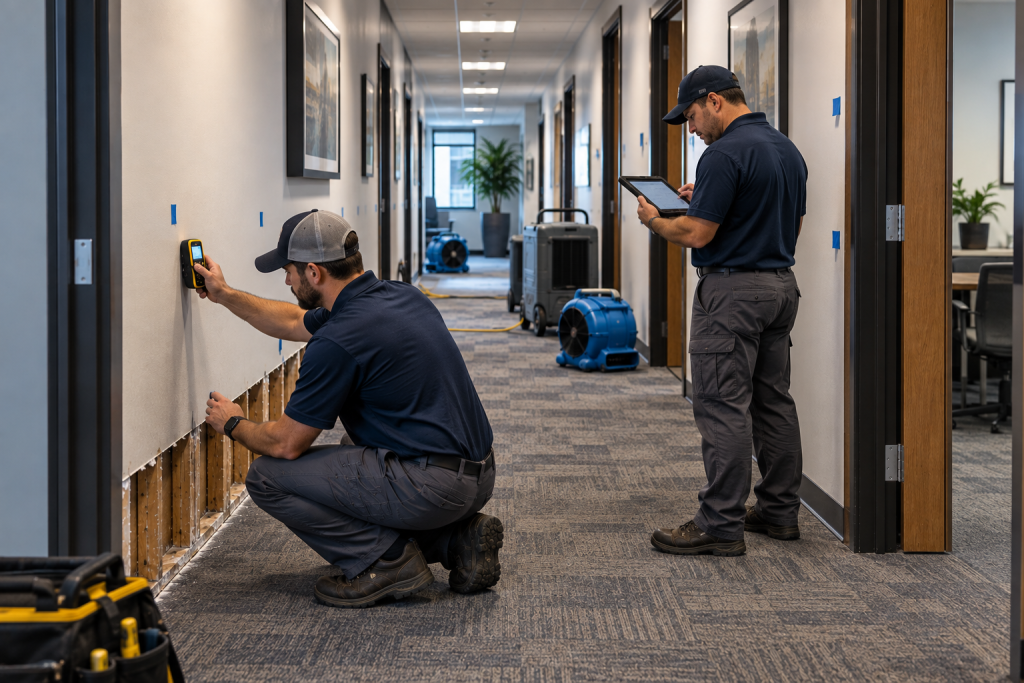
Imagine walking into a damaged commercial building several hours after a major water event.
You see:
- Stained ceiling tiles
- Damaged drywall
- Discolored flooring
- Corroded components
- Cracked finishes
- Deteriorated sealants
- Swollen materials
- Previously patched construction
- Damaged equipment
Which conditions happened today?
Which existed yesterday?
Which developed gradually over five years?
That distinction can fundamentally affect the restoration scope.
The challenge becomes greater as the building gets older.
Commercial properties accumulate history.
Construction
→ renovations
→ tenant improvements
→ maintenance
→ repairs
→ equipment replacements
→ previous leaks
→ additional renovations
→ current property loss.
The building standing today may contain decades of layered conditions.
A restoration team enters that history at one moment in time.
Pre-Loss Condition Is the Starting Line of Commercial Recovery
Most restoration discussions concentrate on the finish line.
When will reconstruction finish?
When can tenants return?
When can the business reopen?
Before defining the finish line, however, the project needs a starting point.
Think of commercial recovery as:
PRE-LOSS CONDITION
↓
DAMAGE EVENT
↓
POST-LOSS CONDITION
↓
INVESTIGATION
↓
RESTORATION
↓
RECOVERED CONDITION
The restoration process sits between two conditions.
To understand what changed, you need some understanding of both.
You cannot meaningfully define restoration without defining the condition from which the building departed.
That starting condition becomes the restoration baseline.
The Building Did Not Begin Its Life on the Day of the Loss
Commercial properties can create a strange psychological effect after damage occurs.
Suddenly, everyone looks closely.
A ceiling that nobody inspected for years receives intense attention.
Every crack gets photographed.
Every stain becomes suspicious.
Every irregularity appears potentially related to the loss.
Yet many of those conditions may have existed previously.
This doesn’t mean they should automatically be dismissed.
It means they should be investigated honestly.
A useful distinction is:
New damage
— evidence indicates it resulted from the current event.
Pre-existing condition
— evidence indicates it existed before the current event.
Aggravated condition
— an existing problem may have been affected or worsened by the current event.
Undetermined condition
— available evidence does not yet establish the relationship.
Those four categories are considerably more useful than assuming everything is either “covered by the loss” or “old damage.”
Pre-Existing Does Not Automatically Mean Irrelevant
This distinction matters.
Suppose a commercial wall assembly already had deterioration before a new water event.
The new loss then affects the same assembly.
Calling the deterioration “pre-existing” doesn’t automatically answer what should happen next.
The restoration team may still need to determine:
— What existed before?
— What changed during the current event?
— Did the new event interact with the previous condition?
— Can the assembly be appropriately restored?
— Does an existing deficiency affect the repair strategy?
Pre-loss conditions can influence the recovery even when they were not caused by the current event.
Existing conditions are part of the building that restoration inherits.
They cannot simply be erased from the analysis.
The Three Conditions That Should Not Be Confused
Commercial property restoration becomes easier to understand when three conditions remain separate.
1. Pre-Loss Condition
What existed immediately before the event.
2. Loss-Related Condition
What changed because of the event being investigated.
3. Post-Restoration Condition
What exists after restoration and reconstruction.
Those are not necessarily:
old building → damaged building → brand-new building.
The goal may be restoration of affected construction while appropriately accounting for existing conditions, current requirements, available materials and necessary repairs. Owners dealing with a flooded building can review warehouse flood cleanup and drying for a practical view of pre-loss conditions.
That is a much more realistic picture of commercial recovery.
Existing Stains Can Tell Two Completely Different Stories
Imagine water enters an office building during a plumbing failure.
Investigators find staining inside a wall cavity.
One interpretation is:
The current water event caused the staining.
Another possibility:
The staining resulted from a previous leak.
A third possibility:
The area had previous water exposure and was affected again.
Those possibilities have very different implications.
How can the project begin separating them?
Evidence.
Prior photographs.
Maintenance records.
Tenant complaints.
Previous restoration reports.
Repair invoices.
Building-envelope records.
Material condition.
Current moisture observations.
Historical leak locations.
The objective isn’t to force certainty where certainty doesn’t exist.
The objective is to distinguish evidence from assumption.
Commercial Buildings Carry Physical Memory
Buildings record their histories.
Old patches reveal previous repairs.
Different drywall can indicate earlier construction.
Sealant changes can show envelope maintenance.
Flooring transitions reveal renovations.
Corrosion may suggest long-term exposure.
Water staining can document previous intrusion.
Replacement equipment dates can establish system history.
In that sense, a commercial property contains a kind of physical memory.
Restoration investigation involves learning how to read it.
Some clues are obvious.
Others require specialized evaluation.
The key is recognizing that the condition discovered after a loss does not automatically establish when that condition developed.
Maintenance Records Can Become Restoration Evidence
Facility departments frequently possess information that becomes unexpectedly valuable after commercial property damage.
Examples include:
✓ Roof repair records
✓ Plumbing work orders
✓ Leak complaints
✓ HVAC service history
✓ Electrical repairs
✓ Elevator maintenance
✓ Window and glazing repairs
✓ Building-envelope work
✓ Previous restoration projects
✓ Flooring replacement records
✓ Tenant improvement documentation
Before a loss, these records primarily support facility management.
After a loss, they can help establish building history.
A maintenance ticket from eight months earlier stating:
“Recurring water stain at northeast conference-room window”
may become highly relevant when water appears in that same area after a storm.
Tenant Complaints Can Reveal Conditions Nobody Documented Formally
Not every building problem reaches a maintenance database.
Sometimes the people occupying the property know more than the records.
Employees may remember:
“The ceiling tile was already stained.”
A tenant might report:
“That window has leaked during heavy rain for years.”
Facilities personnel may recall:
“We repaired that pipe last winter.”
Housekeeping might know:
“That carpet discoloration was already there.”
These statements should not automatically be treated as definitive technical conclusions.
However, they can provide valuable investigative leads.
Institutional memory can help reconstruct pre-loss conditions when formal records are incomplete.
Photographs Taken Before the Loss Can Become Extremely Valuable
Modern commercial properties generate photographs constantly.
Construction photographs.
Tenant improvement photographs.
Real-estate marketing photographs.
Inspection photographs.
Maintenance photographs.
Security documentation.
Property-management records.
Previous insurance documentation.
Even ordinary photographs taken for unrelated purposes can capture useful background conditions.
Imagine a photograph taken six months before the loss clearly showing an undamaged ceiling.
That image establishes something meaningful.
Conversely, an older photograph showing the same stain discovered after the loss can prevent an incorrect assumption.
A photograph does not need to have been taken for restoration purposes to become restoration evidence. Distribution operations feel pre-loss conditions sharply, which is why water damage repair for distribution centers deserves early attention.
Video Can Preserve Even More Building History
Commercial properties increasingly generate video.
Walkthroughs.
Drone inspections.
Construction documentation.
Property marketing.
Facility surveys.
Security footage.
Roof inspections.
Tenant improvement progress videos.
These recordings can sometimes establish conditions that no written record describes.
A slow walkthrough from one year earlier may reveal:
— Existing flooring condition
— Ceiling configuration
— Wall finishes
— Equipment locations
— Storefront condition
— Previous repairs
— General condition of operating spaces
Pre-loss visual documentation can therefore become a valuable part of commercial property risk management.
Building Plans Explain What Exists. They Don’t Always Explain Its Condition.
Architectural and engineering drawings can be extremely useful during restoration.
They may identify:
- Wall assemblies
- Structural systems
- Electrical distribution
- Plumbing routes
- Mechanical systems
- Fire protection
- Building penetrations
- Equipment
- Tenant configurations
But plans have limitations.
They show what was designed.
Not necessarily what exists today.
A building may have undergone:
original construction
→ renovation
→ tenant improvement
→ repair
→ unrecorded modification.
Therefore:
Plans should inform field investigation, not replace it.
The building itself remains the final physical reality.
Tenant Improvements Can Complicate the Pre-Loss Baseline
Commercial properties evolve constantly.
A single office floor may have been renovated four times.
Walls move.
Doors change.
Glass partitions are added.
Plumbing shifts.
Electrical circuits are modified.
Ceiling systems are altered.
Mechanical distribution changes.
Different tenants install different finishes.
When property damage occurs, the affected construction may not resemble the original building drawings.
That makes tenant improvement history particularly valuable.
Understanding when a space was renovated can help identify:
✓ Material age
✓ Construction configuration
✓ Previous contractors
✓ Equipment changes
✓ Existing repairs
✓ Potential documentation sources
The TI record becomes part of the restoration record.
Previous Water Damage Changes the Investigation
A building that has never experienced water intrusion presents one type of investigation.
A building with five previous water events presents another.
Old moisture-related conditions can overlap with new ones.
Previous repairs may conceal original assemblies.
Historical staining can be mistaken for current migration.
Repeated intrusion can indicate an unresolved building problem.
That creates an important question:
Is this a new loss—or the latest chapter of an existing building problem?
Sometimes the answer is obvious.
Other times, it requires careful investigation.
Either way, prior-loss history belongs in the conversation.
Recurring Water Intrusion Is a Building Story, Not a Series of Isolated Stains
Consider a commercial storefront that leaks during wind-driven rain.
Year 1:
Interior stain appears.
Paint is repaired.
Year 2:
Another stain appears.
Sealant is added.
Year 3:
Drywall becomes damaged.
Interior finishes are replaced.
Year 4:
Another significant water event occurs.
If each event is treated independently, the building repeatedly receives cosmetic restoration.
The historical record reveals something different:
Recurring symptom
→ temporary repair
→ recurring symptom
→ additional repair
→ recurring damage.
Now the question changes from:
“How do we repair this stain?”
to:
“What persistent building condition has allowed this pattern to continue?”
Pre-loss history can transform restoration into diagnosis.
Aging Materials Should Not Be Confused With Sudden Damage
Commercial buildings contain materials at different points in their service lives.
A roof membrane may be old.
Sealants may have deteriorated.
Flooring may already be worn.
Mechanical equipment may be nearing replacement.
Exterior coatings may have weathered.
When a property loss occurs, those conditions do not disappear.
The restoration team needs to distinguish between:
age
wear
maintenance condition
and
new damage.
That distinction can become especially important when the event exposes components that were previously concealed.
Hidden Pre-Existing Conditions Can Be Discovered During Restoration
Opening a wall after water damage may reveal something unexpected.
Old staining.
Previous repairs.
Corrosion.
Abandoned utilities.
Improper modifications.
Existing deterioration.
Unrelated construction defects.
Those conditions may have been invisible before the current event.
Their discovery creates an important documentation challenge.
The record should distinguish:
“Discovered during restoration”
from
“Caused by the current loss.”
Those statements are not equivalent.
Discovery date is not necessarily damage date.
That principle can prevent significant confusion.

Commercial Restoration Can Expose Deferred Maintenance
A property loss sometimes reveals conditions the building was already carrying.
Roof problems.
Aging plumbing.
Deteriorated sealants.
Drainage issues.
Equipment corrosion.
Failed coatings.
Old repairs.
These discoveries can create tension because restoration and maintenance suddenly overlap.
A sophisticated recovery process separates the questions:
What damage resulted from the current event?
What existing condition affects the restoration?
What maintenance issue should be addressed independently?
The answers may interact.
They should not automatically be collapsed into one scope.
The Pre-Loss Baseline Should Be Evidence-Based
Nobody has a perfect photograph of every wall taken five minutes before a pipe bursts.
The baseline therefore may need to be reconstructed from multiple information sources.
Think of it as a hierarchy.
Direct Pre-Loss Evidence
Recent photographs, videos, inspections or documented conditions.
Building Records
Maintenance logs, repair histories, plans and prior project documentation.
Physical Evidence
Conditions observed during investigation.
Institutional Knowledge
Facility staff, tenants and other people familiar with the property.
Technical Interpretation
Qualified professionals evaluating the available evidence.
The more sources agree, the stronger the picture becomes.
Use a Pre-Loss Condition Matrix
Large commercial losses can benefit from organizing disputed or uncertain conditions systematically.
For example:
AREA
Conference Room 301
CURRENT CONDITION
Ceiling staining and wet drywall.
PRE-LOSS INFORMATION
No prior leak reports located.
CURRENT LOSS EVIDENCE
Active plumbing failure identified above area.
CLASSIFICATION
Likely associated with current event, subject to project findings.
Another area:
AREA
West storefront.
CURRENT CONDITION
Interior staining around window perimeter.
PRE-LOSS INFORMATION
Three previous maintenance complaints involving rain intrusion.
CURRENT LOSS EVIDENCE
Additional water entered during recent storm.
CLASSIFICATION
Existing condition with possible current-event interaction requiring further evaluation.
The point isn’t the terminology.
The value comes from making uncertainty visible instead of burying it.
The Four-Category Pre-Loss Condition Model
A useful commercial restoration framework is:
NEW
Evidence supports that the condition resulted from the current event.
EXISTING
Evidence supports that the condition existed before the event.
AGGRAVATED
An existing condition appears to have interacted with or worsened during the current event. If your facility stores inventory, restoring a warehouse after water loss explains how pre-loss conditions affects shipping schedules.
UNDETERMINED
Available information does not reasonably establish timing or relationship.
This framework creates intellectual discipline.
Not every condition needs to be forced immediately into a definitive answer.
“Undetermined” can be more accurate than an unsupported conclusion.
Documentation Should Preserve Existing Conditions Before Work Changes Them
Once restoration begins, distinguishing pre-existing and new conditions becomes harder.
Walls are opened.
Materials are removed.
Surfaces are cleaned.
Equipment moves.
Temporary repairs occur.
Therefore, initial project photography should capture not only obvious new damage but also significant surrounding conditions.
Wide photographs provide context.
Detailed photographs preserve specific conditions.
Written notes can identify apparent existing deterioration.
Maintenance personnel can point out known prior issues.
The earlier this happens, the stronger the baseline becomes.
Pre-Loss Condition Matters When the Replacement Material Is Different
Commercial buildings age.
Products disappear.
Manufacturers discontinue materials.
Codes and standards evolve.
Construction methods change.
A 20-year-old flooring product may no longer exist.
A specific ceiling system may have been discontinued.
Old glazing or mechanical components may not have direct modern equivalents.
Now “restore to pre-loss condition” becomes practically complicated.
The project may need to distinguish:
functional equivalence
from
exact material duplication.
That is another reason the original condition should be documented carefully.
The more clearly the original assembly is understood, the better replacement decisions can be evaluated.
Code and Current Requirements Can Affect Reconstruction
Restoration does not occur in a historical vacuum.
A building may have been constructed decades ago under requirements different from those applicable to current work.
Depending upon the jurisdiction, project and scope, current requirements may affect aspects of reconstruction.
That can create another distinction:
Pre-loss condition
versus
permissible or required post-loss reconstruction condition.
These questions may require architects, engineers, contractors, code professionals or authorities having jurisdiction, depending upon the circumstances.
The restoration team should avoid casually assuming:
“We just put it back exactly the way it was.”
Sometimes the recovery path is more complicated.
Pre-Loss Condition Is Different From Pre-Loss Value
Condition and value are related but not identical.
A floor can be functional but heavily worn.
A mechanical component can be operational but old.
A wall can be intact but cosmetically imperfect.
Commercial restoration documentation should describe physical conditions precisely rather than reducing everything to monetary conclusions.
That helps separate:
What existed physically?
from
What was it worth?
and
What should happen now?
Different professionals may ultimately address those questions.
Pre-Loss Conditions Can Change the Restoration Sequence
Imagine demolition reveals significant unrelated deterioration behind a wall.
Reconstruction cannot simply proceed as though it wasn’t discovered.
The project may require:
Current loss work
→ existing condition identified
→ condition evaluated
→ responsibility/scope clarified
→ appropriate corrective work
→ reconstruction continues.
Now a pre-existing condition has become a recovery dependency.
It may not have caused the current loss.
Yet it can still affect the schedule.
This is why existing conditions should be identified quickly rather than becoming surprises at the end of reconstruction. Teams in Las Vegas and the Bay Area can find warehouse water damage restoration services that accounts for pre-loss conditions from day one.
Existing Conditions Can Become Restoration Choke Points
Suppose water damages an electrical room.
During evaluation, previously deteriorated components are discovered.
The new water event creates one problem.
The existing equipment condition creates another.
If the system is required for building operation, both issues can influence reopening.
The same can happen with:
- Roof assemblies
- Plumbing
- HVAC
- Elevators
- Fire/life-safety systems
- Building controls
- Exterior envelopes
- Structural components
A pre-existing problem can become an operational choke point once restoration depends upon that system.
The Facility Manager May Know More Than the First Inspection Reveals
Commercial restoration teams should involve people who understand the property.
A facility manager may know:
“That valve has leaked twice.”
“The south roof was replaced three years ago.”
“Those ceiling tiles were stained before this event.”
“That air handler was already scheduled for replacement.”
“We had a storefront leak in that exact location last winter.”
This information can dramatically improve early investigation.
Institutional building knowledge is evidence worth collecting.
The facility team shouldn’t merely receive restoration updates.
They can help establish the starting condition.
Pre-Loss Condition Documentation Should Become Part of Facility Management
Why wait for the disaster?
Commercial property owners can establish baseline documentation before a major loss ever occurs.
This doesn’t require photographing every square inch every week.
Focus on high-value information.
Critical Building Systems
Electrical rooms, mechanical equipment, plumbing infrastructure, fire/life-safety systems, elevators and controls.
Building Envelope
Roofing, windows, storefronts, curtain walls, doors and known leak areas.
Major Interior Areas
Representative photographs of tenant spaces, corridors, common areas and major finishes.
Equipment
Important commercial or production equipment.
Existing Deficiencies
Known leaks, repairs, deteriorated areas and scheduled replacements.
Renovations
Document significant tenant improvements and construction changes.
The result becomes a pre-loss building condition record.
A Pre-Loss Restoration Readiness Assessment
This concept can go further.
Instead of documenting the building only after damage, commercial properties can periodically evaluate how prepared they are for a major restoration event.
A Pre-Loss Restoration Readiness Assessment could document:
✓ Critical building systems
✓ Operational choke points
✓ Single points of failure
✓ Shutoff locations
✓ Utility dependencies
✓ Current building condition
✓ Existing leaks or deterioration
✓ Emergency access
✓ Building plans
✓ Key vendors
✓ Long-lead equipment
✓ Replacement constraints
✓ Alternative operating areas
✓ Current property photographs
✓ Recent tenant improvements
✓ Facility contacts
Now the property has more than a condition baseline.
It has a recovery baseline.
Imagine Having the Restoration File Before the Loss Happens
Most commercial restoration files begin after something goes wrong.
Consider reversing that.
Before the loss, the property already has:
Current building photographs
Critical-system documentation
Floor plans
Utility information
Emergency contacts
Equipment inventories
Maintenance history
Known building deficiencies
Choke-point mapping
Operational dependency mapping
Temporary-operation alternatives
Then the loss occurs.
Instead of spending the first day discovering how the property works, the recovery team begins with institutional knowledge.
That could dramatically improve decision-making during the most chaotic portion of the event.
The Building’s History Should Travel With the Building
Commercial property personnel change.
A facility engineer retires.
Property management changes companies.
Ownership sells.
Tenants leave.
Contractors disappear.
Much of the building’s institutional knowledge can disappear with them.
A structured building-condition record preserves that history.
2023 — roof repair
2024 — west storefront leak investigated
2025 — fourth-floor tenant improvement
2026 — mechanical equipment replaced
2027 — commercial water loss
Now the restoration team doesn’t have to reconstruct the building’s entire history from memory. Industrial properties add their own wrinkles to pre-loss conditions; see industrial warehouse water damage for more detail.
The property carries its own record forward.
Pre-Loss Intelligence Can Reduce Post-Loss Uncertainty
Commercial restoration begins with uncertainty.
What happened?
What was affected?
What existed previously?
Which systems matter?
What must operate first?
Where are the choke points?
The more information that exists before the loss, the fewer questions must be answered during the emergency.
That creates a powerful relationship:
Better pre-loss intelligence
↓
faster post-loss understanding
↓
better restoration decisions
↓
fewer unnecessary delays
↓
faster operational recovery.
Pre-loss documentation therefore isn’t merely defensive recordkeeping.
It can become a recovery acceleration tool.
Establish the Baseline Before Defining the Destination
Commercial restoration should not begin with the assumption that every condition discovered after a loss was created by that loss.
Nor should every unusual condition automatically be dismissed as pre-existing.
The correct approach is investigation.
What do we know?
What records exist?
What does the building history show?
What changed?
What evidence supports that conclusion?
What remains uncertain?
Then establish the best-supported baseline possible.
Because the purpose of commercial restoration is not to rewrite the building’s history.
It is to understand the point at which the new loss entered that history—and determine what changed afterward.
You Cannot Restore What You Have Never Defined
Every commercial property arrives at a loss with a history.
Some of that history is obvious.
Much of it is hidden.
Previous repairs sit behind walls.
Maintenance records live in databases.
Old photographs sit on servers.
Facility managers carry years of knowledge.
Tenant improvements have altered original construction.
Building systems have aged.
Materials have worn.
Then one day, something happens.
A pipe fails.
A roof leaks.
A sprinkler activates.
A storm enters the building.
Suddenly, yesterday’s condition becomes extremely important.
That is the fundamental purpose of establishing pre-loss building conditions.
Define what existed.
Separate new conditions from old ones where the evidence allows.
Document uncertainty where it does not.
Understand how existing conditions affect the current recovery.
Preserve the evidence before restoration changes it.
Better yet, establish the building’s condition before the loss ever occurs.
Because commercial restoration ultimately asks:
“What are we restoring this property from—and what are we restoring it back to?”
Without a baseline, that question becomes surprisingly difficult.
With one, the entire recovery becomes easier to understand.
Before you can prove what changed, you need to know what was already there.
Not sure what's new damage and what predates the loss?
We establish a documented baseline before we scope repairs, including on warehouse water damage repair projects with a long maintenance history.
Related Reading
- Commercial Restoration Documentation — recording evidence as the work happens.
- Hidden Commercial Water Damage — separating new findings from existing conditions.
- Insurance Process — how a documented baseline supports a claim.
- Facility Manager Guide — the records worth keeping before a loss ever happens.
- Property Manager Water Damage — coordinating records across a multi-tenant property.
- IICRC S500 Standard for Professional Water Damage Restoration — the industry reference for restoration practice.