A commercial restoration contractor can perform excellent work and still leave behind a serious problem.
What if nobody can prove exactly what was done?
Months after a major commercial water loss, the building may look completely normal. Walls have been reconstructed. Flooring has been replaced. Tenants are back. Drying equipment disappeared long ago.
Then someone asks:
How wet was this area originally?
Why was that wall removed?
When did drying objectives get reached?
Was the room below affected?
Which equipment was operating on Tuesday?
Why did the restoration scope expand?
What condition existed before reconstruction covered everything?
Suddenly, the physical evidence is gone.
The project record becomes the evidence.
That is why commercial restoration documentation should never be viewed as paperwork performed after the important work is finished. Read more about how warehouse restoration works if restoration documentation is a concern for your property.
Documentation is part of the restoration itself.
A sophisticated commercial recovery operation actually produces two products:
Product 1 — The restored property
Product 2 — The defensible record of how the property was restored
Both matter.
The Building Eventually Stops Telling the Story
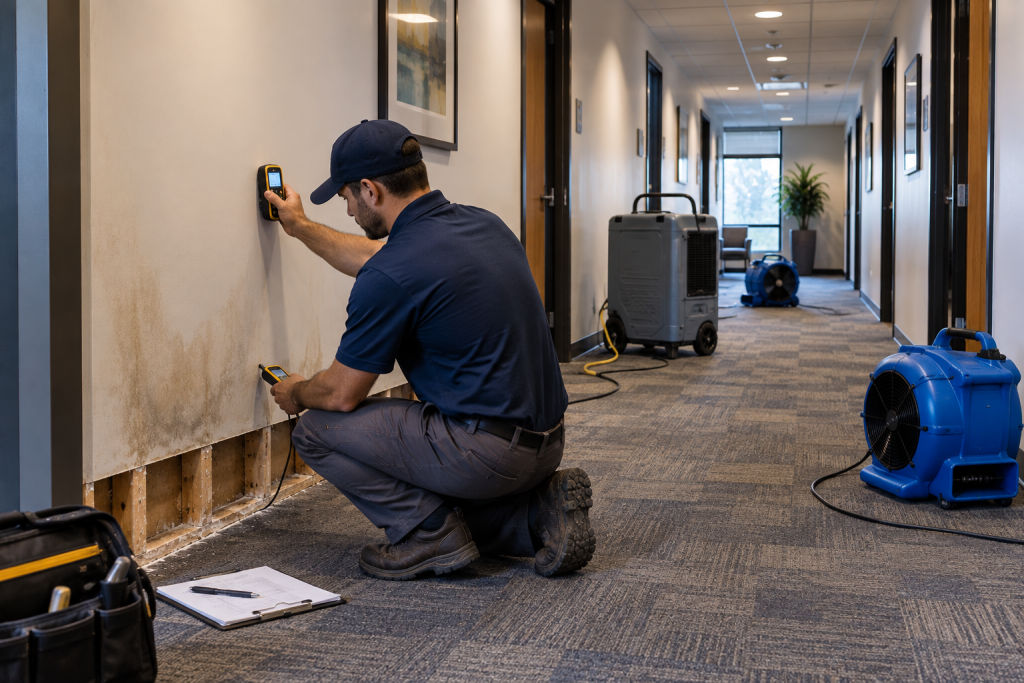
During the first hours after commercial water damage, evidence is everywhere.
Water is standing on the floor.
Ceiling tiles are saturated.
Drywall is visibly affected.
Furniture has been moved.
Equipment is operating.
Crews are removing materials.
Anyone walking through the property can see that something significant happened.
Then restoration begins doing exactly what it is supposed to do:
It removes the evidence.
Water gets extracted.
Wet materials are removed.
Surfaces dry.
Damaged construction disappears.
New materials cover previously exposed assemblies.
Equipment leaves.
Eventually, the property looks normal again.
That’s success from a restoration perspective.
From a documentation perspective, however, something important has happened:
The building can no longer independently show what the restoration team originally encountered.
Photographs, measurements, logs, diagrams, notes and records now have to tell that story.
Commercial Restoration Produces Two Deliverables
Most people think the contractor‘s deliverable is obvious:
Fix the building.
Commercial losses create another deliverable.
Explain the recovery.
A complete project record should help another person understand:
— What happened?
— Where did it happen?
— What was affected?
— What was investigated?
— What actions were taken?
— Why were those actions appropriate?
— How did conditions change?
— What additional damage was discovered?
— When were important milestones reached?
— What remained unresolved?
— How did reconstruction progress?
The physical restoration answers:
What does the property look like now?
Documentation answers:
How did we get from the loss to here?
Photographs Are Evidence, Not Decoration
Taking photographs sounds simple.
Useful restoration photography is more deliberate.
A random collection of 800 images can sometimes communicate less than 80 organized photographs showing the progression of the loss.
Strong commercial restoration photography should create context.
Establishing Photographs
Show the affected area in relation to the building.
Damage Photographs
Capture visible conditions before they disappear.
Detail Photographs
Document specific materials, equipment or unusual conditions.
Investigation Photographs
Show what was discovered when concealed areas were evaluated.
Progress Photographs
Establish how conditions changed during restoration.
Reconstruction Photographs
Capture important conditions before assemblies are permanently closed.
Completion Photographs
Document the restored property.
Together, those photographs create a timeline.
The goal isn’t to prove that somebody owned a camera.
The objective is to make the project understandable to someone who never entered the building.
Context Makes a Commercial Restoration Photograph Valuable
Imagine receiving a close-up photograph of wet drywall.
Where is it?
Which floor?
Which wall?
What room?
How large is the affected area?
What is above it?
What is below it?
Without context, the photograph proves very little.
A better documentation sequence might be:
Building exterior
→ establishes property.
Floor or corridor
→ establishes location.
Room overview
→ establishes affected area.
Wall overview
→ establishes orientation.
Close-up
→ establishes specific condition.
Now the person reviewing the project can mentally reconstruct the scene.
Good restoration photography moves from context to detail.
That simple discipline can dramatically improve the evidentiary quality of a commercial restoration record.
Photograph It Before You Remove It
Demolition changes evidence permanently.
Once damaged drywall enters a dumpster, nobody can inspect how it originally looked.
When flooring is removed, the previous condition disappears.
Opening a wall changes the assembly.
Moving equipment changes the scene.
Cleaning removes residue.
Drying changes moisture conditions.
Therefore, an extremely useful documentation rule is:
Capture the condition before the action changes the condition.
Before removal.
Before cleaning.
Before relocation.
Before drying substantially alters the evidence.
Before closing walls.
Before replacing finishes.
The photograph taken afterward may show excellent workmanship.
It cannot recreate what existed beforehand.
Commercial Moisture Documentation Should Tell a Story Over Time
A single moisture reading is a moment.
Commercial drying is a process.
That means the value of moisture documentation increases when readings can be compared over time. Property owners comparing options can look at warehouse drying and dehumidification to see where restoration documentation fits.
Think:
Initial condition
↓
Day 1
↓
Day 2
↓
Day 3
↓
Drying objective
↓
Final documented condition
Now the record shows progression.
Instead of simply stating:
“The wall was dried.”
the documentation demonstrates how conditions changed during the drying process.
That distinction matters.
Conclusion tells someone what happened.
Data helps show why the conclusion was reached.
Location Matters as Much as the Reading
A number without a location has limited value.
Imagine a project record containing:
17
21
14
What was measured?
Where?
On what material?
When?
Under what project identifier?
Useful commercial restoration documentation connects information to the physical property.
For example:
Floor
→ Suite
→ Room
→ Wall or assembly
→ Material
→ measurement location
→ date/time
→ recorded condition
Now the information can be revisited later.
This becomes increasingly important as commercial projects grow from five rooms to fifty rooms—or five floors.

Moisture Maps Turn Thousands of Measurements Into Intelligence
Large commercial losses can generate enormous amounts of data.
Raw data quickly becomes difficult to interpret.
Mapping solves part of that problem.
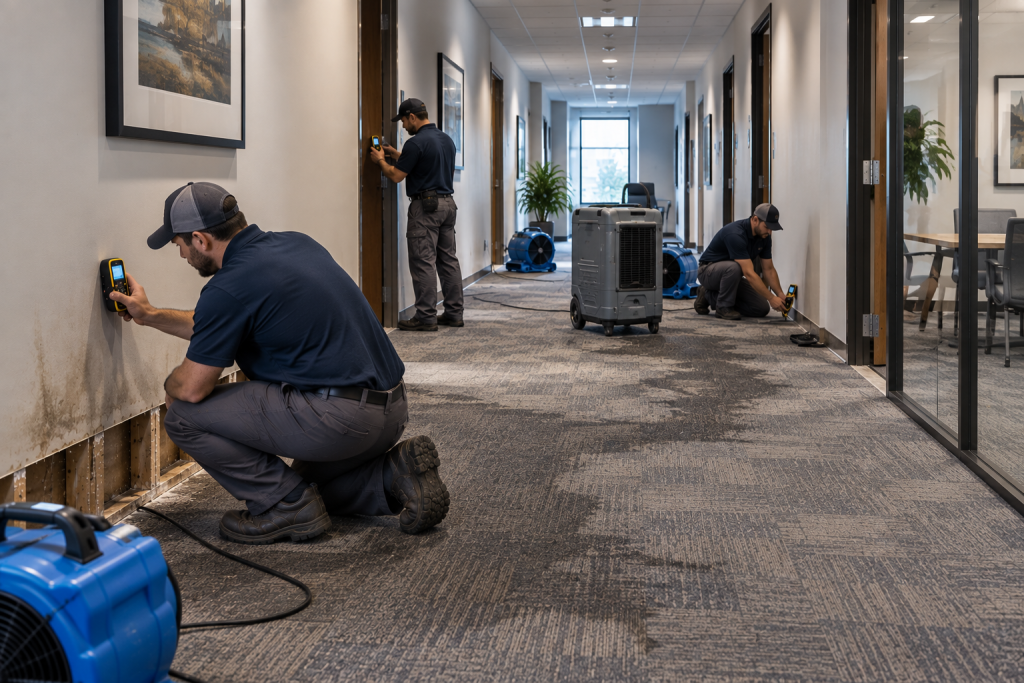
A commercial moisture map can show:
✓ Source location
✓ Initially affected areas
✓ Confirmed moisture boundaries
✓ Areas investigated
✓ Vertical migration
✓ Areas removed
✓ Drying zones
✓ Monitoring locations
✓ Areas reaching objectives
✓ Newly discovered conditions
Instead of looking through hundreds of disconnected readings, the team can see how the loss evolved spatially.
Data tells you individual conditions. Mapping reveals the pattern.
Document the Source, Not Just the Damage
Restoration records naturally concentrate on affected materials.
However, understanding the source can be equally important.
Was there:
— A failed supply line?
— Roof intrusion?
— Sprinkler discharge?
— Drainage failure?
— Plumbing backup?
— Mechanical failure?
— Exterior-envelope intrusion?
— Unknown origin requiring further investigation?
The record should distinguish between what is confirmed and what is merely suspected.
That distinction protects the integrity of the project documentation.
Don’t turn assumptions into facts.
A useful structure is:
Observed condition
→ suspected explanation
→ investigation
→ confirmed finding
→ corrective action.
Document What You Know—and What You Don’t Know Yet
Commercial restoration occurs under uncertainty.
During the first day, the team may not know the full damage boundary.
That’s normal.
Poor documentation sometimes hides uncertainty.
Good documentation records it.
For example:
Confirmed: Visible water damage in Suites 201 and 203.
Suspected: Possible migration into shared wall cavity.
Action: Additional evaluation planned.
Finding: Moisture confirmed within lower portion of shared assembly.
Response: Restoration boundary expanded accordingly.
This creates a transparent decision trail.
Professional documentation doesn’t require pretending you knew everything from the beginning.
It should demonstrate how new information changed the understanding of the loss.
Scope Changes Need a Reason
Large commercial restoration scopes evolve.
Hidden damage appears.
Additional areas are discovered.
Building systems require attention.
Previously concealed construction becomes accessible.
One material behaves differently than expected.
That doesn’t automatically mean the original assessment was poor.
Commercial losses are dynamic.
The important issue is whether the expanding scope can be explained.
A strong record shows:
Original condition
↓
new evidence
↓
investigation
↓
new finding
↓
scope change.
Now expansion isn’t arbitrary.
It is evidence-driven.
“Why Did You Remove This?” Should Have an Answer
Months later, someone reviewing the project may question why a particular material was removed. Large warehouse water damage adds another layer to restoration documentation that is easy to underestimate.
The person asking may never have visited the property.
Documentation should make the decision understandable.
Useful supporting information can include:
- Photographs
- Material condition
- Moisture information
- Contamination considerations where relevant
- Accessibility issues
- Assembly configuration
- Damage extent
- Applicable project criteria
- Professional recommendations
The objective isn’t to bury the project in unnecessary paperwork.
It is to connect:
Condition → reasoning → action.
When those three elements remain connected, the restoration record becomes much stronger.
Daily Logs Are the Memory of a Large Commercial Loss
Commercial restoration projects move quickly.
Ten contractors may be working simultaneously.
Equipment moves.
Areas open.
Areas close.
New conditions are discovered.
Decisions are made in hallways and on phone calls.
Three months later, memory becomes unreliable.
Daily logs preserve the sequence.
A useful commercial restoration daily record may capture:
✓ Date and project phase
✓ Areas worked
✓ Significant observations
✓ Crew activity
✓ Equipment changes
✓ New discoveries
✓ Important decisions
✓ Access limitations
✓ Delays
✓ Specialty contractors involved
✓ Upcoming dependencies
The goal isn’t to write a novel every evening.
The goal is to preserve the events that could matter later.
Equipment Logs Should Explain More Than Equipment Counts
Imagine documentation simply says:
42 air movers.
That tells us very little.
Where were they?
For how long?
Which drying zones did they serve?
When were units added?
When were they removed?
Why did the equipment configuration change?
Commercial drying equipment documentation becomes more useful when tied to:
location
- time
- purpose
- changing conditions.
Now equipment records support the larger restoration story instead of existing as isolated inventory counts.
Document the Building Before the Restoration Changes It
Pre-work conditions matter enormously.
A commercial property may already contain:
- Existing stains
- Damaged flooring
- Previous repairs
- Deteriorated finishes
- Old ceiling damage
- Cracked materials
- Corrosion
- Unrelated construction defects
- Previously damaged equipment
Once restoration begins, distinguishing old conditions from new conditions can become difficult.
Initial documentation therefore serves another important purpose:
establishing the observed pre-restoration condition.
This doesn’t necessarily determine cause or responsibility.
It creates a record of what existed when the restoration team arrived.
Pre-Loss Documentation Is Even More Powerful
The strongest evidence of a building’s condition before a loss is often information created before the loss happened.
Facility photographs.
Maintenance records.
Renovation documentation.
Equipment records.
Building plans.
Inspection reports.
Prior repair records.
Asset inventories.
These records can become extraordinarily useful after significant property damage.
That creates an overlooked commercial risk-management opportunity:
Document important building systems before you ever need restoration.
A pre-loss building record can make post-loss decisions faster and reduce uncertainty.
Documentation Helps Different Teams Speak the Same Language
A commercial property loss can involve many parties.
Ownership sees the investment.
Facility management sees the building systems.
Operations sees business interruption.
Contractors see construction.
Restoration professionals see affected materials.
Specialty trades see individual systems.
Insurance professionals see documentation and financial exposure.
Those perspectives aren’t identical.
A strong project record creates a common factual foundation.
Everyone can reference:
the same photographs
the same locations
the same timeline
the same findings
the same project milestones.
Documentation therefore becomes a form of coordination infrastructure.
Documentation Can Reduce Decision Dead Time
Consider a decision-maker located 2,000 miles away.
They need to understand a newly discovered condition before determining the next step.
Without organized documentation:
Someone schedules a site visit.
The project waits.
Additional questions emerge.
Another visit occurs.
Days disappear.
With organized photographs, measurements, drawings and explanations, some decisions may be made much faster.
This creates an important commercial recovery principle:
Better information can reduce waiting.
Documentation therefore isn’t merely retrospective.
It can actively accelerate the restoration project.
Capture the Decision, Not Just the Condition
Many restoration records document what crews saw.
Fewer document what happened because of it.
Imagine moisture is discovered in an adjacent room.
Photographing the condition is useful.
The more complete record is:
Finding
→ moisture discovered beyond original boundary.
Decision
→ adjacent assembly will be investigated.
Action
→ targeted access performed.
Result
→ additional affected material confirmed.
Project change
→ drying zone expanded.
That is a complete recovery sequence.
It shows how evidence influenced action.
Commercial Restoration Documentation Should Have a Timeline
Large losses become confusing when records are organized only by file type.
One folder contains photographs.
Another contains readings.
Another contains emails.
Another contains invoices.
Another contains daily logs.
The individual records exist, but reconstructing the event becomes difficult.
A timeline creates coherence.
Day 0
Loss discovered and emergency response initiated.
Day 1
Source controlled, affected areas mapped and stabilization underway.
Day 2
Additional concealed conditions investigated.
Day 3
Restoration boundary adjusted and drying strategy modified.
Day 5
Specified areas reach drying objectives.
Day 7
Reconstruction begins in released areas.
Day 12
Partial occupancy restored.
Day 30
Remaining reconstruction completed.
Now hundreds of individual records fit into a story.
Before-and-After Is Not Enough
Restoration marketing loves before-and-after photographs.
Commercial documentation needs the middle.
Before
shows damage.
After
shows completion.
Neither explains the process.
The critical evidence often exists between those images:
Before
↓
investigation
↓
exposure
↓
↓
drying
↓
verification
↓
reconstruction
↓
After.
The middle explains why the finished property can be trusted.
Hidden Conditions Should Be Documented Before They Become Hidden Again
Commercial reconstruction eventually closes walls, ceilings, floors and assemblies.
Once that happens, important work disappears from view.
This creates a valuable documentation window.
Before closure, consider documenting relevant:
- Repairs
- Replacement components
- Utility work
- Framing
- Insulation
- Fire-rated construction
- Mechanical work
- Electrical work
- Plumbing work
- Waterproofing
- Exterior-envelope repairs
The exact needs depend on the project.
The principle is simple:
If important work is about to become permanently concealed, document it while it can still be seen.
Documentation Should Separate Fact From Interpretation
Commercial restoration records become stronger when they clearly distinguish between:
Observation
What was directly seen or measured.
Interpretation
What those observations may indicate.
Recommendation
What action is proposed.
Decision
What was ultimately authorized or selected.
For example:
Observation: Staining visible beneath window opening after rainfall.
Interpretation: Exterior water intrusion is suspected.
Recommendation: Evaluate exterior glazing and adjacent envelope conditions.
That’s considerably more defensible than immediately recording:
“Window failed.”
Precision builds credibility.
Consistent Naming Prevents Documentation Chaos
Commercial properties can contain hundreds of rooms.
Different people may call the same area different things.
“East conference room.”
“Large conference room.”
“Room 305.”
“Johnson conference room.”
Now photographs and readings become difficult to match.
A simple location hierarchy helps:
Building
→ Floor
→ Suite
→ Room
→ Wall / Area / Assembly.
Consistent naming turns thousands of records into searchable information.
On a large loss, this small administrative discipline can produce enormous practical value. For operators of big-box and industrial sites, commercial warehouse restoration shows how restoration documentation plays out at scale.
A Commercial Restoration Project Should Be Reconstructable From Its Records
Imagine the entire restoration team disappears five years after the project.
A new facility manager opens the project archive.
Could that person understand what happened?
They should be able to determine:
✓ Where the loss originated
✓ Which areas were affected
✓ How the damage boundary developed
✓ What major actions occurred
✓ Which systems were involved
✓ What materials were removed
✓ How drying progressed
✓ What hidden conditions were discovered
✓ What was reconstructed
✓ When areas returned to service
That is a useful test of documentation quality.
The record should allow someone who wasn’t there to reconstruct the recovery intellectually.
Documentation Becomes More Important as the Loss Gets Larger
Small projects can survive informal communication.
Large projects cannot.
Imagine:
2 rooms
versus
200 rooms.
Or:
1 contractor
versus
15 contractors.
Or:
3 days
versus
6 months.
As project complexity increases, memory becomes less useful and structured information becomes more valuable.
Commercial restoration documentation therefore scales with complexity.
Large-loss restoration is partly a construction-management problem.
It is also an information-management problem.
Information Has a Half-Life During Commercial Restoration
This is one of the least appreciated realities of a loss.
Some information becomes harder to obtain every day.
Standing water disappears.
Materials are removed.
Equipment moves.
Employees forget details.
Temporary conditions change.
Walls are closed.
Contractors leave.
Therefore, certain evidence has a limited collection window.
Today: easily documented.
Next week: difficult to reconstruct.
Six months later: possibly impossible.
That means documentation priority should partly depend upon how quickly the evidence will disappear.
Capture the temporary condition while it still exists.
The Documentation Gap Can Become a Recovery Gap
Poor records don’t necessarily mean poor restoration work occurred.
They mean proving the work becomes harder.
That can create questions.
Questions create requests.
Requests create research.
Research creates meetings.
Meetings create delays.
Suddenly, a documentation problem becomes a project-management problem.
This produces another commercial restoration chain:
Missing information
→ uncertainty
→ additional questions
→ delayed decisions
→ dead time
→ extended recovery.
Good documentation helps interrupt that chain.
What Should a Commercial Restoration Documentation Package Include?
Every project differs, but a substantial commercial loss may generate records across several categories.
Loss Documentation
- Initial conditions
- Source information
- Affected areas
- Building context
- Existing conditions
Investigation Documentation
- Moisture mapping
- Concealed-condition findings
- Material observations
- Building-system concerns
- Specialty evaluations
Restoration Documentation
- Work performed
- Equipment
- Drying progress
- Material removal
- Cleaning or mitigation activities
- Daily project records
Decision Documentation
- Scope changes
- Important communications
- Recommendations
- Authorizations
- Identified constraints
Reconstruction Documentation
- Repairs
- Replacement materials
- Concealed work
- Progress
- Completion conditions
Recovery Documentation
- Area release
- Partial occupancy milestones
- System restoration
- Reoccupancy progress
- Final completion
Together, these records form the commercial restoration evidence chain.
The Commercial Restoration Evidence Chain
A useful way to structure documentation is:
CONDITION
What existed?
↓
EVIDENCE
How do we know?
↓
INTERPRETATION
What does the evidence indicate?
↓
DECISION
What action was selected?
↓
WORK
What was performed?
↓
VERIFICATION
What established the next milestone?
↓
RESULT
What condition existed afterward?
That chain can be repeated hundreds of times during a major commercial restoration.
When each link remains intact, the project becomes much easier to understand.
When links are missing, questions multiply.
Documentation Is Quality Control
Project records aren’t useful only after the restoration.
They can improve work while it is happening.
Maps reveal missed areas.
Photographs expose inconsistencies.
Daily logs identify stalled dependencies.
Moisture records show whether conditions are progressing.
Schedules expose handoff delays.
Equipment logs help teams understand changing drying strategies.
Completion documentation identifies unfinished items.
In this sense, documentation acts like a feedback system.
Record
→ review
→ identify
→ correct
→ verify.
That turns documentation into an active quality-control tool rather than passive paperwork. Owners dealing with a flooded building can review warehouse flood cleanup and drying for a practical view of restoration documentation.
The Best Documentation Is Created in Real Time
Trying to recreate a project record weeks later is fundamentally weaker than documenting events as they occur.
Memory fades.
Conditions change.
Details disappear.
A better approach is continuous:
See it → record it.
Measure it → locate it.
Discover it → photograph it.
Change the scope → explain why.
Complete the work → document the result.
This creates contemporaneous records instead of reconstructed memories.
Don’t Document Everything Equally
More documentation isn’t automatically better documentation.
Ten thousand random photographs can create noise.
Hundreds of repetitive notes can bury important decisions.
The objective is decision-quality evidence.
Prioritize information that answers:
✓ What was damaged?
✓ Where was it?
✓ How extensive was it?
✓ What changed?
✓ Why did the scope change?
✓ What work became concealed?
✓ What controlled an important decision?
✓ What delayed the project?
✓ What established completion?
Documentation should reduce uncertainty—not create an enormous digital pile that nobody can interpret.
The Final Commercial Restoration Report Should Tell the Recovery Story
A useful final record shouldn’t merely dump files into folders.
It should explain the project.
A logical summary might include:
Loss event
→ what happened.
Initial conditions
→ what was observed.
Damage extent
→ what investigation established.
Restoration strategy
→ how the loss was approached.
Major discoveries
→ what changed during the project.
Recovery milestones
→ how areas progressed.
Reconstruction
→ what was restored.
Operational recovery
→ when important portions returned to use.
Final condition
→ where the project ended.
That transforms project records into institutional knowledge.
The Evidence May Outlive the Restoration Company
Commercial buildings can remain in service for decades.
Ownership changes.
Property managers change.
Facility personnel retire.
Contractors disappear.
Years later, somebody may open a wall and ask:
Why was this assembly rebuilt?
Another water event may occur in the same area.
A future buyer may review property records.
Management may investigate recurring building-envelope problems.
Previous restoration documentation can suddenly become valuable again.
The project archive becomes part of the building’s history.
Commercial Restoration Documentation Is the Second Product
The physical property is always the primary focus.
Stop the damage.
Investigate the loss.
Dry affected materials.
Restore building systems.
Reconstruct the property.
Return operations.
But every one of those actions produces information.
If that information is organized properly, it creates something almost as important as the repaired building:
a defensible history of the recovery.
Months later, the water is gone.
Years later, the drywall looks ordinary.
Eventually, nobody remembers where the drying equipment stood or why a particular wall was opened. Distribution operations feel restoration documentation sharply, which is why water damage repair for distribution centers deserves early attention.
The evidence has disappeared.
Except for the record.
That is why commercial restoration documentation should answer more than:
“What did we do?”
It should answer:
“What conditions did we encounter, what evidence did we collect, why did we make each important decision, what work followed, and what demonstrated the result?”
When those questions can be answered clearly, the restoration project has produced both of its essential deliverables.
The building has been restored.
And:
The recovery can be proven.
Need a restoration record that holds up months later?
We document findings, decisions, and results as we go — the same standard we apply to warehouse water damage repair claims involving high-value inventory.
Related Reading
- Hidden Commercial Water Damage — investigation findings worth documenting.
- Insurance Process — how documentation supports a commercial claim.
- Commercial Restoration Sequencing — records that keep pace with a moving schedule.
- Moisture Mapping Services — turning readings into an evidence-based map.
- Facility Manager Guide — pre-loss records worth keeping on hand.
- IICRC S500 Standard for Professional Water Damage Restoration — the industry reference for restoration practice.