Water emergency? Our commercial crews respond 24/7.
Home / Water Sources / HVAC Condensate Failures
HVAC Condensate Failures
- 24/7 Response
- Extraction
- Structural Drying
- Restoration
What happens when you call
24/7 dispatch
Call any hour. Crews mobilize for commercial losses, including nights and weekends.
Extraction & drying
Standing water removed, then structural drying with monitored moisture readings.
Insurance-ready records
Readings, photos and scope notes documented for your carrier from day one.
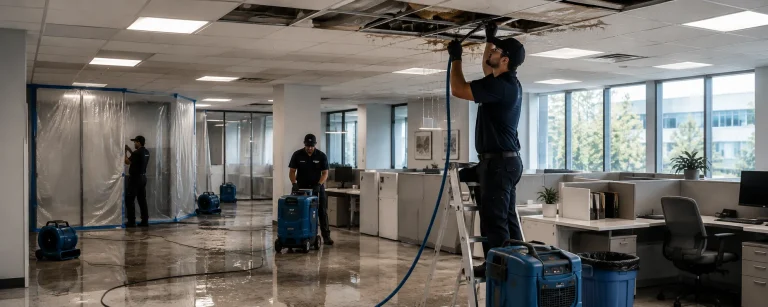
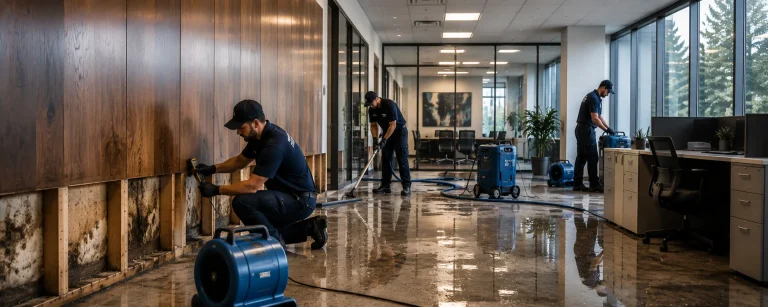
Air conditioning equipment removes moisture from the air, and that moisture has to go somewhere. In a commercial building it collects in a drain pan and leaves through a condensate line. When that path is interrupted, the water backs up and overflows into whatever sits below the unit.
Condensate failures cause a large share of commercial water losses, and they have a particular signature: the water is clean, the volume is modest, and the leak runs continuously for hours or days before anyone notices. Slow and steady does more damage than most people expect.
Why Condensate Lines Fail
The failure is almost always about drainage rather than the equipment itself:
- Biological growth inside the line restricts or blocks flow
- Drain pans corrode, crack or develop pinholes
- Traps run dry, allowing air to interfere with drainage
- Lines are installed with insufficient slope or develop sags
- Insulation on cold lines fails, so the pipe sweats along its length
- Float switches are missing, disconnected or defeated
- Debris from filter changes or construction enters the pan
Most of these develop over a season rather than overnight, which is why condensate problems cluster in the first hot weeks of summer when systems run at full load for the first time.
Where the Water Ends Up
Air handlers sit in places chosen for mechanical convenience, not for water containment: above ceilings, in closets, in attics and mezzanines, in penthouses, and on roofs. An overflow therefore starts above occupied space almost by definition.
From a ceiling-mounted unit the water saturates insulation, runs across the ceiling grid, and drips through the weakest point. From a mechanical room it spreads across the floor and finds penetrations, sleeves and slab edges. In multi-story buildings it moves down through floor assemblies and appears on levels well below the equipment.
Because the volume is small at any one moment, materials absorb it rather than shedding it. That is what makes the affected area larger than the visible evidence suggests.
What Makes Condensate Losses Different
Three characteristics separate condensate failures from other water sources, and each one affects the response.
Duration. A pipe break announces itself. A condensate overflow can run for days, particularly over a weekend or in a space nobody visits, so materials are thoroughly saturated by the time it is found.
Location. The water starts near electrical and mechanical equipment, which raises safety questions before drying questions.
Air handling. The leak is inside the system that moves air through the building, so the affected materials sit in an airstream that can carry odor and particulates to other areas.
Early Warning Signs
- A stain on a ceiling tile directly below or beside an air handler
- Water in the secondary pan, or a float switch that has tripped
- Musty odor at a supply diffuser when the system starts
- Rust or mineral deposits at the pan or on the unit housing
- Humidity that rises in one zone while the equipment appears to run normally
- A unit that short cycles or shuts down without an obvious cause
The Response Sequence
Shut the unit down and clear the blockage. Nothing else matters while water is still arriving. Clearing the line, servicing the pan and restoring the trap stop the source.
Evaluate what the water reached. The pathway from a mechanical space often passes electrical equipment, controls and data infrastructure, and those are assessed by the appropriate trades rather than assumed to be fine because they look dry.
Establish the affected boundary. Insulation above the ceiling, the ceiling assembly itself, wall cavities and flooring below all get checked, because slow leaks travel farther than they appear to.
Remove saturated materials. Wet fibrous insulation and compromised ceiling tile generally come out. Structure and many finishes can be dried in place.
Dry and monitor. Drying continues until documented readings show the assembly has reached its target condition, not until surfaces feel dry.
Address the air path. Where the loss sat inside the air handling system, the interior of the unit and nearby ductwork are evaluated before the system returns to normal service.
What This Looks Like for a Facility Team
A condensate failure usually lands in an awkward place operationally. The equipment involved is often serving the exact area that now needs to be dried, so shutting it down for repairs affects comfort and sometimes process conditions elsewhere in the building.
The practical questions are which zones can operate on other equipment, whether temporary cooling is warranted, and how to sequence the mechanical repair and the drying work so that neither waits on the other. Those decisions are easier when the building’s zoning and redundancy are understood before the failure rather than during it.
Prevention That Actually Works
Condensate failures respond well to maintenance, which is not true of every water source.
- Clear and treat condensate lines on a seasonal schedule, before peak cooling
- Inspect drain pans for corrosion and standing water
- Install and test float switches, and never bypass them
- Confirm the line has continuous slope and no sags
- Maintain insulation on cold lines to control sweating
- Check secondary pans and their drains, which are often forgotten
- Add leak detection under units located above finished space
A float switch that shuts the unit down is the single most cost-effective protection in the list. It converts a water damage claim into a service call.
Documentation Worth Keeping
Condensate losses raise questions about duration and maintenance history, so the record should establish what was found and when.
- Photographs of the pan, line and float switch as found
- Service history for the unit, including previous line clearing
- Moisture readings by location and date
- What was removed and why
- Any evaluation of electrical or mechanical components in the pathway
Small Leak, Real Project
Condensate water arrives quietly. It is clean, it is slow, and it comes from equipment that is otherwise working. That combination is exactly why the damage is often well developed before anyone calls.
Treated early, it is a maintenance item. Left to run, it becomes a project involving ceilings, insulation, wall cavities, flooring and the mechanical system itself, and the building cannot return to normal operation until all of them are resolved.
Water Emergency?
Our commercial response team is available 24/7 for water extraction, structural drying and restoration.
Our Services
Talk To A Specialist
Need help with a water loss right now?
Call our commercial team for extraction, drying and restoration planning built around your building and your operations.