Water emergency? Our commercial crews respond 24/7.
Home / Water Sources / Fire Sprinkler Discharges
Fire Sprinkler Discharges
- 24/7 Response
- Extraction
- Structural Drying
- Restoration
What happens when you call
24/7 dispatch
Call any hour. Crews mobilize for commercial losses, including nights and weekends.
Extraction & drying
Standing water removed, then structural drying with monitored moisture readings.
Insurance-ready records
Readings, photos and scope notes documented for your carrier from day one.
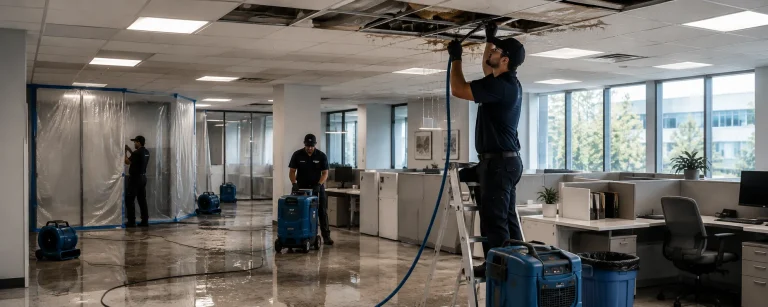
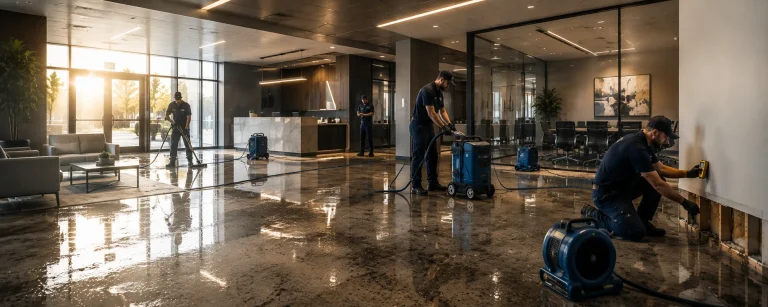
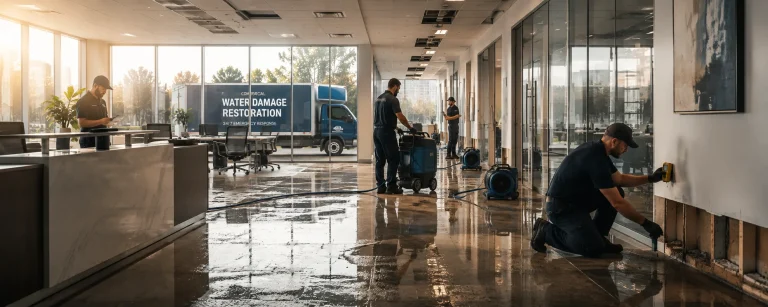
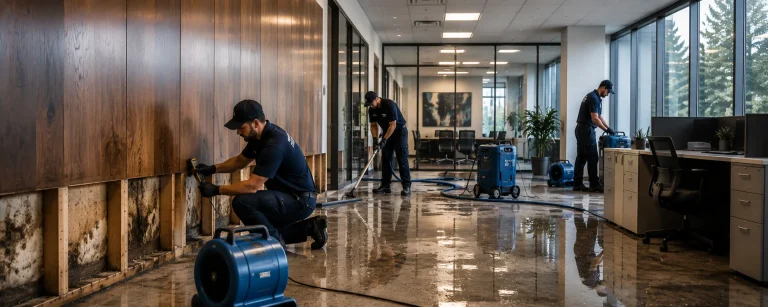
A fire sprinkler discharge is one of the highest volume water events a commercial building can experience. A single head flows continuously until someone closes a valve, and in the meantime it delivers water at a rate no interior space is designed to absorb.
What makes these losses distinctive is the combination: large volume, sudden onset, and a life-safety system that has to be returned to service before the building can be normally occupied. The drying work and the sprinkler work run on parallel tracks.
Why Sprinklers Discharge Without a Fire
Most commercial sprinkler discharges have nothing to do with fire:
- Freezing in unheated spaces, attics, loading areas and exterior walls
- Physical impact from forklifts, ladders, racking or moving equipment
- Corrosion inside the piping, particularly in older wet systems
- Manufacturing defects in a head or fitting
- Overheating near equipment, lighting or process heat
- Accidental activation during construction or maintenance work
- Pipe failure at fittings, couplings or threaded connections
Freezing is the most common of these in cold climates, and it tends to happen in the parts of a building nobody visits during winter.
The Volume Problem
An activated head flows continuously. That volume becomes standing water on the floor within minutes, and standing water does what it always does in a commercial building: it spreads to the lowest point, finds floor penetrations, elevator pits and stairwells, and moves down through the structure.
Because the discharge is sudden, water reaches areas that slow leaks never touch. Inventory on the floor, equipment bases, electrical gear at low level, records storage and anything stored directly on a slab are all exposed at once.
Time to shutoff drives everything. The difference between a five-minute response and a forty-minute response is usually the difference between one area and several floors.
What Gets Damaged
- Flooring systems, including anything beneath a raised floor
- Drywall partitions, which wick water upward from the base
- Contents and inventory sitting on the floor
- Equipment bases, motors and low-mounted electrical components
- Elevator pits and equipment at the bottom of shafts
- Lower floors, via slab penetrations and shafts
- Ceiling and finishes on the level below
The First Hour
Close the control valve. Everything else waits on this. Knowing where the valves are, and who is authorized to operate them, is the single biggest factor in the size of the loss.
Notify the monitoring company and the authority having jurisdiction as required. The system is a life-safety system, and taking it out of service has notification requirements.
Establish a fire watch if required. While the system is impaired, the building may need a documented fire watch to remain occupied.
Extract standing water. Volume removal comes before anything else on the restoration side, because every additional minute of standing water widens the affected area.
Protect and relocate contents. Anything on the floor in the pathway is moved or elevated.
Evaluate electrical exposure. Low-level electrical equipment that was in standing water is assessed by qualified personnel before power is restored.
Restoring the System Itself
The sprinkler system has its own recovery track that runs alongside the drying work: replacing the activated head or damaged piping, restoring pressure, testing the system, and documenting that it has been returned to service.
That track frequently controls reoccupancy. A space can be dry and clean and still not be ready for normal use while the life-safety system is impaired. Planning both tracks from day one avoids the common situation where the construction is finished and the building still cannot open.
Why Discovery Time Matters So Much
A discharge that starts at two in the afternoon in an occupied building is usually contained quickly. The same discharge on a Friday night in a vacant area of the building runs until Monday.
That is why buildings with monitored systems, clear valve access and a trained response usually see far smaller losses than the water volume alone would predict. The equipment failure is the same. The outcome is not.
Documentation for a Sprinkler Loss
- Time of activation and time the valve was closed
- Which head or section discharged, and its condition
- Photographs of standing water before extraction
- Affected areas by floor, including the levels below
- Contents and inventory exposed, before they are moved
- Moisture readings by location and date
- System impairment notifications and the return-to-service record
Prevention and Preparation
Sprinkler discharges cannot be eliminated, but their cost is very sensitive to preparation:
- Maintain heat in every space containing wet piping
- Protect heads near forklift traffic, racking and loading areas with guards
- Inspect and test the system on schedule, including internal inspection for corrosion
- Post valve locations and train staff on shutoff, including after hours
- Keep inventory and records off the floor where practical
- Know which areas drain toward elevators, stairs and shafts
A Life-Safety System That Also Causes Damage
The same system that protects the building from fire is capable of flooding several floors of it in under an hour. That tension is unavoidable, and it is the reason sprinkler losses get handled differently from other water events.
The response has to resolve two things at once: dry and restore the affected space, and return the fire protection system to service with the documentation that requires. Buildings that plan for both recover measurably faster than those that treat it purely as a water problem.
Water Emergency?
Our commercial response team is available 24/7 for water extraction, structural drying and restoration.
Our Services
Talk To A Specialist
Need help with a water loss right now?
Call our commercial team for extraction, drying and restoration planning built around your building and your operations.