Water emergency? Our commercial crews respond 24/7.
Home / Water Sources / Domestic Water Line Breaks
Domestic Water Line Breaks
- 24/7 Response
- Extraction
- Structural Drying
- Restoration
What happens when you call
24/7 dispatch
Call any hour. Crews mobilize for commercial losses, including nights and weekends.
Extraction & drying
Standing water removed, then structural drying with monitored moisture readings.
Insurance-ready records
Readings, photos and scope notes documented for your carrier from day one.
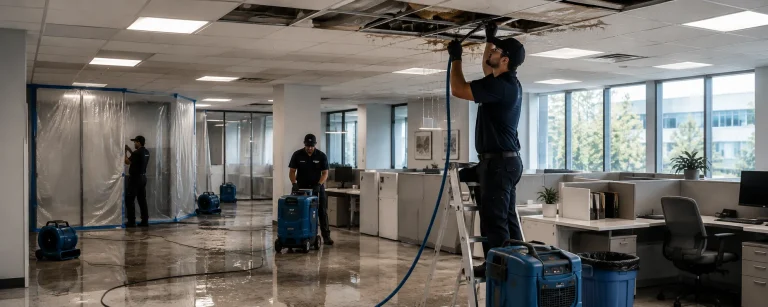
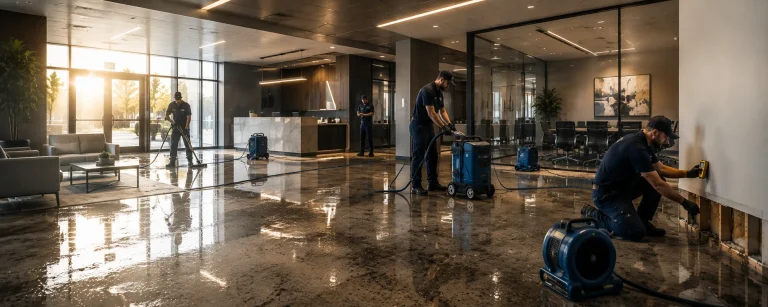
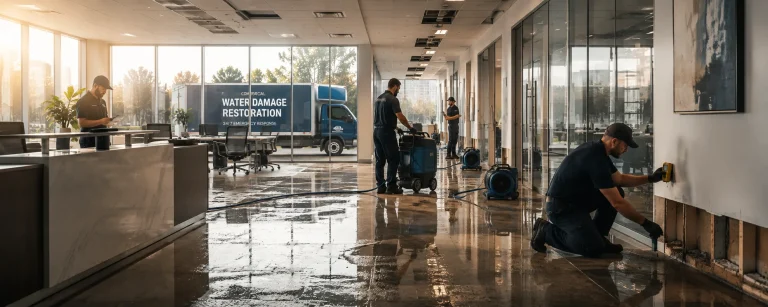
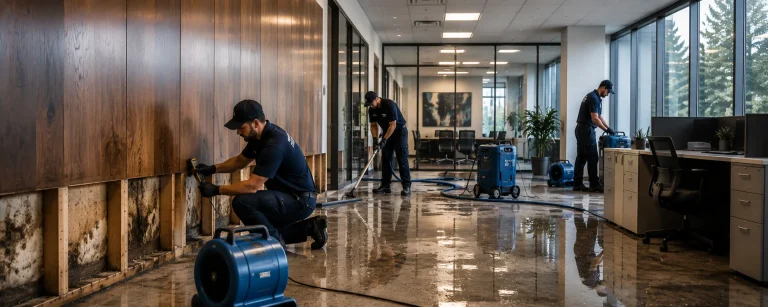
Domestic water lines run everywhere in a commercial building. They feed restrooms, break rooms, kitchens, janitor closets, drinking fountains and mechanical equipment, and they are under pressure at all times. When one fails, water is delivered continuously until someone closes a valve.
These are the losses that flood multiple floors overnight. The pipe itself may be small, but pressure and time together move a remarkable volume of water through a building.
Where Supply Failures Start
- Supply lines and shutoff valves at fixtures
- Flexible connectors at sinks, toilets and appliances
- Vertical risers serving multiple floors
- Fittings, couplings and threaded connections
- Water heaters and their connections
- Lines in unheated or poorly insulated spaces, which freeze
- Piping damaged during unrelated construction work
- Corroded galvanized piping in older buildings
Flexible connectors deserve particular attention. They are inexpensive, they are everywhere, they have a service life measured in years rather than decades, and they are rarely tracked or replaced on a schedule.
Why These Losses Spread So Far
A supply break has three characteristics that combine badly: it is pressurized, it is continuous, and it frequently happens where nobody is present.
Pressure pushes water into wall cavities rather than simply onto the floor. Continuity means the volume grows for as long as the line is open. Timing means the discovery often comes at the start of the next business day.
In a multi-story building the water follows the structure: down through floor penetrations, along the underside of slabs, into wall assemblies, through stairwells and elevator shafts. A break in a fifth-floor restroom regularly produces damage on the third.
What Gets Damaged
- Wall assemblies, insulation and framing along the pathway
- Flooring systems on multiple levels
- Ceiling assemblies on the floors below
- Tenant improvements, millwork and finishes
- Electrical devices, panels and low-level equipment
- Data and communications infrastructure
- Contents, records and inventory
- Elevator equipment where water reaches the shaft or pit
The Response Sequence
Close the valve. The isolation valve for the affected branch, riser or floor stops the event. Buildings that have mapped and labeled their valves lose far less than buildings that have to hunt for them.
Extract standing water. Removing volume quickly limits how far the affected boundary grows while investigation is underway.
Trace the pathway. Supply breaks demand vertical investigation as well as horizontal. The floors below the failure are part of the loss until evidence shows otherwise.
Evaluate building systems in the path. Electrical equipment, elevators, controls and communications infrastructure that were exposed are assessed by the appropriate trades.
Open and dry the assemblies. Pressurized water inside wall cavities does not dry by leaving the surface alone; controlled access is usually required.
Document and monitor to completion. Readings by location over time establish when each assembly has reached its target condition.
The Multi-Tenant Problem
A supply break rarely respects lease boundaries. Water from a common area restroom ends up in a tenant suite; water from one tenant’s kitchen ends up in the suite below. That creates parallel conversations about building systems, tenant improvements and tenant property, all while the affected parties want to know when they can reopen.
Handling that well depends on establishing early which spaces are affected, which can continue operating, and what each tenant needs in order to function. Restoration sequencing can then follow operational priority rather than simply working through the building floor by floor.
Early Warning Signs
- Water meter readings that climb with no operational explanation
- Reduced pressure at fixtures on one branch
- Staining at the base of walls or at floor transitions
- Corrosion, mineral deposits or dampness at visible piping and connectors
- Sounds of running water in walls when fixtures are not in use
- Recurring small leaks at the same fixture or connector
Prevention That Pays for Itself
- Map and label every shutoff valve, and confirm they operate
- Replace flexible supply connectors on a defined schedule
- Insulate and maintain heat in spaces containing piping
- Monitor water use for unexplained increases
- Add leak detection and automatic shutoff where water sits above finished space
- Inspect water heaters and their connections routinely
- Know the age and material of the building’s piping
Automatic shutoff deserves emphasis in buildings that are unoccupied overnight or over weekends. Most of the largest supply losses are not caused by unusual failures; they are ordinary failures that ran for sixty hours.
Documentation
- The failure point, photographed before repair where possible
- Time of failure, discovery and shutoff
- Affected areas by floor, including all levels below
- Moisture readings by location and date
- Building systems evaluated and by whom
- Materials removed, with the reasoning
- Tenant spaces affected and the condition of their contents
Pressure and Time
Domestic water line breaks are ordinary failures with outsized consequences. The components are small and familiar, the water is clean, and nothing about the event is exotic.
What turns it into a major commercial loss is the combination of constant pressure and unattended hours. Anything that shortens that window, whether it is a labeled valve, a monitored meter or an automatic shutoff, reduces the eventual scope of the work more than any decision made after the water is found.
Water Emergency?
Our commercial response team is available 24/7 for water extraction, structural drying and restoration.
Our Services
Talk To A Specialist
Need help with a water loss right now?
Call our commercial team for extraction, drying and restoration planning built around your building and your operations.