
Water emergency? Our commercial crews respond 24/7.
Home / Water Sources / Chilled Water Systems
Chilled Water System Failures
- 24/7 Response
- Extraction
- Structural Drying
- Restoration
What happens when you call
24/7 dispatch
Call any hour. Crews mobilize for commercial losses, including nights and weekends.
Extraction & drying
Standing water removed, then structural drying with monitored moisture readings.
Insurance-ready records
Readings, photos and scope notes documented for your carrier from day one.
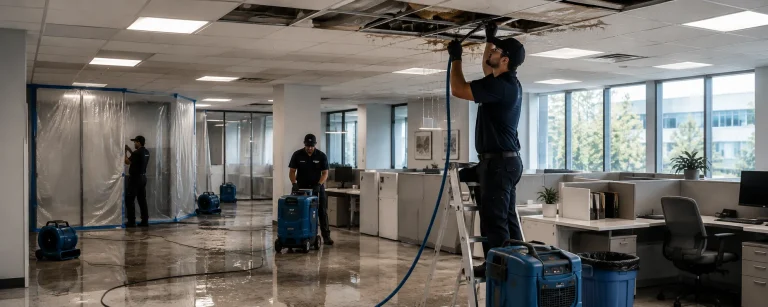
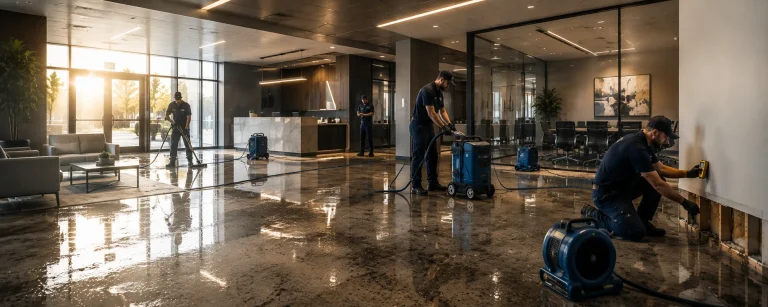
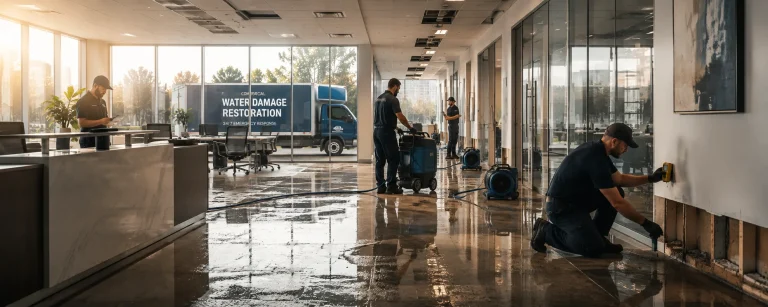
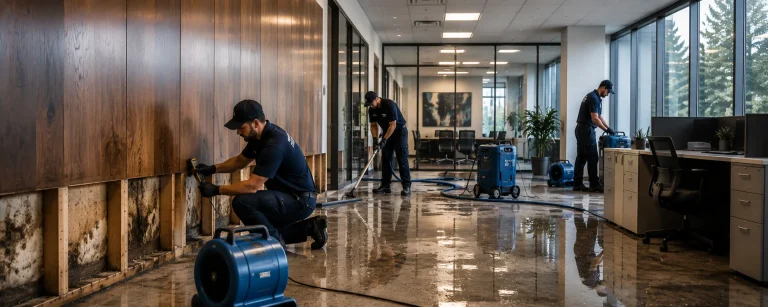
Chilled water systems move cooling through a commercial building using water rather than refrigerant. A central plant chills the water, pumps circulate it through risers and mains, and coils in air handlers and fan coil units transfer the cooling into the occupied space.
The loop holds a great deal of water, and it is under pressure throughout the building. When a component fails, the system does not simply drip. It empties into the building until someone isolates the section, and in a tall building that can mean thousands of gallons.
Where Chilled Water Systems Fail
- Coil connections and control valves at air handlers and fan coil units
- Failed gaskets at flanges, couplings and unions
- Pump seals and packing in the mechanical room
- Corrosion in older steel piping, particularly at threaded joints
- Insulation failure on cold lines, causing condensation along the run
- Freeze damage in coils exposed to outside air
- Expansion tanks, air separators and related plant components
- Piping damaged during unrelated construction or tenant work
Two of these deserve special mention. Condensation on poorly insulated chilled water lines produces a slow, continuous drip that mimics a roof leak and is frequently misdiagnosed as one. And coils that freeze because of an outside air damper or a control failure can split, releasing the loop contents directly into an air handler.
Why the Volume Is the Problem
A chilled water loop is a closed system, but closed does not mean small. The water in the mains, risers, coils and plant equipment is a large standing volume, and pumps keep it moving under pressure.
A failure at a coil connection on an upper floor releases water that travels down through the building the way any supply break does, except that the source keeps feeding it until the correct valve is closed. Isolation is rarely as simple as one shutoff, because the affected branch has to be identified within a system that serves the whole property.
This is why chilled water losses often affect more floors than the equivalent domestic water break. The volume is larger and the isolation takes longer.
Where the Equipment Sits
Chilled water equipment is installed where mechanical systems live: penthouses, mechanical rooms, ceiling spaces above corridors and tenant suites, and closets on each floor. Almost none of those locations are designed to contain water.
Fan coil units above ceilings are a frequent failure point in hotels, offices and healthcare buildings, precisely because there are so many of them. Each one has supply and return connections, a control valve, and a condensate pan, and each one sits directly above finished space.
What Gets Damaged
- Ceiling assemblies and insulation immediately below the failure
- Wall cavities along the path of travel
- Flooring systems on multiple levels
- Electrical equipment and controls in mechanical spaces
- Data and communications infrastructure sharing the ceiling space
- Tenant improvements and contents on lower floors
- The mechanical equipment itself, including motors and controls
The Response Sequence
Identify and isolate the affected branch. This is the controlling step. A building with a current piping diagram and labeled isolation valves recovers faster than one where the plant has to be shut down while the leak is traced.
Extract standing water. Volume removal limits how far the water travels while the mechanical side is still being addressed.
Evaluate mechanical and electrical exposure. Pumps, motors, controls and electrical equipment that were wet are assessed by qualified trades before anything is re-energized.
Trace the pathway vertically. The floors below the failure are treated as part of the loss until readings show otherwise.
Dry the assemblies. Insulated pipe chases, wall cavities and ceiling assemblies hold moisture long after surfaces appear dry.
Plan the return to service. The building may need cooling restored before restoration is complete, particularly in warm weather or where equipment rooms depend on it.
The Cooling Problem During Restoration
A chilled water failure creates a situation the other water sources usually do not: the system you have to shut down is the system that keeps the building habitable.
That raises questions with real operational weight. Can the affected branch be isolated while the rest of the loop runs? Does the building need temporary cooling to stay occupied? Are there spaces, such as data rooms or process areas, that cannot tolerate an outage at all?
Answering those questions early tends to reshape the restoration schedule, because the mechanical repair often has to be sequenced around occupancy rather than around convenience.
Early Warning Signs
- Persistent damp spots below fan coil units or above ceilings
- Insulation on chilled lines that is wet, compressed or missing
- Make-up water usage climbing without explanation
- Corrosion or mineral staining at valves, flanges and connections
- Repeated ceiling tile stains in a corridor with piping above it
- Pressure or flow readings drifting at the plant
Make-up water consumption is the most useful of these. A closed loop should not need continuous replacement. If it does, the system is losing water somewhere in the building.
Prevention
- Maintain a current piping diagram with isolation valves identified
- Exercise and label isolation valves so they can be found and operated under pressure
- Track make-up water use as a leak indicator
- Inspect and maintain insulation on cold lines to prevent condensation
- Service pump seals and replace gaskets on a defined schedule
- Protect coils from freezing conditions, including damper and control checks
- Install leak detection in mechanical rooms and above critical spaces
Documentation
- The failed component, photographed before repair where possible
- Time of failure, discovery and isolation
- Which branch was isolated and what remained in service
- Affected areas by floor, including all levels below
- Moisture readings by location and date
- Mechanical and electrical evaluations, and by whom
A Building System, Not Just a Leak
Chilled water losses sit at the intersection of water damage and mechanical failure. The water has to be extracted and the building dried, and at the same time the cooling system has to be repaired, refilled, purged and returned to service.
Recovery usually depends on how quickly the right section was isolated and how well the building understands its own piping. Those two factors decide whether this becomes a contained repair or a multi-floor restoration project.
Water Emergency?
Our commercial response team is available 24/7 for water extraction, structural drying and restoration.
Our Services
Talk To A Specialist
Need help with a water loss right now?
Call our commercial team for extraction, drying and restoration planning built around your building and your operations.