Water emergency? Our commercial crews respond 24/7.
Home / Water Sources / Cooling Tower Leaks
Cooling Tower Leaks
- 24/7 Response
- Extraction
- Structural Drying
- Restoration
What happens when you call
24/7 dispatch
Call any hour. Crews mobilize for commercial losses, including nights and weekends.
Extraction & drying
Standing water removed, then structural drying with monitored moisture readings.
Insurance-ready records
Readings, photos and scope notes documented for your carrier from day one.
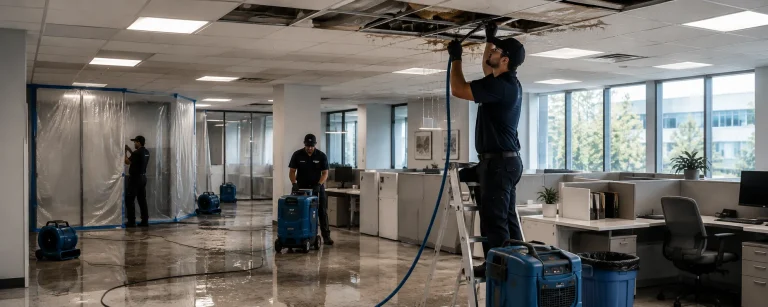
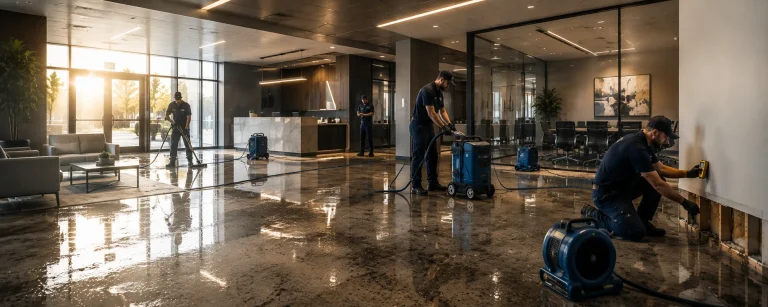
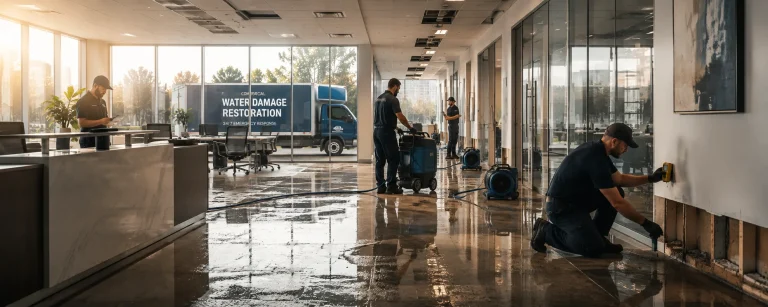
Cooling towers reject heat from a building’s mechanical plant by evaporating water. They hold a substantial volume in the basin, they operate continuously through the cooling season, and they are almost always installed on a roof or an exterior pad.
That location is what makes a tower leak a building problem rather than an equipment problem. Water escaping a tower on a roof has the entire roof assembly and everything below it available to it.
Where Cooling Towers Leak
- Basin corrosion, seam failure and cracked panels
- Sump connections, drains and overflow piping
- Make-up water valves that stick open and overfill the basin
- Float and level control failures
- Piping between the tower and the plant, including risers
- Pump seals and connections at the tower
- Drift and overspray from damaged eliminators or fan issues
- Freeze damage to basins and piping in shoulder seasons
Two failure modes are worth separating. A structural leak in the basin releases water continuously at a rate set by the size of the defect. A make-up valve that fails open, by contrast, delivers city water into an already full basin indefinitely, and the overflow goes wherever the roof takes it.
Why Roof Location Matters
Water escaping a tower spreads across the roof surface. Whether that becomes a water damage loss depends on the roof.
If the roof drains well and the membrane is sound, a tower leak can run for a long time as a utility cost rather than a building loss. If there is ponding, a compromised seam, an unsealed penetration or a curb detail that has moved, the water finds the opening and enters the assembly.
That is why tower leaks frequently present as roof leaks. The interior damage looks identical, the investigation starts on the roof, and the actual source is the equipment rather than the membrane.
Water Quality Considerations
Cooling tower water is not clean supply water. It is recirculated, concentrated by evaporation, and chemically treated for scale, corrosion and biological control. It may carry mineral scale, treatment chemicals and biological material.
That matters when it enters the building. Materials that would be straightforward to dry after a clean water loss may require different handling, and the interior of the affected assembly is assessed with the water quality in mind rather than assumed to be a clean water event.
What Gets Damaged
- The roof assembly itself, including insulation beneath the membrane
- Ceiling assemblies and finishes on the top floor
- Mechanical and electrical equipment on the roof and in penthouses
- Wall assemblies where water follows a parapet or curb detail
- Interior spaces along the drainage path
- Structural components exposed to prolonged wetting
The Response Sequence
Stop the source at the tower. That may mean isolating the tower, closing the make-up water supply, or shutting the affected loop, depending on where the failure is.
Find where the water entered the roof. The tower leak and the building entry point are two different locations, and both have to be established.
Protect the building below. Contents and equipment along the interior pathway are covered or relocated.
Establish the affected boundary. Roof insulation, deck assemblies and interior materials are evaluated, keeping the water quality in mind.
Remove and dry. Saturated insulation generally comes out; structure and many finishes can be dried in place with monitoring.
Coordinate the equipment repair and the roof repair. Interior work that proceeds before both are resolved is at risk from the next cycle.
The Operational Question
A cooling tower is not optional equipment during the cooling season. Taking it out of service to make repairs affects the chilled water plant and therefore the building.
Buildings with multiple cells or redundant towers can often isolate one and continue operating. Buildings with a single tower face a harder decision, and the repair may need to be staged, scheduled around occupancy, or supported with temporary equipment. That question belongs in the response plan on the first day, not after the drying equipment is set.
Early Warning Signs
- Make-up water consumption higher than seasonal norms
- Persistent wet areas on the roof around the tower or its piping
- Staining, scale or mineral deposits on the roof surface
- Basin level that will not hold, or a make-up valve cycling constantly
- Corrosion at basin seams, fasteners and panel joints
- Ceiling stains on the top floor near the tower or its piping
Prevention
- Inspect the basin, seams and sump at start-up and through the season
- Service float and level controls, and verify make-up valve operation
- Track make-up water consumption as a leak indicator
- Maintain the water treatment program to control corrosion and scale
- Keep the roof area around the tower clear and draining properly
- Inspect curb details, flashing and penetrations near the tower
- Winterize basins and piping where freezing is possible
Two Systems, One Loss
A cooling tower leak is rarely just an equipment problem. By the time it reaches the interior, it has become a roof problem too, and the interior work cannot be completed until both are addressed.
The practical approach is to treat the tower repair, the roof entry point and the interior restoration as three related tracks with one schedule. Resolving any one of them alone leaves the building exposed to the same loss again.
Water Emergency?
Our commercial response team is available 24/7 for water extraction, structural drying and restoration.
Our Services
Talk To A Specialist
Need help with a water loss right now?
Call our commercial team for extraction, drying and restoration planning built around your building and your operations.