Water emergency? Our commercial crews respond 24/7.
Home / Water Sources / Expansion Joint Failures
Expansion Joint Failures
- 24/7 Response
- Extraction
- Structural Drying
- Restoration
What happens when you call
24/7 dispatch
Call any hour. Crews mobilize for commercial losses, including nights and weekends.
Extraction & drying
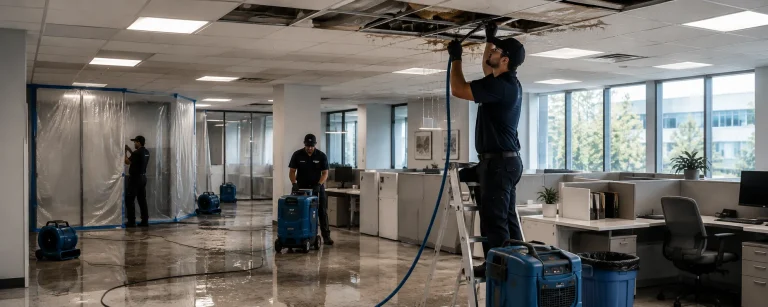
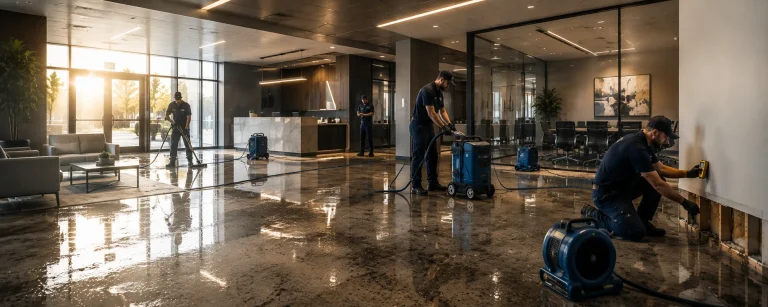
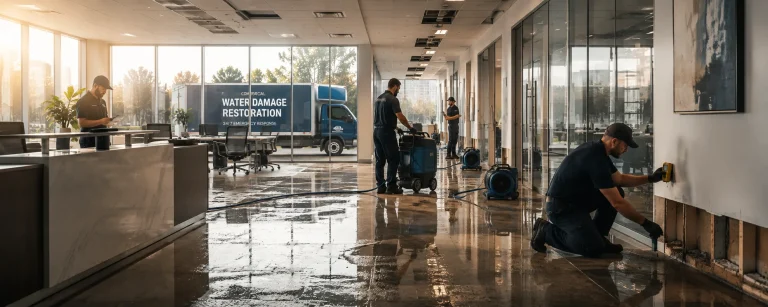
Standing water removed, then structural drying with monitored moisture readings.
Insurance-ready records
Readings, photos and scope notes documented for your carrier from day one.
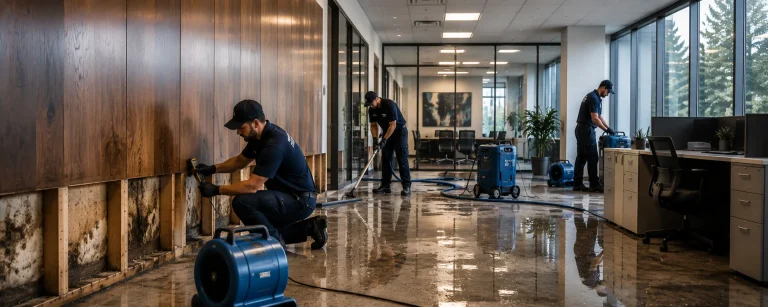
Buildings move. They expand and contract with temperature, settle over time, deflect under load, and shift during seismic events. Expansion joints exist to allow that movement without cracking the structure, and they run through roofs, decks, walls and floors.
Because a joint is a deliberate gap in an otherwise continuous assembly, it depends entirely on its cover system and seal to keep water out. When that system fails, the building has a long, narrow opening in the exact place where water can travel the farthest.
Why Expansion Joints Fail
- Sealant that has aged, hardened, cracked or lost adhesion
- Cover plates that have loosened, shifted or lost fasteners
- Membrane or bellows that has torn at a change in direction
- Movement beyond what the installed system was designed to accommodate
- Joints in parking decks damaged by traffic and snow removal
- Transitions where a joint changes plane, such as deck to wall
- Repairs that bridged the joint rigidly, preventing movement
- Debris packed into the joint, restricting movement and holding water
That last pair matters. A joint that has been sealed rigidly, or filled with debris, can no longer do its job. The building still moves, and the movement goes into the adjacent structure or tears the repair open again.
How Water Behaves at a Joint
Water entering an expansion joint follows the joint. That single characteristic shapes the whole loss.
Instead of a localized stain below a defect, the damage appears as a line: successive ceiling tiles along a corridor, a run of wet wall on each floor, or a series of stains that track the joint across the building. The water may enter at a roof or deck and appear several floors down at the same joint line, because the joint is continuous through the structure.
In parking structures the same behavior sends water onto vehicles, equipment and any occupied space below the deck, and the joint usually runs the full width of the structure.
What Gets Damaged
- Ceiling and wall assemblies along the joint on multiple floors
- Insulation within the joint assembly and adjacent cavities
- Structural components exposed to repeated wetting at the joint
- Finishes and flooring on each side of the joint line
- Electrical and mechanical runs that cross the joint
- Contents and vehicles below a deck joint
- Corrosion of embedded reinforcement over time
The corrosion point deserves attention. Joint leaks in parking structures and plaza decks expose reinforcement to water and, in cold climates, to de-icing salts. That is a structural maintenance issue as much as a water damage one.
The Response Sequence
Confirm the joint as the source. The linear pattern is the clue. Damage that tracks a straight line across several bays usually indicates a joint rather than a point defect.
Trace the joint, not the stain. Investigation follows the joint line up and down through the structure, since entry and appearance are often on different levels.
Protect below. In garages and plaza decks that means moving vehicles and equipment out of the path before work begins.
Dry the adjacent assemblies. Materials on both sides of the joint are evaluated, including cavities that the joint passes through.
Repair with a system designed for movement. The replacement has to accommodate the building’s actual movement range, which is why rigid patching fails so consistently.
Test and monitor. Water testing after repair, and observation through a full temperature cycle, confirm the repair holds.
Why Patching Rarely Holds
Expansion joints are the most commonly mis-repaired water source in commercial buildings, because the intuitive fix is to seal the gap and the correct fix is to restore a system that moves.
Caulk applied across a joint is bonded to both sides. The next temperature swing pulls it apart, usually at one edge, and the leak returns in the same place. The repair looked reasonable and lasted one season.
A durable repair uses a joint system sized for the movement, properly anchored, with the correct profile for the location, and detailed at the transitions where the joint changes plane. Those transitions are where most systems fail first.
Early Warning Signs
- Stains or drips that line up along a straight path
- Efflorescence or mineral deposits following a joint line
- Sealant at the joint that is cracked, torn or separated at one edge
- Cover plates that rattle, have moved, or show missing fasteners
- Debris or vegetation packed into a deck or roof joint
- Rust staining below a joint in a parking structure
- Repeated leak reports from the same corridor on different floors
Prevention
- Inspect joints seasonally, including transitions and terminations
- Keep joints clear of debris so they can move as designed
- Replace failed sealant with materials rated for the movement range
- Check cover plate fasteners and anchorage
- Include joints in roof and deck inspection routines rather than treating them separately
- Track repairs by joint and location to reveal chronic areas
- Plan joint replacement as a capital item, since these systems wear out
A Long, Narrow Path
Expansion joint leaks stand out because of their geometry. The opening is narrow but continuous, so the water has an unusually long path through the building and the damage presents as a line rather than a spot.
Recognizing that pattern early changes the investigation, and it changes the repair. A joint that is patched will leak again at the next temperature swing. A joint that is rebuilt as a moving system stops the cycle.
Water Emergency?
Our commercial response team is available 24/7 for water extraction, structural drying and restoration.
Our Services
Talk To A Specialist
Need help with a water loss right now?
Call our commercial team for extraction, drying and restoration planning built around your building and your operations.