
Water emergency? Our commercial crews respond 24/7.
Home / History of Commercial Water Damage
The History of Commercial Water Damage
- 24/7 Response
- Extraction
- Structural Drying
- Restoration
What happens when you call
24/7 dispatch
Call any hour. Crews mobilize for commercial losses, including nights and weekends.
Extraction & drying
Standing water removed, then structural drying with monitored moisture readings.
Insurance-ready records
Readings, photos and scope notes documented for your carrier from day one.
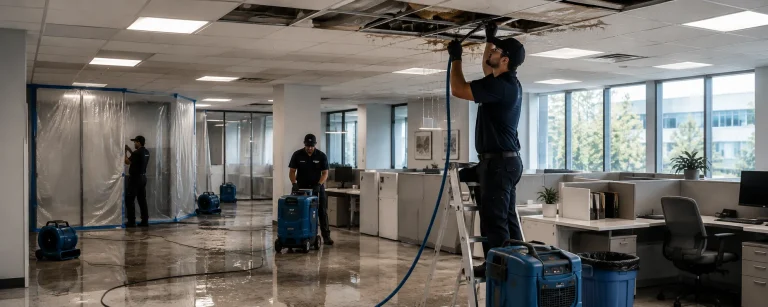
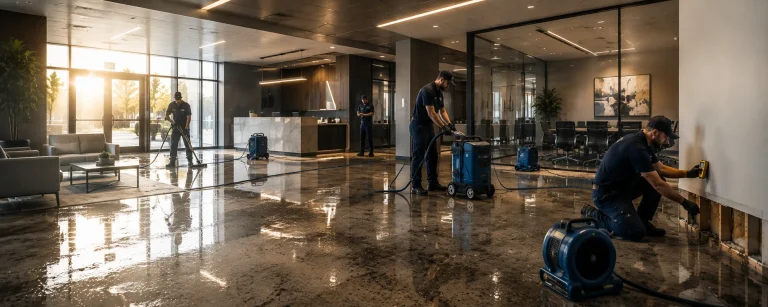
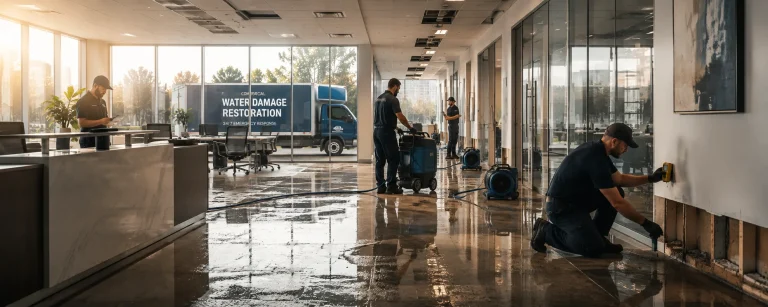
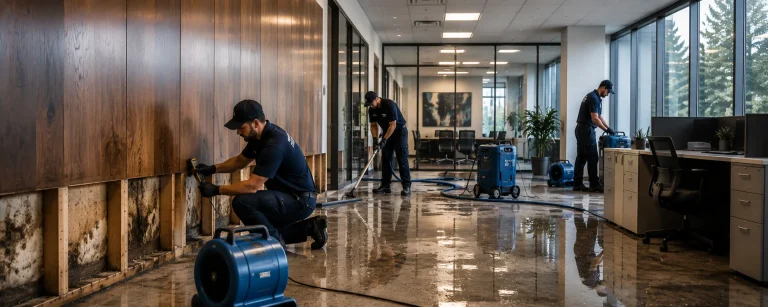
Water has always been one of the most destructive forces a building faces. What has changed over time is where that water comes from. Early commercial buildings mostly dealt with rain, snowmelt and flooding from the outside. Modern commercial buildings carry thousands of feet of pressurized pipe, cooling equipment and fire protection inside their walls and ceilings, and most commercial water losses today start inside the building itself.
Understanding that history explains why commercial water damage behaves the way it does, why it is often hidden, and why the recovery process looks the way it does today.
Before Indoor Plumbing: Water From the Outside
For most of history, commercial buildings were built of masonry, timber and stone, with little water running through them. Water damage meant roof leaks, wind-driven rain, rising groundwater and floods. Merchants stored goods off the floor, warehouses were built on raised foundations near rivers and ports, and heavy masonry walls were expected to get wet and dry out again.
Recovery was simple and slow. Buildings were opened up, goods were moved, and the structure was left to dry naturally. Wet plaster and wood were often replaced rather than dried, and mold and rot were accepted as part of owning property near water.
Plumbing Moves Inside Commercial Buildings
In the second half of the 1800s, city water systems and indoor plumbing spread through commercial districts in growing American cities. Offices, hotels, department stores and factories added restrooms, sinks and boilers. For the first time, large amounts of pressurized water ran through the inside of commercial buildings.
That brought a new kind of loss. A burst pipe, a failed fitting or an overflowing fixture could now release water on an upper floor and send it down through every level below. As buildings grew taller, many relied on rooftop water tanks and pumps to keep pressure on upper floors, which added more stored water above occupied space.
Fire Sprinklers: Protection That Brings Its Own Risk
The automatic fire sprinkler changed commercial buildings permanently. Henry S. Parmelee patented an automatic sprinkler head in 1874, and designs improved quickly after that, especially in textile mills and factories where fire losses were severe. The National Fire Protection Association was founded in 1896, and its sprinkler installation standard became the foundation for how sprinkler systems are designed in the United States.
Sprinklers have saved countless buildings and lives. They also put pressurized water above nearly every room of a protected building. Accidental discharges from damaged heads, frozen pipes, corrosion and impact became a well-known source of water damage, serious enough that insurers developed specific coverage for sprinkler leakage.
Today, a single sprinkler head can release a large volume of water in a short time, and a fire event can leave a building with far more water damage than fire damage. Sprinkler-related water is still one of the defining causes of commercial losses.
Air Conditioning and Mechanical Systems
Willis Carrier’s work on mechanical air conditioning began in 1902, and during the 20th century air conditioning moved from factories and theaters into offices, stores, hospitals and hotels. By the second half of the century, most commercial buildings depended on it.
Cooling systems brought new water sources into ceilings and mechanical rooms:
- Condensate from cooling coils that must drain reliably
- Chilled water piping running through ceilings and shafts
- Cooling towers on roofs and in equipment yards
- Boilers, heat exchangers and hot water loops
- Humidifiers and specialty equipment in labs and data rooms
A clogged condensate line or a failed chilled water valve can soak a ceiling and the space below it long before anyone notices. These mechanical sources are a major reason commercial water damage is often discovered late.
High-Rise and Modern Construction
Steel-frame high-rise construction, suspended ceilings, drywall partitions and raised floors changed how water moves through a building. Lightweight modern materials absorb water faster than old masonry and plaster, and hidden spaces above ceilings and inside walls let water travel far from its source.
Buildings also filled up with electrical equipment, computers, records and inventory that do not tolerate moisture. A leak that would have been an inconvenience in an old warehouse could now shut down an office floor, a data room or a hospital wing.
Restoration Becomes a Profession
For much of the 20th century, water damage cleanup was handled by general contractors, janitorial crews and carpet cleaners. As losses grew more complex, a dedicated restoration industry took shape.
The Institute of Inspection, Cleaning and Restoration Certification (IICRC) was founded in 1972 and went on to publish the S500 standard for professional water damage restoration, first released in 1994. The standard introduced a shared language for the industry, including categories of water based on contamination and classes of loss based on how much water was absorbed.
That shift changed the goal of restoration. Instead of tearing everything out, trained technicians began measuring moisture, drying materials in place where it was safe, and documenting the process from start to finish.
Better Drying Science and Tools
Over the following decades, drying became far more precise. Commercial restoration crews came to rely on:
- High-capacity refrigerant and desiccant dehumidifiers
- Air movers placed to control evaporation
- Moisture meters and thermal imaging cameras
- Psychrometric readings to track drying progress
- Containment to protect occupied areas
These tools make it possible to find hidden moisture, dry structural materials faster and prove that a building is dry before it is closed up again.
Mold, Insurance and Documentation
Around the turn of the 21st century, mold became a major concern after water losses. A wave of mold claims led many insurers to limit or exclude mold coverage, and property owners learned that slow or incomplete drying could turn a water loss into a much larger problem.
Since then, fast response and careful documentation have become central to commercial water damage recovery. Moisture logs, photos and drying records support insurance claims, protect owners and tenants, and show that the building was returned to a safe condition.
Commercial Water Damage Today
Modern commercial buildings are more complex than ever, and so are their water sources. Roof systems, curtain walls, plumbing, fire protection, HVAC and process equipment all carry some risk. At the same time, owners have better ways to limit damage, including leak detection sensors, automatic shutoff valves, building automation alarms and preventive maintenance programs.
The core lesson from this history has not changed. Water that is found early and removed quickly causes far less damage than water that is left to spread. The difference today is that there is a professional process, backed by standards and equipment, to make that happen.
To see where commercial water damage usually starts, explore our guide to where commercial water damage comes from.
Water Emergency?
Our commercial response team is available 24/7 for water extraction, structural drying and restoration.
Our Services
Talk To A Specialist
Need help with a water loss right now?
Call our commercial team for extraction, drying and restoration planning built around your building and your operations.