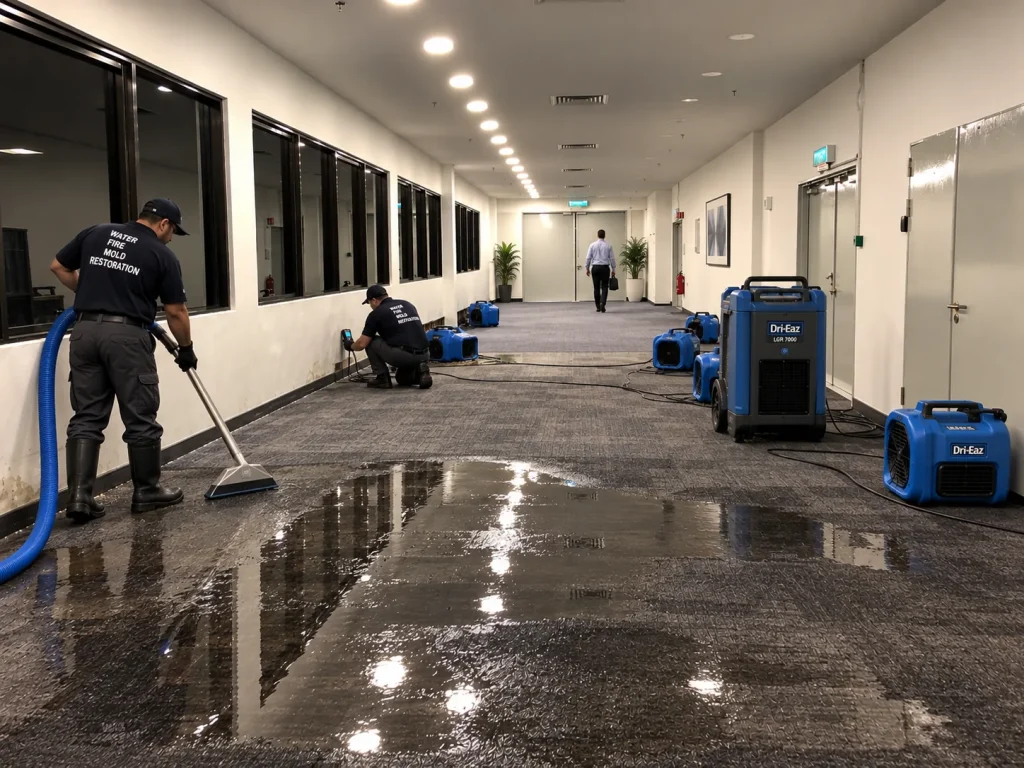
Written for: property managers and facility engineers at Las Vegas office, retail and mixed-use buildings. The decision: whether the affected space can keep operating while it dries, or needs to close.
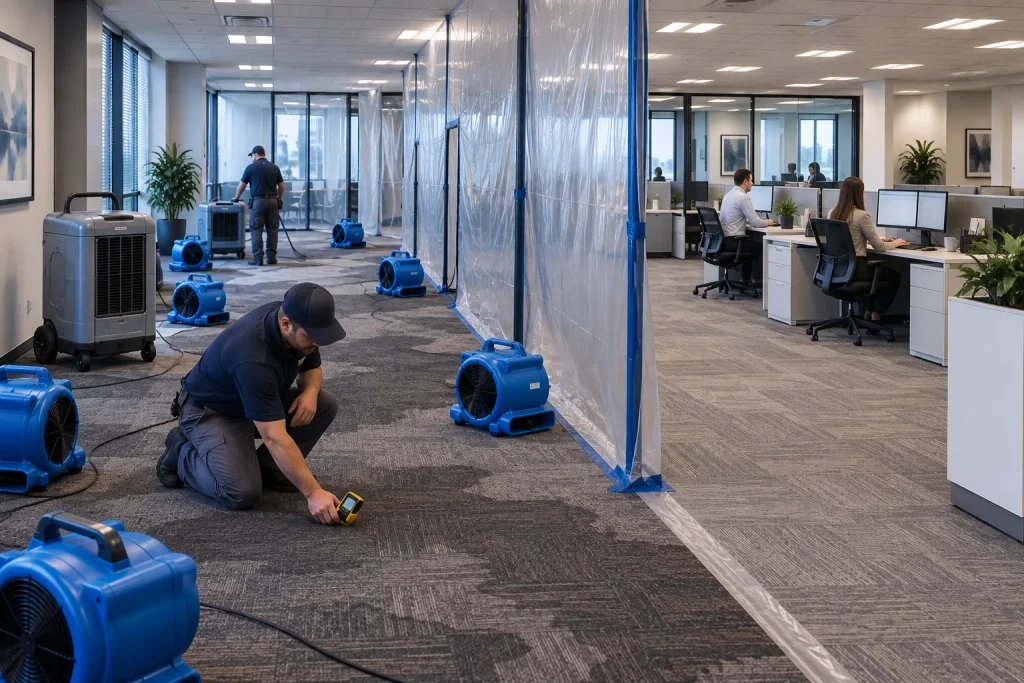
Short answer: Most buildings can keep unaffected areas open if the source is stopped fast, wet materials are mapped the same day, and drying zones are sealed off from occupied space. Close a suite when water has reached electrical equipment, ceilings are sagging, or the water is contaminated.
Example scenario (hypothetical): A supply line above a second-floor ceiling in a two-story office near Summerlin Parkway splits overnight. By 7 a.m., water has come through the ceiling grid into a tenant’s conference room and run under the demising wall into the next suite. The building needs to keep its lobby, elevators and first-floor tenants open.
The First Hour
- Shut the closest isolation valve, or the main if you cannot find it. Know where both are before you need them.
- Cut power to wet circuits if water has reached outlets, panels or floor boxes, following your lockout/tagout procedure.
- Lift sagging ceiling tiles only after the area below is cleared. Wet tile is heavy.
- Photograph everything before anything is moved: the break, the ceiling, the floor, and the next suite.
- Call a restoration contractor and tell the affected tenants what you know and when you will update them.
The Las Vegas Detail That Changes the Plan
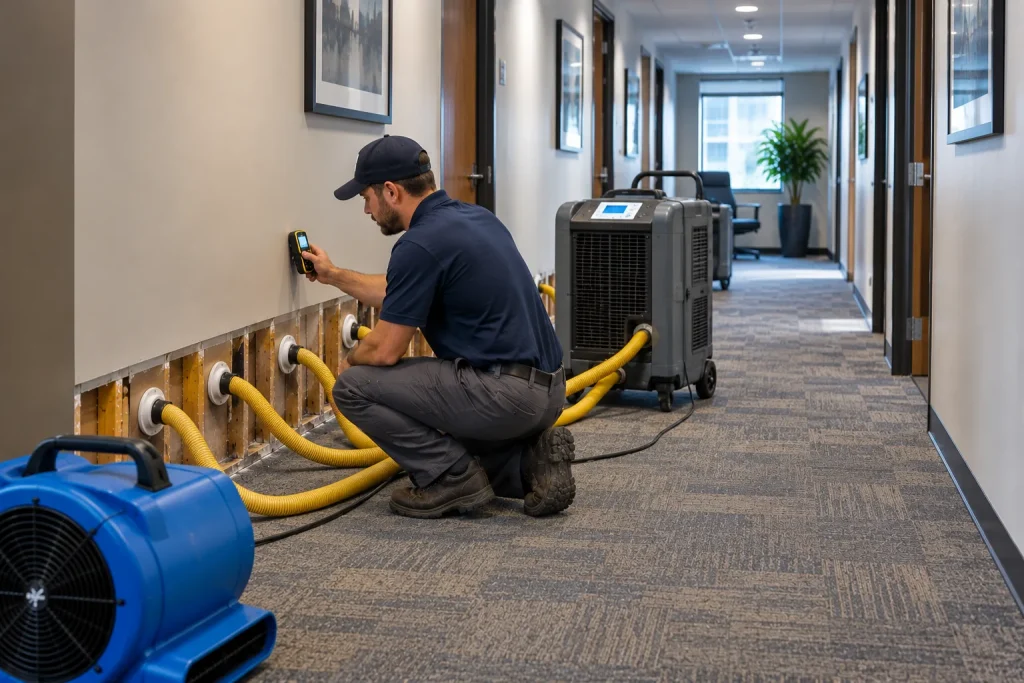
Southern Nevada’s dry air helps drying, but it also fools people. Surfaces such as paint and carpet face can feel dry within hours while the drywall core, bottom plate and pad underneath stay wet. Moisture readings, not touch, decide when drying is done. The valley’s hard water is also worth noting: mineral scale at fittings and valves is a common reason older supply connections fail, so inspect neighboring fittings once the break is repaired.
What Decides Whether a Suite Stays Open
| Condition | Usually means |
|---|---|
| Clean supply water, stopped quickly, no electrical contact | Suite can often stay open with drying equipment zoned off |
| Water reached panels, floor boxes or IT equipment | Close the affected area until an electrician clears it |
| Ceiling saturated or sagging over workspaces | Close the area below until tile and grid are removed |
| Water sat more than a day, or came through dirty spaces | Treat as contaminated; more removal and containment needed |
From the Field
The first thing an experienced project manager checks is where the water went that nobody can see: the wall cavity on the far side of the demising wall, the floor below, and any slab penetrations or electrical chases. The common miss is the adjoining suite. Its carpet may look fine at the surface while the pad under the shared wall is soaked. Finding that early is what keeps a one-suite loss from becoming a two-suite reconstruction.
Tool: Burst Pipe Photo Log
| Photo | Why it matters |
|---|---|
| The failed fitting or pipe, close up and with a ruler | Cause of loss for the insurer |
| Each wet room, wide shot, before cleanup | Shows extent before work starts |
| Ceiling above and floor below the break | Proves migration path |
| Moisture meter readings on walls, with location noted | Baseline for the drying record |
| Damaged contents and equipment, with labels | Contents claim |
Next Step
If the water is active now, have these details ready when you call:
- The property address and the entrance the crew should use
- Where the water came from and whether it has been stopped
- Which floors, suites or rooms are wet, and roughly how large the area is
- Whether the water is clean, gray or sewage
- Who can approve work on site, and the insurance carrier if known
Sources
Burst Pipe in Your Building?
Call our 24/7 line for extraction, moisture mapping and drying. See commercial water damage restoration in Las Vegas.
Related Reading
- Commercial Water Damage in Las Vegas — 24/7 response across the valley
- Moisture Mapping Services — finding water you cannot see
- Commercial Water Emergency Checklist — printable first steps