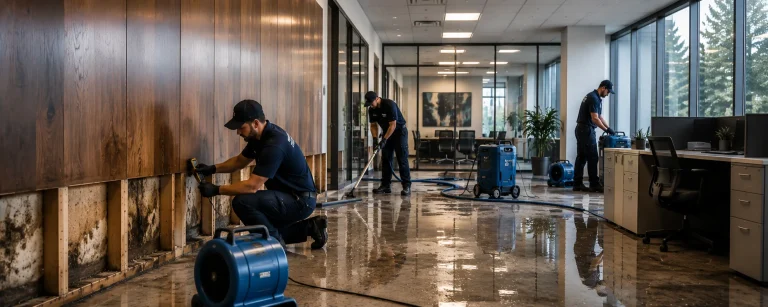
Water emergency? Our commercial crews respond 24/7.
Commercial Water Damage
- 24/7 Response
- Extraction
- Structural Drying
- Restoration
What happens when you call
24/7 dispatch
Call any hour. Crews mobilize for commercial losses, including nights and weekends.
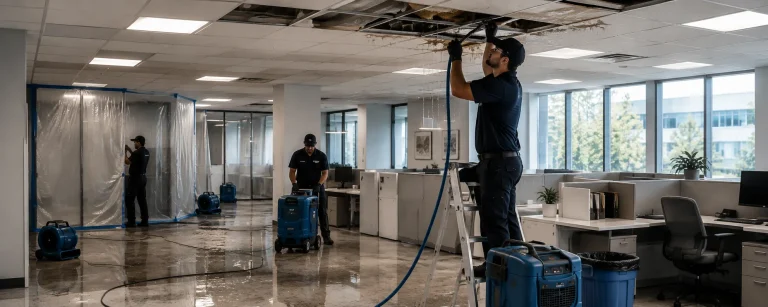
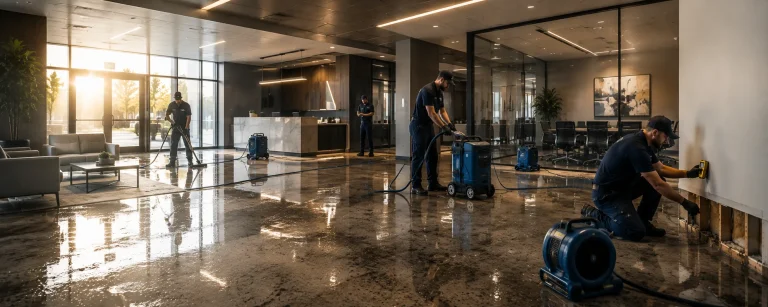
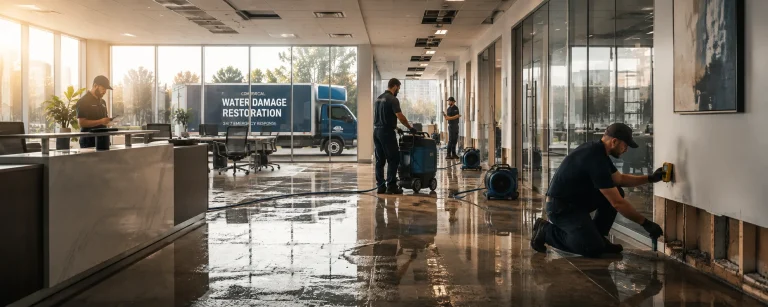
Extraction & drying
Standing water removed, then structural drying with monitored moisture readings.
Insurance-ready records
Readings, photos and scope notes documented for your carrier from day one.
Chicago, IL
Commercial Water Damage in Chicago Requires Planning for Freeze-Thaw Cycles, Aging Infrastructure, and Continuous Building Operations
Chicago anchors one of the largest commercial markets in the country. Loop office towers, West Loop and Fulton Market conversions, the Illinois Medical District, university campuses, hotels, retail corridors, manufacturing plants, and the vast distribution and logistics corridor around O’Hare all create distinct challenges when water damage occurs.
Water damage in Chicago is rarely a simple cleanup project. A freeze-thaw climate, deep below-grade construction, aging water and sewer infrastructure, and a building stock that spans more than a century allow moisture to spread quickly and quietly through commercial properties. Owners are often challenged to restore operations while protecting valuable assets and limiting downtime.
Commercial Water Damage provides educational resources that help facility managers, property managers, building owners, developers, and commercial contractors better understand commercial water damage throughout the Chicago area.
Restoration Has Become More Valuable Than Replacement
Commercial construction across Chicagoland has changed considerably over the past several decades.
Today’s facilities often include:
- High-performance curtain wall and window systems
- Advanced building automation and controls
- Central steam and chilled water connections
- Specialized medical and laboratory spaces
- Adaptive reuse of historic masonry and timber structures
- Energy-efficient building envelopes
- Custom tenant improvements
- Data and telecommunications infrastructure
Replacing these systems can require extensive coordination, specialized trades, and long project timelines.
As construction costs continue to rise throughout the Chicago region, restoration frequently offers a practical strategy for preserving valuable building components while reducing operational disruption.
Chicago Winters Create a Distinct Water Damage Profile
Few commercial markets experience the temperature swings that Chicago buildings absorb each year.
Cold-weather losses commonly involve:
- Frozen and burst pipes in unheated or poorly insulated spaces
- Ice dams along parapets and low-slope roof edges
- Snow and meltwater loading on flat commercial roofs
- Freeze-thaw cycling in masonry facades and terra cotta
- Failed roof drains and interior downspouts
- Sprinkler line freezing in loading docks and stairwells
- Slab and foundation cracking from ground movement
- Condensation inside building envelopes during extreme cold
Spring and summer bring a second pattern. Heavy rainfall, lake-effect storms, and combined sewer surcharge can drive water into below-grade levels long after the surface has dried.
Water Moves Beyond the Point of Entry
Commercial water damage is rarely confined to the location where it first appears.
Moisture may migrate through:
- Curtain wall and window wall assemblies
- Structural steel framing and fireproofing
- Elevator shafts and utility chases
- Ceiling plenums and raised access floors
- Multi-level and below-grade parking structures
- Freight and loading dock openings
- Concrete floor systems and topping slabs
- Mechanical penthouses and rooftop equipment curbs
- Party walls in older attached masonry buildings
Understanding moisture migration allows recovery teams to evaluate the entire building—not just the visible damage. Moisture mapping and leak detection are frequently used to define the true extent of a loss before repairs begin.
Below-Grade Space Complicates Chicago Recovery
Chicago commercial properties often extend well below street level, and that changes how a water loss behaves.
Projects frequently involve:
- Deep basements and sub-basement mechanical rooms
- Below-grade parking and service tunnels
- Pedway and concourse connections between buildings
- Elevator pits and sump systems
- Main electrical switchgear at or below grade
- Building service entrances and water mains
- Storage and records rooms beneath occupied floors
- Foundation drainage and backflow prevention
Water that reaches these areas can affect life-safety systems and base building services well beyond the originally affected tenant space.
Business Continuity Is a Priority
Many Chicago businesses cannot suspend operations after a water loss.
Recovery planning frequently includes:
- Overnight and off-hours restoration
- Weekend and holiday scheduling
- Temporary workspaces and swing space
- Safe tenant and customer access
- Occupant and building-wide communication
- Dust and odor containment
- Noise management in occupied towers
- Phased reconstruction by floor or zone
Keeping commercial facilities operational is often one of the primary goals throughout the recovery process. Business continuity planning is typically addressed alongside the physical repairs.
Every Commercial Property Has Different Priorities
The Chicago market contains an extraordinary variety of commercial properties.
Recovery strategies may differ between:
- Loop and West Loop office towers
- Distribution and logistics facilities near O’Hare
- Hospital and research campuses in the Illinois Medical District
- Adaptive reuse loft and timber buildings in River North and Fulton Market
- Hotels and convention properties
- Shopping centers and neighborhood retail corridors
- Manufacturing and industrial plants
- University and institutional campuses
- Mixed-use developments
Each environment requires different planning, scheduling, and restoration priorities.
Modern Restoration Helps Preserve Valuable Assets
Commercial restoration has advanced considerably over the past several decades.
Rather than immediately replacing every affected material, today’s recovery planning often focuses on:
- Moisture mapping and documentation
- Structural drying
- Targeted repairs
- Material preservation
- Controlled demolition
- Building system protection
- Interior finish restoration
- Long-term asset preservation
For many commercial owners, preserving existing building components helps reduce both project costs and operational downtime.
Questions Chicago Property Owners Frequently Ask
Commercial recovery involves balancing technical decisions with ongoing business operations.
Important questions frequently include:
- Can building operations continue during repairs?
- Which systems require immediate attention?
- How far has moisture migrated below grade?
- Were pipes or sprinkler lines compromised by freezing?
- Can historic or specialty materials be restored rather than replaced?
- How will insurance documentation be managed?
- Which repairs should be completed before winter returns?
- How will tenant communication be handled?
These conversations frequently shape both project timelines and long-term building performance.
Preparing for Future Water Events
Commercial recovery also creates opportunities for improvement.
Many organizations review:
- Roof and drainage maintenance programs
- Pipe insulation and heat trace in cold zones
- Building envelope and masonry performance
- Water detection and automatic shutoff systems
- Backflow prevention and sump redundancy
- Winterization procedures for vacant space
- Emergency response and after-hours contacts
- Capital improvement planning
Looking beyond today’s emergency often strengthens the property’s long-term resilience.
Why Commercial Water Damage Focuses on Chicago
Chicago combines a century-spanning building stock, extensive below-grade construction, a demanding freeze-thaw climate, and one of the country’s most active commercial environments.
Commercial Water Damage provides educational resources that help facility managers, property managers, building owners, developers, and commercial contractors better understand water mitigation, moisture migration, restoration planning, repair strategies, insurance coordination, and long-term building performance.
Whether responding to a frozen riser in a Loop office tower, meltwater intrusion through a Fulton Market roof assembly, sewer backup in a River North basement, or a major loss at a distribution facility near O’Hare, informed planning helps reduce downtime, preserve valuable assets, and support a faster, more efficient commercial recovery.
Water Emergency?
Our commercial response team is available 24/7 for water extraction, structural drying and restoration.
Our Services
Talk To A Specialist
Need help with a water loss right now?
Call our commercial team for extraction, drying and restoration planning built around your building and your operations.