A commercial property does not always have to choose between two conditions:
Completely closed.
Or:
Completely restored.
Between those extremes is one of the most valuable strategies in commercial restoration— partial occupancy during repairs.
A hotel may continue operating unaffected guest-room wings while another section undergoes water damage restoration.
An office building can potentially maintain operations on usable floors while damaged areas remain isolated.
A warehouse may redirect shipping around an affected section.
Retailers can sometimes preserve customer access while reconstruction continues elsewhere.
The objective is not to force a damaged property to remain open.
It is to determine whether portions of the business that are capable of operating can be separated from portions that cannot.
Commercial restoration should not automatically remove 100% of the business because 20% of the building is damaged.
When conditions allow, effective recovery planning can create two environments inside the same property: Distribution operations feel partial occupancy sharply, which is why water damage repair for distribution centers deserves early attention.
an operating business and a controlled restoration project.
Partial Occupancy Changes the Commercial Restoration Question
After significant property damage, people naturally ask:
“When can we reopen?”
That question assumes the entire property shares one reopening date.
Many commercial buildings don’t.
A more useful set of questions is:
— Which areas are actually affected?
— Which areas remain usable?
— What building systems are shared?
— Can occupants safely reach unaffected areas?
— Can construction activity be separated from business operations?
— Which critical dependencies serve both zones?
— Can temporary solutions maintain essential operations?
— What specifically prevents one portion of the property from reopening?
These questions move commercial restoration away from an all-or-nothing recovery model.
Instead, the property can be evaluated by operational zones.
What Is Partial Occupancy During Commercial Restoration?
Partial occupancy means returning appropriate portions of a commercial property to use while restoration, remediation or reconstruction continues elsewhere.
That doesn’t mean putting employees next to demolition crews.
Nor does it mean ignoring unresolved building conditions to reduce downtime.
Proper partial occupancy requires deliberate separation between:
Operational areas
and
Restoration areas.
Depending upon the property and project, that separation can involve:
- Physical containment
- Controlled access
- Alternate entrances
- Temporary pathways
- Airflow management
- Dust control
- Noise scheduling
- Material staging
- Temporary utilities
- Construction scheduling
- Worker coordination
- Equipment placement
- Appropriate signage and barriers
- Required inspections or professional determinations
The exact requirements vary dramatically by building and event.
The underlying principle remains consistent:
Protect the operating environment from the restoration environment.
One Building Can Contain Several Different Recovery Zones
Instead of viewing a damaged commercial property as one giant project, divide it according to function and condition.
Zone 1 — Active Restoration Area
This is where demolition, drying, remediation, repair or reconstruction is occurring.
Access may need to be controlled.
Zone 2 — Transition Area
Hallways, elevators, loading areas or other spaces may connect construction activity with occupied portions of the property.
These areas require special attention because the two environments intersect.
Zone 3 — Operational Area
Business activities continue here.
Employees, tenants, customers or guests may be present.
Zone 4 — Support Area
Temporary storage, contractor staging, equipment locations or relocated business functions may occupy separate spaces.
Now the building isn’t simply open or closed.
It has a recovery geography.
Managing that geography is fundamental to partial occupancy.
Shared Building Systems Determine Whether Separation Is Really Possible
Physical distance can be misleading.
Two areas may be located on opposite sides of a building while depending upon the same infrastructure.
Consider:
- Electrical distribution
- HVAC
- Domestic water
- Fire protection
- Elevators
- Building automation
- Communications
- Security systems
- Plumbing
- Emergency power
Suppose floors six through ten were never touched by water.
That sounds promising for partial occupancy.
However, if their electrical service passes through damaged infrastructure on the third floor, those “unaffected” floors may still have an operational dependency on the restoration zone.
This is why partial occupancy begins with dependency mapping, not merely floor plans.
Physical separation does not automatically mean operational independence.
Protect the Unaffected Building Like It Is Part of the Restoration Project
Commercial restoration naturally concentrates attention on damaged areas.
Partial occupancy requires equal attention to the areas that remain functional.
Why?
Because those spaces now carry extraordinary economic importance.
If 70% of a hotel remains operational during restoration, protecting that 70% becomes a major recovery objective.
Likewise, if a warehouse maintains one functioning shipping area, restoration activity cannot be allowed to unnecessarily interfere with it.
The unaffected area should therefore be treated as an asset requiring protection.
✓ Maintain access
✓ Protect environmental conditions
✓ Prevent unnecessary dust migration
✓ Control construction traffic
✓ Protect finishes
✓ Preserve required utilities
✓ Coordinate noise
✓ Maintain business pathways
Saving operational space can be as valuable as restoring damaged space.
Construction Traffic and Business Traffic Should Not Fight Each Other
Partial occupancy becomes difficult when everybody uses the same pathways.
Employees enter through one door.
Contractors enter through the same door.
Customers walk through material staging.
Restoration equipment blocks corridors.
Debris moves through occupied spaces.
Deliveries collide with construction deliveries.
That is not a sustainable recovery plan.
Where conditions permit, commercial restoration logistics can separate:
Occupant circulation
from
construction circulation.
Possible strategies include:
— Separate contractor entrances
— Dedicated material routes
— Alternate elevators
— Scheduled debris removal
— Controlled loading areas
— Temporary corridors
— After-hours material movement
— Separate staging locations
This sounds like a construction-management detail.
It is actually a business continuity strategy.
The Transition Zone Can Be More Important Than Either Side
Everyone notices the damaged zone.
Everyone understands the occupied zone.
The space between them receives less attention.
Yet this transition zone is where many operational conflicts occur.
Workers cross it.
Equipment passes through it.
Materials move through it.
Noise travels across it.
Air moves through it.
Occupants may approach it.
Creating a controlled transition between construction and normal operations can therefore be fundamental to successful partial occupancy.
Think of it as an interface:
Restoration environment
→ controlled transition
→ operating environment
The better that interface is managed, the easier it becomes for the two activities to coexist.
Air Doesn’t Recognize Construction Boundaries
A plastic barrier can visually separate two areas.
Airflow is more complicated.
Commercial buildings contain interconnected mechanical systems, pressure relationships, return-air pathways, doors, shafts and penetrations.
Depending upon the nature of the work, restoration planning may need to consider whether construction activity could affect occupied environments through: If your facility stores inventory, restoring a warehouse after water loss explains how partial occupancy affects shipping schedules.
- Dust
- Air movement
- Odors
- Particulates
- Mechanical pathways
- Openings
- Traffic between zones
This makes HVAC and airflow considerations particularly important when restoration occurs near active operations.
A wall on a floor plan does not necessarily represent an environmental boundary.
Noise Is an Operational Contaminant Too
Commercial restoration doesn’t need to create a health hazard to make a business unusable.
Sometimes noise is enough.
Imagine demolition above an executive office.
Concrete drilling next to hotel rooms.
Floor removal beside a medical office.
Saw cutting adjacent to a retail environment.
Physically, occupants might be separated from the work.
Operationally, the space becomes nearly useless.
That means partial occupancy planning should consider when work occurs, not simply where it occurs.
A project might divide activities into:
Business-Hour Work
Lower-impact restoration and construction activities compatible with ongoing operations.
After-Hours Work
Demolition, drilling, cutting, debris movement or other disruptive operations.
Shutdown Windows
Specific periods when utilities or shared systems can be temporarily taken offline.
Scheduling becomes another form of containment.
Temporary Utilities Can Keep Permanent Operations Alive
Permanent repair may take days or weeks.
The business may need functionality tomorrow.
That creates an important commercial restoration question:
Can a temporary solution safely bridge the gap between failure and permanent repair?
Depending upon the circumstances and appropriate professional involvement, temporary arrangements might involve:
- Electrical power
- Cooling
- Heating
- Ventilation
- Lighting
- Communications
- Water
- Workspace
- Storage
- Access
- Equipment
Temporary solutions do not eliminate the need for permanent restoration.
They can change the timeline of business interruption.
Permanent repair solves the building problem. Temporary infrastructure may solve the immediate operational problem.
Partial Occupancy Can Turn One Shutdown Into Several Smaller Interruptions
Suppose a commercial property requires significant repairs.
The traditional approach might be:
Close building
↓
Perform all work
↓
Complete reconstruction
↓
Reopen everything.
Another possibility is phased recovery:
Stabilize property
↓
Restore critical infrastructure
↓
Open Area A
↓
Continue restoration
↓
Open Area B
↓
Complete major reconstruction
↓
Open Area C
↓
Finish remaining noncritical work.
The same overall construction scope may still be required.
What changes is the business interruption profile.
Instead of one long period of zero operation, the organization gradually recovers productive capacity.
A Hotel Does Not Need Every Room to Reopen at Once
Hotels provide one of the clearest examples of partial occupancy.
Imagine water damage affects two floors of a ten-story property.
A conventional restoration discussion may focus on when repairs to those floors will be complete.
Operations has different questions.
Can the other floors remain available?
Can guests reach them without interacting with restoration activity?
Are elevators functioning?
Is domestic water available?
Can housekeeping operate?
Are common areas usable?
Do shared systems support the unaffected rooms?
If those questions can be appropriately resolved, the hotel’s economic recovery may begin long before the final damaged room is reconstructed.
Hotel restoration should therefore consider available-room recovery—not simply building completion.
Office Buildings Can Reopen Floor by Floor
Commercial offices frequently lend themselves to phased recovery because their operations may already be geographically divided.
One floor can house one tenant.
Another can contain a separate department.
Conference areas may be relocated.
Employees may work remotely or temporarily move.
This creates options.
Affected Floor
Restoration continues.
Adjacent Floor
Access and environmental conditions are evaluated.
Unaffected Floors
Operations continue where appropriate.
Shared Areas
Elevators, restrooms, lobbies and mechanical systems receive priority because multiple floors depend upon them.
The strategy becomes:
Restore shared infrastructure first, then maximize the number of independently usable floors. Teams in Las Vegas and the Bay Area can find warehouse water damage restoration services that accounts for partial occupancy from day one.
That can produce a much faster operational recovery than waiting for complete reconstruction everywhere.
Warehouses Can Route Around Damage
Warehouse operations are fundamentally about movement.
Products enter.
Inventory is stored.
Orders are processed.
Goods leave.
A damaged section does not necessarily eliminate all of those functions.
Partial operations might involve:
✓ Relocating inventory
✓ Creating alternate forklift routes
✓ Moving shipping functions
✓ Using different loading docks
✓ Isolating restoration equipment
✓ Adjusting material staging
✓ Temporarily reducing storage capacity
The central question becomes:
Can product still move through the facility without interfering with restoration?
If yes, the warehouse may retain significant operating capacity even during substantial repairs.
Manufacturing Requires Production-Line Thinking
Manufacturing facilities make partial occupancy more complex because processes can be sequential.
One department may depend upon another.
A damaged area might interrupt one step that stops everything downstream.
Therefore, partial occupancy cannot be determined merely by asking which rooms remain intact.
The restoration team needs to understand:
Raw material
→ Process A
→ Process B
→ Assembly
→ Quality control
→ Finished product
→ Shipping
If Process B is unavailable, keeping Processes C and D physically accessible may accomplish nothing.
Manufacturing recovery should therefore focus on production dependencies.
Sometimes restoring one relatively small process area can return an enormous portion of the operation to service.
Retail Properties Need Customer-Safe Restoration Logistics
Retail adds another variable:
the public.
Employees may understand temporary routes and construction procedures.
Customers do not.
A partially occupied retail environment therefore needs especially clear separation between restoration and customer activity.
Important considerations can include:
- Safe entrances
- Clear circulation
- Accessible operating areas
- Protected merchandise
- Controlled construction traffic
- Appropriate work scheduling
- Noise management
- Dust control
- Delivery coordination
A store may technically be capable of opening.
If customers have to navigate an active construction site to enter, the business is not meaningfully restored.
Revenue Zones Should Be Identified Early
Commercial properties contain spaces with different economic importance.
A hotel guest room generates revenue differently from a storage closet.
A warehouse loading dock has a different operational role than an administrative conference room.
A restaurant dining area differs from a back office.
A manufacturing line differs from employee training space.
During commercial restoration, identifying revenue-producing and operation-enabling zones can help establish priorities. Industrial properties add their own wrinkles to partial occupancy; see industrial warehouse water damage for more detail.
One useful hierarchy is:
Tier 1 — Operation-Enabling Areas
Without these, major portions of the business cannot function.
Tier 2 — Direct Revenue Areas
These spaces directly support sales, production, occupancy or customer activity.
Tier 3 — Supporting Areas
Important to efficient operations but potentially replaceable temporarily.
Tier 4 — Deferrable Areas
Necessary to restore, but not essential to immediate business continuity.
Now the restoration schedule begins to reflect economic importance rather than construction convenience alone.
Keep Restoration Equipment From Becoming the New Business Interruption
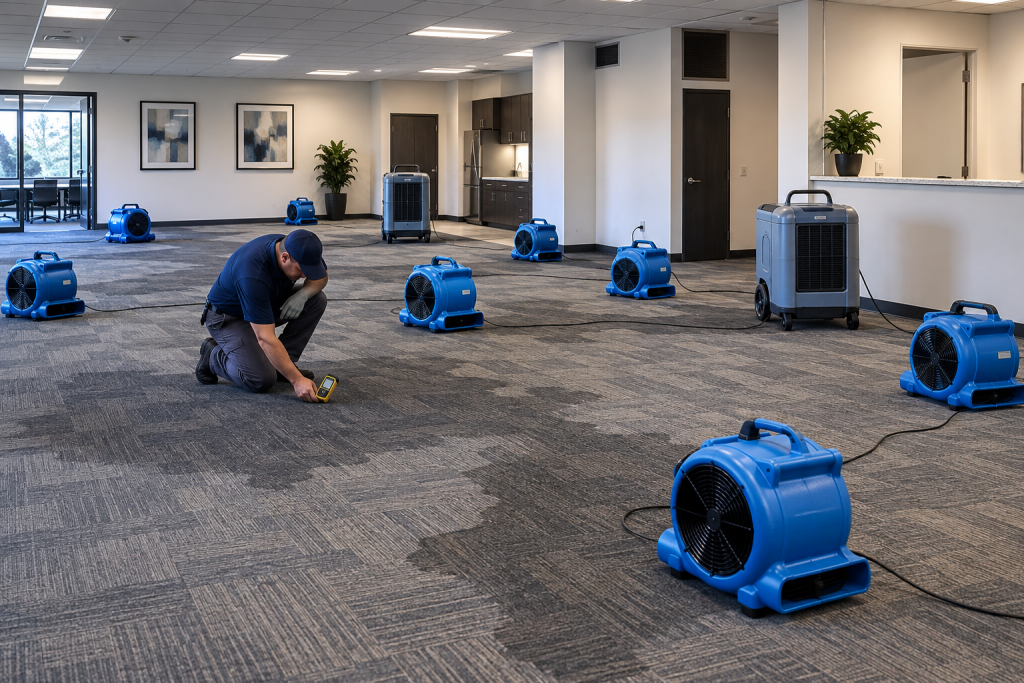
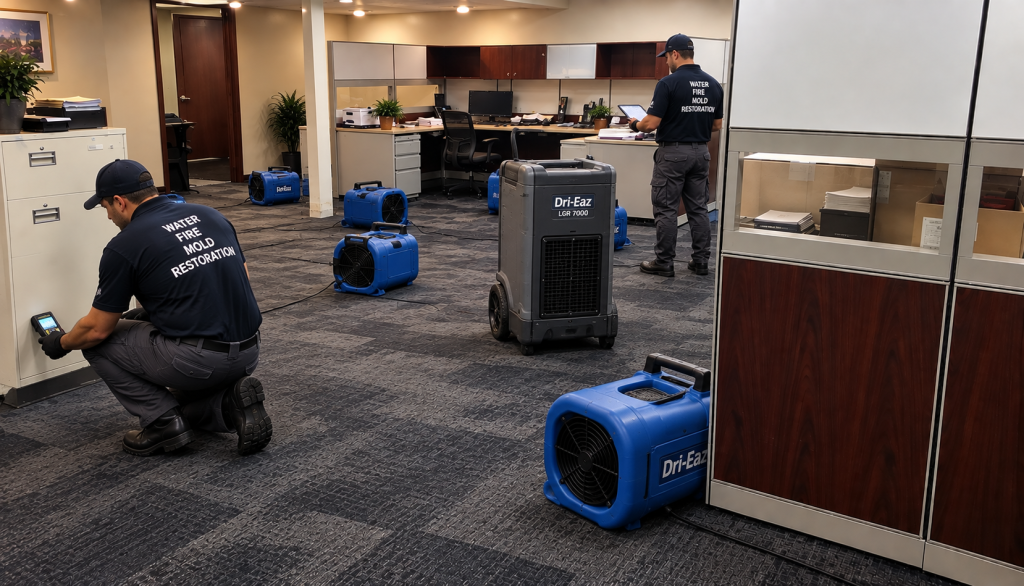
Drying and restoration equipment needs space.
So do people.
In occupied commercial environments, poor equipment placement can create avoidable problems.
Cords cross walkways.
Machines occupy circulation routes.
Temporary containment blocks access.
Equipment noise disrupts employees.
Staging consumes customer or tenant areas.
The equipment may be helping restore the building while simultaneously making another portion difficult to use.
Good partial-occupancy planning asks:
Can the restoration system itself be configured around the operating business?
That may involve thoughtful equipment placement, routing, scheduling and staging.
Shared Elevators Can Become a Major Logistics Problem
Elevators deserve special attention during partial occupancy.
Employees need them.
Guests need them.
Tenants need them.
Contractors also need them.
Restoration crews may be moving:
— Equipment
— Debris
— Drywall
— Flooring
— Tools
— Carts
— Replacement materials
Putting all of that traffic into the same elevators during peak operating hours can create significant disruption.
Where feasible, a recovery plan may designate:
Occupant elevators
and
construction/service elevators
or establish specific construction-use periods.
Again, the issue seems small.
Across months of reconstruction, it can make an enormous difference.
Protect the Business Schedule From the Construction Schedule
Commercial buildings already have operating rhythms.
Hotels have check-in periods.
Offices have peak arrival times.
Restaurants have meal periods.
Warehouses have shipping windows.
Retail stores have customer peaks.
Manufacturing facilities have production schedules.
Restoration planning should understand those rhythms.
A sophisticated schedule might deliberately avoid:
Hotel demolition during peak guest periods
Office debris movement during morning arrival
Retail construction deliveries during customer peaks
Warehouse utility interruptions during major shipping windows
Manufacturing shutdowns during critical production runs
The contractor still completes the work.
The difference is when the disruption is imposed upon the business.
Communication Becomes Infrastructure During Partial Occupancy
When a building is completely closed, construction teams have considerable control over the environment.
Partial occupancy introduces more participants.
Employees.
Customers.
Tenants.
Contractors.
Vendors.
Security.
Building engineers.
Everyone needs to understand which areas are available and what is changing.
That makes communication an operational system.
Useful information can include:
✓ Today’s active work zones
✓ Access changes
✓ Utility interruptions
✓ Noise-producing work
✓ Elevator restrictions
✓ Delivery changes
✓ Areas returning to service
✓ Upcoming shutdown windows
A ten-minute daily coordination meeting can sometimes prevent hours of avoidable disruption.
Daily Recovery Planning Should Ask Two Questions
Every day of a partially occupied commercial restoration project should answer:
What restoration work needs to happen today?
Then immediately:
How do we perform that work while protecting today’s business operations?
Those questions force construction and continuity planning into the same conversation.
Without the second question, restoration naturally optimizes around contractor efficiency.
With both questions, the project can optimize around overall commercial recovery.
The Goal Is Controlled Coexistence
Partial occupancy doesn’t mean pretending construction isn’t happening.
It means deliberately designing how two incompatible activities coexist.
Business wants:
Cleanliness
Predictability
Access
Quiet
Utilities
Customers
Production
Restoration wants:
Access
Demolition
Equipment
Materials
Labor
Utility shutdowns
Construction movement
Those needs can conflict.
The recovery plan’s job is to manage the interface.
Sometimes business operations adjust.
Sometimes restoration operations adjust.
Frequently, both do.
When Partial Occupancy May Not Be Appropriate
Keeping a business operating is valuable.
It should not become the objective at any cost.
Certain conditions can make partial occupancy inappropriate or require additional professional evaluation.
Examples may involve unresolved:
- Structural conditions
- Electrical hazards
- Fire/life-safety concerns
- Environmental conditions
- Access problems
- Building-system failures
- Significant uncontrolled restoration activity
- Requirements affecting occupancy
Every property and loss is different.
The correct question isn’t:
“How do we keep this building open no matter what?”
It is:
“Which portions, if any, can appropriately remain operational while the damaged portions are restored?”
That distinction protects the integrity of the recovery process.
Partial Occupancy Should Be Planned From Day One
One of the biggest mistakes is waiting until halfway through restoration to ask whether part of the property could have remained operational.
By then:
Construction pathways are established.
Equipment has been positioned.
Containment is built.
Materials occupy staging areas.
Schedules have been created.
Operational opportunities may already have been lost.
Instead, partial occupancy should be considered during the initial commercial restoration strategy.
Ask immediately:
✓ What remains unaffected?
✓ What can operate independently?
✓ What infrastructure is shared?
✓ What can be isolated?
✓ What could temporarily relocate?
✓ Which functions generate the most operational value?
✓ What prevents those functions from continuing?
That information can influence the entire project layout.
Measure Recovered Capacity, Not Just Construction Completion
A restoration project may report:
35% complete
60% complete
85% complete
Those percentages are useful for construction.
Business leadership may need another measurement:
How much operational capacity has returned?
Imagine a warehouse restoration project is only 50% complete.
Through careful sequencing, however, the facility has recovered 90% of its shipping capacity. A related question is how partial occupancy changes during emergency warehouse water extraction.
From a business perspective, that’s extremely significant.
Conversely:
95% construction complete
can still mean
0% operational
if the final unresolved system prevents reopening.
Commercial recovery should therefore track both.
The Partial Occupancy Recovery Ladder
A useful way to think about commercial restoration is as a ladder rather than a switch.
0% — Emergency closure
↓
10% — Property stabilized
↓
25% — Critical infrastructure returning
↓
40% — Limited operations possible
↓
60% — Priority business functions restored
↓
80% — Most operating areas returned
↓
95% — Remaining restoration isolated
↓
100% — Normal operations restored
Actual percentages will vary and are not technical thresholds.
The concept matters:
Commercial recovery can happen incrementally.
Every meaningful step up the ladder can potentially reduce the economic consequences of the original property loss.
The Best Restoration Zone May Be the Smallest Possible Restoration Zone
Once damage has been appropriately investigated, another powerful objective emerges:
How tightly can the restoration operation be controlled without compromising the work that needs to occur?
An unnecessarily large construction footprint consumes business space.
It can block corridors.
Reduce occupancy.
Create noise.
Disrupt tenants.
Interfere with customers.
Complicate logistics.
A controlled restoration footprint protects more of the property for productive use.
This doesn’t mean artificially shrinking the actual damage boundary.
It means preventing the construction boundary from unnecessarily expanding beyond the restoration boundary.
Commercial Restoration Can Happen Around the Business
The conventional mental picture of restoration is simple:
Damage occurs.
Everyone leaves.
Contractors take over.
Repairs finish.
Everyone returns.
Sometimes that is necessary.
Often, commercial properties present more possibilities.
A hotel can operate around a damaged wing.
An office building can recover floor by floor.
A warehouse can redirect product movement.
Retailers can separate customers from construction.
Manufacturers can prioritize production dependencies.
Large properties can create independent operating and restoration zones.
The fundamental commercial restoration question therefore becomes:
“How much of this business actually needs to stop?”
Not:
“How much of this building was damaged?”
Those are completely different measurements.
Identify the true affected area.
Understand shared building systems.
Protect operational zones.
Separate construction traffic.
Control environmental pathways.
Schedule disruption intelligently.
Use temporary solutions where appropriate.
Return functional areas to service as conditions allow.
Then continue restoring everything else around them.
Because the objective of partial occupancy during commercial restoration is not merely keeping the doors open.
It is preserving as much productive business function as reasonably possible while the building recovers.
Trying to keep part of your business running during restoration?
We plan containment and access around your operating hours, including phased warehouse water damage repair that keeps shipping moving.
Related Reading
- Commercial Restoration Downtime — why interruption can cost more than the repair.
- Dry Does Not Mean Ready — what actually determines reoccupancy.
- Business Continuity — keeping operations running during repairs.
- Warehouse Water Damage Repair — routing shipping around active restoration.
- Retail Water Damage Repair — separating customers from construction safely.
- IICRC S500 Standard for Professional Water Damage Restoration — the industry reference for restoration practice.