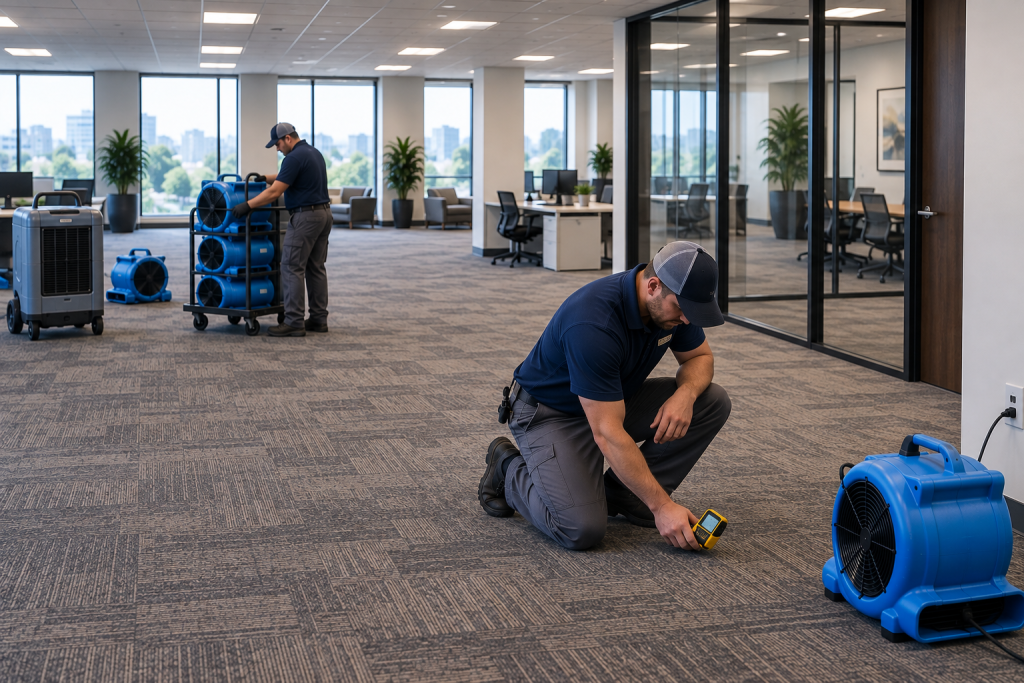
The moisture readings look good.
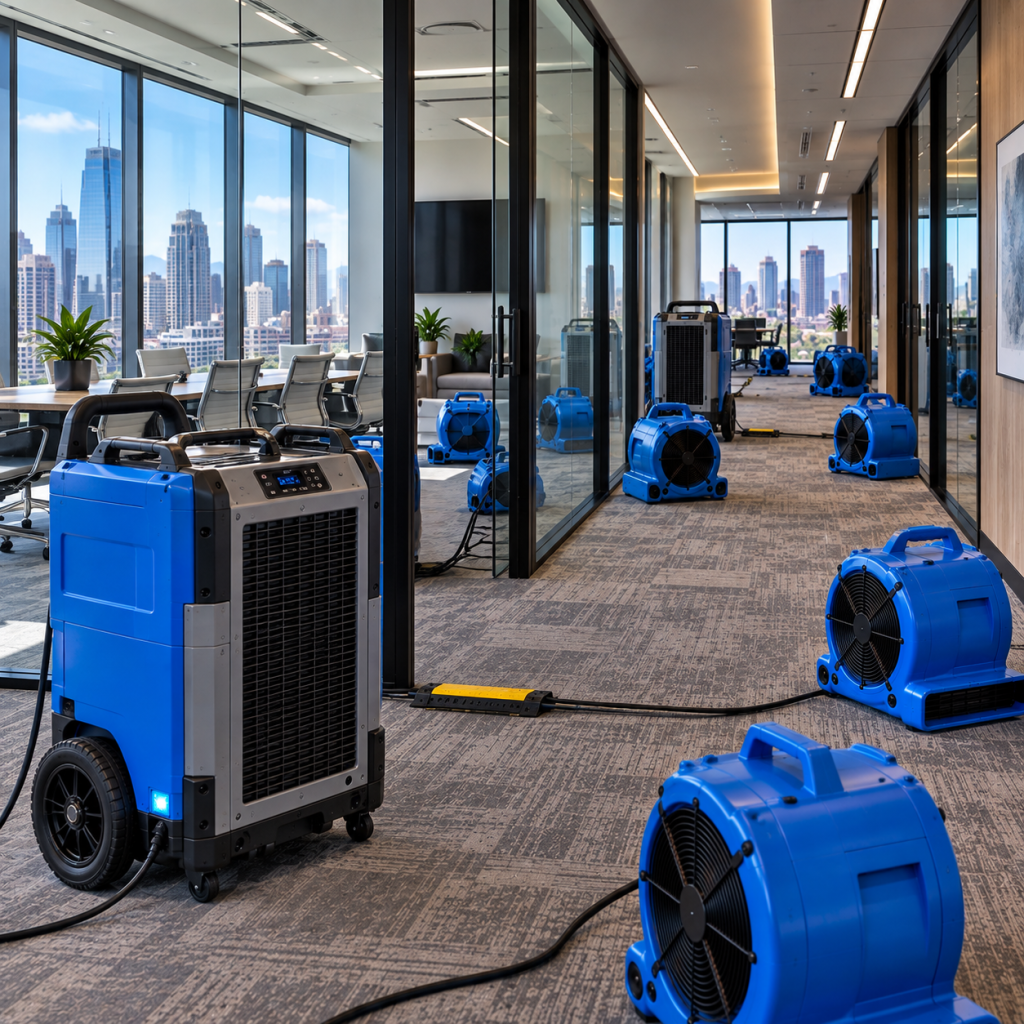
Drying equipment is being removed.
Standing water disappeared days ago.
Employees can walk through the building without seeing obvious damage.
Does that mean the commercial property is ready to reopen?
Not necessarily.
Drying is an important milestone in commercial water damage restoration, but it is not automatically the final determination of whether a building, floor, tenant space or operational area is ready for normal use.
Electrical systems may have been exposed. Fire and life-safety components may require attention. HVAC systems can need evaluation. Concealed assemblies may remain unresolved. Reconstruction might be incomplete. Specialized equipment may require testing.
Then there is the most important distinction:
A dry building and a ready building are not necessarily the same thing.
Commercial reoccupancy should be viewed as the restoration of all conditions necessary for the property to safely and appropriately perform its intended function.
Drying Completion Is One Milestone, Not the Finish Line
Commercial restoration frequently begins with water.
Stop the source.
Extract standing water.
Remove materials where appropriate.
Establish drying conditions.
Monitor affected areas.
Eventually, moisture conditions reach the project objectives established for the affected materials and assemblies. For operators of big-box and industrial sites, commercial warehouse restoration shows how reoccupancy readiness plays out at scale.
That’s meaningful progress.
However, consider everything else that may have happened during the loss.
Water could have interacted with:
- Electrical equipment
- Fire alarm components
- HVAC infrastructure
- Elevators
- Building automation
- Insulation
- Interior finishes
- Structural assemblies
- Communications equipment
- Commercial equipment
- Plumbing systems
- Tenant improvements
Drywall reaching an acceptable moisture condition does not answer questions about all of those systems.
Moisture is one condition within a much larger building.
What Does Commercial Building Reoccupancy Actually Mean?
Reoccupancy is sometimes treated as a simple event:
Closed → Reopened
Large commercial properties are rarely that simple.
A better definition is:
Reoccupancy occurs when the conditions required for the intended use of a particular area have been appropriately restored and applicable requirements have been satisfied.
That distinction matters.
A warehouse storage area has different operational requirements than a hospital treatment area.
Hotel guest rooms differ from manufacturing floors.
Office space differs from a commercial kitchen.
Therefore, the question isn’t merely:
“Is the building dry?”
It becomes:
“What must function correctly for this particular building and operation to return to use?”
The Seven Milestones Between Water Damage and Normal Operations
Commercial recovery can be easier to understand when divided into separate milestones.
1. Source Controlled
The active water source or intrusion mechanism has been stopped or otherwise addressed.
2. Emergency Stabilization
Immediate actions reduce additional damage and establish controlled working conditions.
3. Damage Extent Investigated
Visible and reasonably suspected concealed areas are evaluated so the restoration team understands what was affected.
4. Drying and Mitigation Objectives Reached
Affected materials and assemblies reach established restoration objectives.
5. Building Systems Evaluated and Restored
Systems affected by the event receive the appropriate attention from qualified parties.
6. Reconstruction and Required Verification Completed
Necessary repairs, testing, inspections and related work are completed as appropriate for the project.
7. Operational Readiness Established
The area can once again support its intended commercial function.
Notice what happens here:
“Dry” occurs around the middle of the recovery sequence—not necessarily at the end.
Electrical Systems Don’t Receive a Free Pass Because the Walls Are Dry
Water and electricity create obvious concerns during the emergency phase.
The less obvious issue comes later.
Imagine water traveled through a ceiling containing electrical components.
Several days pass.
The surrounding construction dries.
Can everyone simply assume the electrical infrastructure is ready for normal operation?
That conclusion does not automatically follow.
Depending upon what was exposed and the nature of the event, electrical equipment or components may require evaluation by appropriately qualified professionals. Owners dealing with a flooded building can review warehouse flood cleanup and drying for a practical view of reoccupancy readiness.
This creates an important rule for commercial restoration:
The condition of one material cannot establish the condition of another system.
A dry wall doesn’t certify electrical equipment.
A dry ceiling doesn’t evaluate an elevator controller.
A dry mechanical room doesn’t establish that every component inside it is ready for operation.
Each affected system has its own recovery questions.
Fire and Life-Safety Systems Can Control the Reopening Decision
Commercial buildings depend upon systems occupants rarely think about until something goes wrong.
Fire alarms.
Emergency lighting.
Detection systems.
Exit components.
Smoke-control systems.
Fire-rated construction.
Emergency power.
Damage involving required life-safety infrastructure can create a strange situation:
The building looks finished.
Carpet is installed.
Walls are painted.
Furniture is back.
Yet an unresolved system can still prevent normal use.
That illustrates why visual appearance is such a poor measurement of commercial restoration completion.
✓ Looks restored does not necessarily mean systems restored.
✓ Systems restored does not necessarily mean requirements satisfied.
✓ Requirements satisfied still does not necessarily mean every business function has returned to normal.
Commercial reoccupancy is the intersection of all three.
HVAC Can Become a Reoccupancy Dependency
Mechanical systems aren’t simply about whether occupants feel warm or cold.
Depending upon the commercial environment, HVAC can influence:
- Ventilation
- Temperature
- Humidity
- Air distribution
- Pressure relationships
- Equipment environments
- Specialized operations
- Occupant comfort
An office building, hospital, laboratory, hotel and manufacturing property may have completely different mechanical requirements.
That means HVAC should be evaluated according to the building’s intended use, not simply whether air comes from the vents.
A system being capable of turning on and a system being ready to support normal operations are different questions. Distribution operations feel reoccupancy readiness sharply, which is why water damage repair for distribution centers deserves early attention.
The Building Can Be Dry While Hidden Questions Remain
Suppose all exposed materials appear dry.
What about the areas that were never properly investigated?
Commercial buildings contain enormous amounts of concealed construction.
— Wall cavities
— Ceiling spaces
— Floor assemblies
— Insulation
— Shafts
— Mechanical areas
— Equipment bases
— Exterior assemblies
The purpose isn’t to assume hidden damage exists everywhere.
Instead, restoration should establish reasonable confidence that the affected boundary has been understood.
Unknown conditions are different from confirmed dry conditions.
That’s a subtle distinction with enormous consequences.
Reconstruction Completion Is Different From Drying Completion
Another common misconception is that once drying equipment leaves, the restoration project is almost over.
Sometimes it is.
Other times, drying merely clears the way for substantial reconstruction.
A commercial property may still require:
✓ Drywall replacement
✓ Ceiling reconstruction
✓ Flooring installation
✓ Electrical work
✓ Mechanical repairs
✓ Millwork
✓ Painting
✓ Storefront or glazing repairs
✓ Door and hardware work
✓ Fire-rated assembly restoration
✓ Equipment installation
The drying contractor can complete an important phase while the commercial recovery project remains far from complete.
This is why property owners and facility managers benefit from understanding the entire recovery sequence early.
“Can We Reopen Part of the Building?” Is Often the Better Question
A large commercial property does not necessarily need one reopening date.
Consider a ten-story office building.
Three floors experience significant water damage.
Why should the recovery strategy automatically assume that all ten floors must remain unavailable until the last piece of carpet is installed on the damaged floors?
The better analysis is:
Which areas are affected?
Which systems are shared?
Can restoration zones be separated from operational zones?
Can required access be maintained?
Can unaffected areas function appropriately?
What would prevent partial reoccupancy?
That leads to a more useful commercial restoration concept:
Reoccupancy can sometimes be phased.
Phased Reoccupancy Can Turn One Finish Line Into Several
Instead of waiting for the entire project to reach 100% completion, commercial recovery may sometimes be organized around operational milestones. If your facility stores inventory, restoring a warehouse after water loss explains how reoccupancy readiness affects shipping schedules.
Phase A — Critical Infrastructure
Restore systems necessary to support usable portions of the property.
Phase B — Priority Operating Areas
Return the most important business functions where conditions allow.
Phase C — Secondary Areas
Bring additional floors, departments or tenant spaces back online.
Phase D — Remaining Reconstruction
Complete areas that are less important to immediate business operations.
Phase E — Full Normalization
Return the property to normal use and complete outstanding project requirements.
This approach can be especially valuable for:
- Hotels
- Office buildings
- Warehouses
- Manufacturing facilities
- Retail centers
- Universities
- Healthcare properties
- Mixed-use buildings
The objective isn’t premature occupancy.
The objective is avoiding unnecessary downtime in areas capable of appropriately returning to service.
A Commercial Building Can Have Multiple Reoccupancy Clocks
This is another overlooked concept.
Different portions of the same property can progress at different speeds.
Imagine a hotel suffers a major plumbing loss.
The lobby may require three weeks of reconstruction.
Twenty guest rooms could require extensive work.
Another 150 rooms may never have been physically affected.
The kitchen has separate issues.
Elevator equipment requires evaluation.
Now there isn’t really one recovery clock.
There are several:
Guest-room clock
Lobby clock
Elevator clock
Food-service clock
Life-safety clock
Building-system clock
Whichever unresolved dependency controls a particular operation becomes its reoccupancy clock.
That is much more useful than asking for one generalized completion percentage.
90% Restored Can Still Mean 0% Operational
Commercial recovery contains a mathematical trap.
Imagine ten systems are required for a facility to operate.
Nine are fully functional.
One remains unavailable.
The project could appear 90% complete.
Operationally, however, that final system might prevent the business from functioning at all.
Examples are easy to imagine:
A warehouse without usable loading access.
A hotel without required domestic water.
A manufacturing operation without a critical production utility.
An upper-floor office operation without necessary vertical access.
A commercial kitchen without required ventilation.
Completion percentage and operational percentage are not the same measurement.
This is why the final unresolved dependency can sometimes be the most expensive part of the entire recovery timeline.
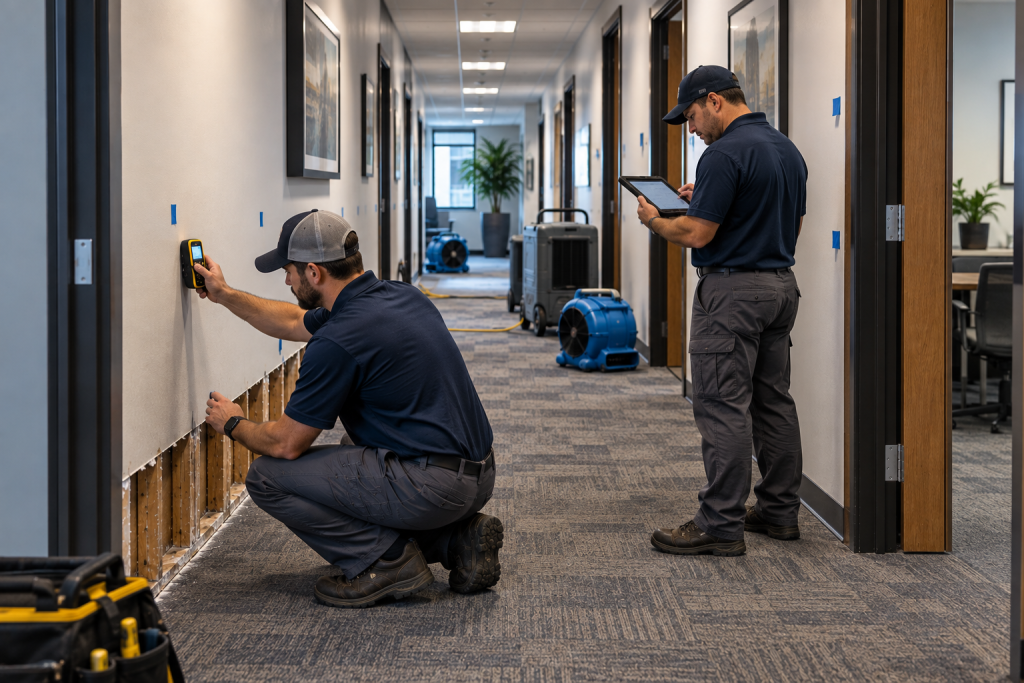
The Last 5% Can Create the Most Expensive Downtime
Early restoration usually involves obvious activity.
Crews arrive.
Equipment is deployed.
Materials are removed.
Progress is highly visible.
Near the end, something interesting can happen.
Most construction is finished, but one remaining issue prevents reopening.
— Specialized equipment hasn’t arrived.
— Testing remains incomplete.
— An inspection is pending.
— Controls aren’t commissioned.
— A required repair remains unresolved.
— Documentation hasn’t reached the necessary party.
Physically, the project looks almost complete.
Economically, the business may still be losing money every day.
That makes the last unresolved dependency an important focus of commercial restoration management.
Reoccupancy Should Be Designed Backward
Traditional restoration thinking tends to move forward:
Damage
→ Drying
→ Reconstruction
→ Reopen
There is another way to approach the problem.
Start at the end.
Step 1 — Define the Desired Operation
What exactly are we trying to reopen?
A hotel wing?
Manufacturing production?
Step 2 — Identify Reoccupancy Requirements
What must be available for that operation to function appropriately?
Step 3 — Identify Required Building Systems
Which utilities, access systems and infrastructure support those requirements?
Step 4 — Identify Remaining Obstacles
What currently prevents those systems from functioning?
Step 5 — Prioritize Restoration Around Those Obstacles
Now the restoration schedule is directly connected to the reopening objective.
This is backward-designed commercial recovery.
Ask “What Prevents Us From Opening Tomorrow?”
This may be one of the most productive questions during a commercial restoration project.
Not:
“How much work remains?”
Ask:
“What specifically prevents this area from opening tomorrow?”
Perhaps the answer is electrical.
Then electrical becomes critical.
Maybe access is the problem.
Address access.
Perhaps drying is complete but a required system remains unresolved.
That system moves to the front.
Maybe nothing prevents one section from reopening except the assumption that the entire building must reopen simultaneously.
Now partial occupancy deserves consideration.
The question forces the recovery team to identify the actual bottleneck.
A Reoccupancy Readiness Checklist Should Be Property-Specific
No universal checklist can determine whether every commercial building is ready.
However, a structured evaluation can help organize the process.
Building Conditions
✓ Has the source of damage been addressed?
✓ Has the affected extent been reasonably established?
✓ Have appropriate drying or remediation objectives been completed?
Critical Systems
✓ Are required electrical systems available?
✓ Is necessary plumbing functional?
✓ Can HVAC support the intended operation?
✓ Are required fire and life-safety systems addressed?
✓ Are elevators or access systems available where necessary?
Construction
✓ Are required repairs completed?
✓ Are necessary assemblies restored?
✓ Are work areas appropriately separated from occupied areas?
Verification
✓ Have applicable inspections or specialized evaluations been completed?
✓ Are unresolved conditions documented?
✓ Have appropriate professionals addressed systems within their expertise?
Operations
✓ Can employees, tenants or customers safely access the intended area?
✓ Can the business actually perform the intended function?
✓ Are temporary operating arrangements understood?
The final question is essential.
A space can be physically usable while remaining operationally useless.
Reoccupancy Is a Team Decision, Not a Moisture-Meter Reading
Commercial properties contain specialized systems.
No single instrument evaluates all of them.
Likewise, one trade should not automatically be expected to determine the condition of every system. Teams in Las Vegas and the Bay Area can find warehouse water damage restoration services that accounts for reoccupancy readiness from day one.
Depending upon the event, relevant participants can include:
- Restoration professionals
- Property management
- Facility management
- Building ownership
- Electrical professionals
- Mechanical professionals
- Engineers
- Environmental professionals
- Fire/life-safety specialists
- Elevator professionals
- Specialty equipment vendors
- Authorities or inspectors where applicable
Each answers different questions.
Commercial recovery works best when those answers are coordinated toward a common objective:
returning the appropriate portions of the property to useful operation.
Documentation Matters Before People Return
Reoccupancy decisions shouldn’t rely solely upon memory.
A significant commercial restoration project can generate substantial information.
Photographs.
Moisture records.
Inspection results.
Equipment logs.
Repair records.
Specialty evaluations.
Construction documentation.
Testing.
Project communications.
Those records help establish what happened between the original loss and the decision to return areas to use.
A strong recovery record should make the sequence understandable:
What happened?
→ What was affected?
→ What was done?
→ What was verified?
→ What remained unresolved?
→ What allowed operations to resume?
Documentation therefore supports more than insurance administration.
It supports confidence in the recovery process itself.
Don’t Let Cosmetic Completion Create False Confidence
New paint is psychologically powerful.
So is new flooring.
Once ceiling tiles are replaced and furniture returns, a property feels finished.
That visual transformation can create pressure to declare the recovery complete.
Yet commercial buildings operate through systems people rarely see.
Electrical infrastructure.
Controls.
Fire protection.
Mechanical systems.
Plumbing.
Communications.
Structural assemblies.
Those hidden systems can matter far more than the visible finishes.
A building should not be considered ready simply because it looks ready.
Appearance is one piece of evidence.
Operational readiness is the larger objective.
Don’t Keep a Building Closed Simply Because Construction Isn’t 100% Complete Either
The opposite mistake can also be expensive.
Suppose an isolated portion of a large commercial building still requires cosmetic reconstruction.
Everything needed to operate another portion of the property is appropriately available.
Keeping the entire building closed simply because one section isn’t finished may unnecessarily extend business interruption.
That’s why commercial reoccupancy deserves deliberate analysis.
Avoid premature reopening.
Also avoid unnecessary closure.
Both errors have consequences.
Different Commercial Buildings Define “Ready” Differently
Hotel Reoccupancy
Can guests safely access rooms?
Are necessary utilities available?
Can required building systems support occupancy?
Can unaffected wings operate independently?
Warehouse Reopening
Can employees access operating areas?
Can products move?
Are loading operations available?
Do required electrical and material-handling systems function?
Manufacturing Recovery
Can production equipment operate?
Are process utilities available?
Can environmental conditions support production?
Can materials move through the facility?
Office Building Reoccupancy
Can tenants access floors?
Are necessary utilities, elevators, HVAC, communications and safety systems available?
Can restoration work remain separated from occupied areas?
Retail Property Reopening
Can customers safely enter?
Can transactions occur?
Are required utilities and systems available?
Can construction zones remain appropriately separated?
The word ready only makes sense when connected to a specific building function.
From “Dry” to “Ready”: Commercial Recovery Has Layers
A useful way to visualize the entire process is:
WATER CONTROLLED
↓
PROPERTY STABILIZED
↓
DAMAGE BOUNDARY UNDERSTOOD
↓
MATERIALS DRIED / MITIGATED
↓
CRITICAL SYSTEMS RESTORED
↓
REPAIRS COMPLETED
↓
REQUIRED VERIFICATION COMPLETED
↓
OPERATIONAL DEPENDENCIES AVAILABLE
↓
REOCCUPANCY
↓
NORMAL OPERATIONS
Each stage answers a different question.
Skipping one because another is complete creates unnecessary uncertainty.
When Is a Commercial Building Actually Ready to Reoccupy?
There isn’t one moisture reading, construction percentage or universal number that answers the question.
Readiness depends upon the property, affected systems, nature of the loss, intended use, applicable requirements and professional determinations involved. Industrial properties add their own wrinkles to reoccupancy readiness; see industrial warehouse water damage for more detail.
That is exactly why commercial building reoccupancy after water damage deserves to be treated as its own recovery phase.
Drying tells us something important:
The moisture problem has reached an established objective.
Reoccupancy asks something larger:
Can this particular portion of the property appropriately perform its intended function again?
Those questions overlap.
They are not identical.
The Finish Line Is Function, Not Dryness
Commercial water damage restoration begins with a damaged building.
Successful commercial recovery ends with a functioning property.
Between those points are numerous milestones.
Extraction matters.
Drying matters.
Investigation matters.
Electrical systems matter.
HVAC matters.
Fire and life safety matter.
Reconstruction matters.
Documentation matters.
Operational dependencies matter.
Ultimately, the building exists for a reason.
Hotels accommodate guests.
Warehouses move goods.
Offices support organizations.
Retail properties serve customers.
Manufacturing facilities produce products.
Healthcare facilities support patient care.
The true recovery question therefore isn’t:
“Is everything dry?”
It is:
“What still prevents this property—or this portion of it—from returning to its intended use?”
Find that obstacle.
Resolve the appropriate dependency.
Verify the conditions that matter.
Return usable areas to service when appropriate.
Continue restoration where work remains.
Because in commercial restoration:
Dry is a milestone. Ready is the objective.
Need a clear answer on whether your building is ready to reopen?
We verify systems, not just moisture readings, before recommending reoccupancy — including on warehouse water damage repair projects with shipping deadlines.
Related Reading
- Hidden Commercial Water Damage — why visible drying isn’t the whole story.
- Operational Choke Points in Commercial Buildings — the systems that can hold up a reopening.
- Structural Drying — reaching a verified drying objective.
- Business Continuity — keeping operations running through reoccupancy.
- Facility Manager Guide — what to ask before signing off on reopening.
- IICRC S500 Standard for Professional Water Damage Restoration — the industry reference for restoration practice.